
SC-PLA Nanospheres Revolutionize Smart Agrochemical Delivery

Engineers use stereo-complexed PLA nanospheres to halt pesticide waste and boost crop yields via precise, trigger-activated release kinetics.
Traditional pesticide formulations create major industrial inefficiencies. In many cases, unencapsulated chemicals wash off targets rapidly, pollute nearby environments, and waste valuable inputs. To overcome this retention problem, engineers use stereo-complexed poly(lactic acid) (SC-PLA) nanospheres. By doing so, they exploit the stereo-complexation of enantiomeric chains between poly(L-lactic acid) (PLLA) and poly(D-lactic acid) (PDLA) to create highly ordered, dense crystalline structures. As a result, these polymers protect active ingredients from premature degradation and then release their payloads only when specific environmental triggers activate the matrix.
You can also read: Agro-Waste to Biopolymers: Upcycling with Bio-Additives.
The Physics of Crystalline Encapsulation
To build these advanced nanospheres, engineers utilize a precise emulsion process. As technicians evaporate the organic solvent dichloromethane, the physical distance between the polymer chains shortens. This forces adjacent PLLA and PDLA chains to aggregate, directly altering the polymer’s morphological self-assembly. The material transforms from chaotic, petal-like structures into smooth, regular spherical or golf-ball-like shapes exhibiting massive crystallinity.
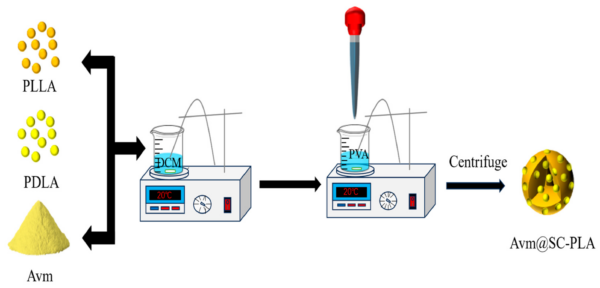
Synthetic illustration showing the preparation of Avm@SC-PLA. Courtesy of Design of Multifunctional SC-PLA Pesticide Carrier System and Study of Controlled-Release Performance.
Manufacturers leverage this dense matrix to create an impenetrable barrier against environmental threats. While normal photolysis degrades unprotected ingredients rapidly, the closed SC-PLA surface absorbs, scatters, and reflects ultraviolet light. Engineers effectively shield the internal pesticide, keeping the chemical payload lethal until it reaches the intended biological target. Developers also precisely control nanosphere size, targeting the 50 to 500 nm range to optimize foliar uptake.
Performance comparison between Traditional method and SC-PLA
| Performance Metric | Traditional Baseline | SC-PLA Formulation |
| Melting Temperature | ~160 °C | ~210 °C |
| Melting Enthalpy ( ) | 93 J/g | 142 J/g |
| Droplet Contact Angle | 70.63° | 46.14° |
| Target Leaf Retention Rate | 23.15% | 45.62% |
| UV Photodegradation (75h) | >59% | ~30% |
Adapted from Design of Multifunctional SC-PLA Pesticide Carrier System and Study of Controlled-Release Performance.
Developers conclude the dense crystal lattice of SC-PLA drastically outperforms single-component homocrystal PLA. Engineers trade traditional organic solvent toxicity for immense mechanical strength and hydrolysis resistance. By plummeting the contact angle, the polymer fundamentally changes the physical interaction between the chemical droplet and the leaf surface. This doubles the target retention rate, proving that manufacturers can slash the raw volume of chemicals applied per acre while achieving superior biological control.
Environmental Triggers and Industrial Prototyping
Engineers program the breakdown of the polymer matrix using exact environmental stimuli. Changes in environmental pH alter the ionization capacity of the polymers. When the environment hits a critical isoelectric point, the solubility shifts, releasing the capsule contents. Furthermore, developers engineer enzyme-responsive materials. When insect pests release cutinase or cell-degrading enzymes, they physically fracture microcapsule walls.
![Diagram illustrating the response mechanism of pH-sensitive polymers (pH in controlled-release pesticides under alkaline conditions in alkaline intestinal insects [Lepidoptera]). Courtesy of Advances in Targeted Pesticides with Environmentally Responsive Controlled Release by Nanotechnology.](https://www.plasticsengineering.org/wp-content/uploads/2026/04/3-1-600x258.png)
Diagram illustrating the response mechanism of pH-sensitive polymers (pH in controlled-release pesticides under alkaline conditions in alkaline intestinal insects [Lepidoptera]). Courtesy of Advances in Targeted Pesticides with Environmentally Responsive Controlled Release by Nanotechnology.
The Future of Smart Agriculture
SC-PLA nanospheres equip developers with the ultimate tool to eradicate agricultural waste and optimize pesticide delivery. Manufacturers directly replace highly volatile formulations with intelligent, structurally robust crystalline carriers. By mastering stereo-complexation and environmental release triggers, engineers empower the agricultural industry to deploy next-generation smart materials that guarantee high commercial yields while rigorously protecting surrounding ecosystems.
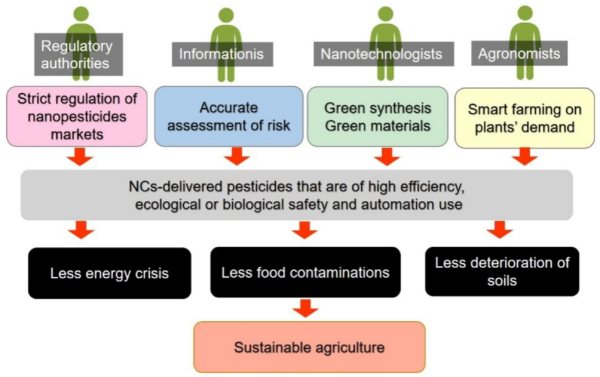
A potential future work of Nano Carriers-based pesticides and the potential future of agriculture. Courtesy of NCs-Delivered Pesticides: A Promising Candidate in Smart Agriculture.

Andres Delgado is a mechanical engineer specializing in design and quality assurance, with experience in precision seal design, turbomachinery maintenance, and orthopedic medical devices. He currently works as a Design Quality Engineer focused on New Product Introductions for knee implants and compliance with advanced manufacturing standards.