Recycled-Content Claims and the Mass Balance Debate
As regulators, NGOs, and manufacturers dispute recycled-content rules, mass balance has become a credibility test for circular plastics claims.
Mass balance has become one of the most important and disputed concepts in the circular plastics sector. Industry has long presented it as a technically feasible accounting framework for introducing renewable or recycled feedstocks into large-scale chemical manufacturing. This rationale reflects the design of many industrial assets, where continuous mixed-feed operations dominate. In these systems, physical segregation would increase technical difficulty, add operational complexity, and raise costs.
You can also read: What Comes Next for EPS Recycling in the UK.
Mass balance addresses this constraint through a certified accounting framework. A manufacturer adds a defined amount of recycled or renewable input to the process and assigns that amount to selected outputs under chain-of-custody rules. This approach lets companies integrate alternative feedstocks without separate production lines, physical segregation, or changes in product performance.
Why Industry Supports the Method
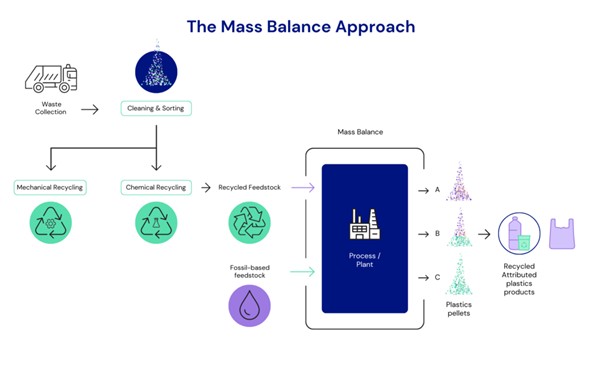
In the mass balance approach, recycled feedstock enters a mixed production system and manufacturers assign the recycled share to selected outputs rather than physically segregating the material. Courtesy of World Plastics Council.
Mass balance appeals to producers because it fits existing industrial infrastructure. In chemical recycling, renewable feedstock integration, and specialty materials manufacturing, inputs often enter continuous mixed-feed systems. In these systems, early blending makes it difficult to trace a specific feedstock fraction to one final product.
Mass balance addresses this constraint through a certified accounting framework. A manufacturer adds a defined amount of recycled or renewable input to the process and assigns that amount to selected outputs under established chain-of-custody rules. This approach allows companies to integrate alternative feedstocks without separate production lines, physical segregation, or changes in material performance.
Its value lies in its fit with current operations. Mass balance supports feedstock transition while preserving process flow, product specifications, and asset efficiency. For producers seeking scalable circularity pathways within existing assets, it offers a technically viable model.
The Claim Problem
The tension emerges when a technical allocation framework supports a legal or commercial claim. Industry presents mass balance as a practical response to the complexity of integrated chemical production. Critics rarely challenge that operational rationale. They challenge the scope and legitimacy of the resulting product claim.
This concern has intensified in the chemical recycling debate. Waste plastics typically pass through conversion, upgrading, and feedstock preparation before entering polymer production. Those stages weaken any direct product-level connection between the original waste stream and the final resin, an issue discussed in recent research on recycled-content quantification in plastics. Mass balance manages that complexity through predefined allocation rules, but the central dispute concerns whether those rules provide a technically robust basis for recycled-content claims with regulatory or commercial significance.
Attribution and Product-Level Meaning
Attribution drives the conflict. Under mass balance, a company assigns a set share of recycled input to selected outputs through chain-of-custody accounting instead of direct physical segregation. Supporters consider this approach technically valid because the production system takes in certified recycled feedstock, and integrated manufacturing systems need allocation rules to manage mixed-feed operations.
Critics focus on claim integrity. They argue that attribution can separate product claims from material composition at the item level, especially when a producer assigns recycled content to a limited group of high-value outputs while most of the system still relies on fossil-derived input. In that case, the accounting may remain internally consistent, but the claim may overstate the circular attributes of the marketed product. The dispute centers on claim legitimacy, not on the arithmetic of allocation.
Why Regulation Has Raised the Stakes
This issue matters more because recycled-content targets are moving from voluntary commitments into formal regulation. Once legislators link compliance to a defined recycled-content requirement, the accounting method starts to shape market access, investment, and technology choices. A permissive framework could favor chemical recycling pathways that meet regulatory thresholds even when the physical link between waste input and final product stays indirect.
A stricter framework could require stronger traceability, but it could also limit investment in technologies that depend on mixed-feed industrial systems. These decisions will affect resin producers, compounders, converters, brand owners, and equipment suppliers. They will also shape investment, technology growth, and the wording of circularity claims in technical and commercial documents.
Beyond Packaging
This debate goes far beyond packaging. The same questions apply to automotive, electronics, construction, consumer goods, and specialty chemicals, where mixed-feed production is also common. In each case, the issue is not only whether mass balance functions as an accounting tool, but also how to interpret a recycled-content claim.
That distinction matters because similar claims can imply similar outcomes, even when they rest on very different levels of traceability. One product may contain recycled material with direct physical traceability. Another may rely on allocation within a complex production system. Treating those claims as equivalent can create confusion in the market.
Mass balance will remain part of the circular plastics landscape because it fits existing industrial systems. But its long-term value will depend on whether the claims associated with it remain clear, credible, and technically defensible.

María José Vargas is a mechanical engineer and MSc candidate in Materials Engineering and Nanotechnology at Politecnico di Milano. Her work focuses on environmental stress cracking in polyethylene, polymer failure behavior, plastics processing, and sustainable polymer applications.