Plastic Pellet Loss Rules Turn Microplastics Into a Plant-Operations Issue

EU pellet-loss rules make spill prevention a plant operations issue, with new demands for containment, procedures, and recordkeeping.
Plastic pellet loss now falls under Regulation (EU) 2025/2365. The regulation establishes requirements to prevent pellet loss and contain it throughout the supply chain. This shift places the issue within the scope of plant operations rather than only within the broader environmental context. It has direct implications for processors, compounders, recyclers, warehouses, terminals, and logistics providers. The regulatory focus is on pellet loss during routine handling, storage, transfer, and transport of primary plastic pellets. The key question is whether facilities maintain effective control over pellet release during receiving, conveying, packaging, clean-up, and shipment. They must also maintain the records needed to demonstrate compliance with regulatory and customer requirements.
You can also read: Engineering Innovations for Microplastic Prevention and Control.
Why Pellet Loss Demands Technical Attention
Pellet loss typically occurs during routine handling operations rather than under major upset conditions. Typical release points include truck and rail unloading, silo charging, and pneumatic conveying. Additional release points include manual transfer, Gaylord discharge, bag rupture, purge handling, and loading dock operations. Release likelihood increases at transfer interfaces and in outdoor handling zones. The risk is greater where drains, traffic lanes, or stormwater pathways facilitate pellet migration beyond the initial release area prior to recovery.
This operating profile makes pellet loss a control issue rather than an awareness issue. A site may maintain throughput and product quality while still generating repeated low-volume releases. Technically, pellet loss often indicates weak containment at transfer points or poor packaging integrity. It may also reflect inadequate recovery equipment, incomplete drain isolation, or inconsistent handling practices across shifts. Under this framework, pellet release falls within the same control category as contamination prevention and material traceability.
What the New Rules Change
The new pellet-loss rules place greater emphasis on prevention, immediate containment, corrective action, and recordkeeping. A company can no longer rely on general stewardship language or informal housekeeping practices. It requires operating procedures that identify release points and define control measures for each handling step. These procedures should also specify containment and recovery equipment. They should establish spill-response actions and document incidents, causal factors, and corrective actions.
This requirement extends across multiple plant functions. Operations must control unloading, conveying, transfer, packaging, and shipping interfaces. Maintenance must ensure the integrity of seals, valves, hoses, couplings, loaders, and conveying systems to prevent leakage and pellet release. Warehousing must maintain packaging integrity, pallet stability, and controlled material movement. EHS must assess drains, outdoor handling zones, and spill-response preparedness. Purchasing and logistics must apply equivalent control requirements to suppliers, carriers, and storage operators. Thus, pellet-loss prevention now depends on site-wide control of equipment condition, handling practices, and material flow, rather than on a single environmental initiative.
Risk Extends Beyond the Plant Gate
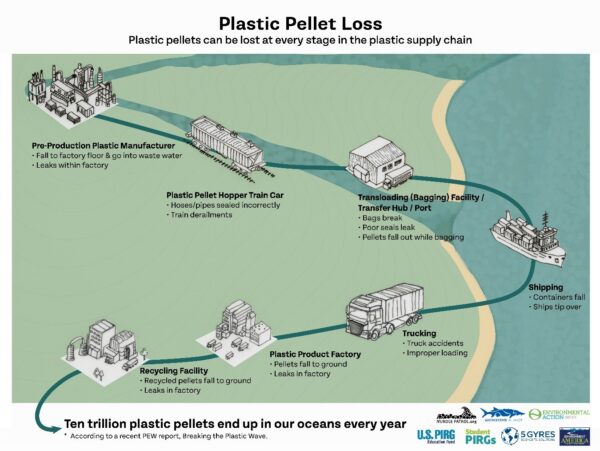
Plastic pellet loss can occur at multiple points across the supply chain, including production, transfer, transport, manufacturing, and recycling. Courtesy of Environment America.
Pellet loss also occurs beyond the plant boundary during transport, storage, rehandling, and distribution. A site may maintain robust internal controls and still experience pellet release. Contributing factors include compromised loads, substandard carrier practices, and deficient transfer or storage conditions at terminals and warehouses. For that reason, pellet containment must extend across the full handling chain. Control is especially critical at points involving container change, location transfer, or custodial handoff.
That broader exposure will require tighter control of packaging integrity, unloading procedures, containment at transfer points, labeling, contractor handling practice, and spill response. It will also increase audit and verification requirements across suppliers, carriers, and storage operators. In that context, pellet loss affects logistics control and supplier performance as much as in-plant housekeeping.
What Plants Should Do Now
Facilities should begin with a pellet-flow assessment that maps all handling nodes, including unloading stations, conveying lines, silo inlets, packaging areas, regrind transfer points, and shipping interfaces. Personnel should then evaluate each node for release probability, containment performance, and migration pathway, especially where pellets can reach trench drains, stormwater inlets, unsealed pavement, or vehicle traffic lanes. That assessment should drive targeted controls such as transfer-point containment, drain isolation, inspection frequency, and operator-specific handling procedures.
Sites should also standardize spill response as a formal control measure. Personnel should deploy dedicated recovery equipment. They should install drain covers and establish line-clearance procedures. Incident documentation and root-cause analysis should address specific failure modes. Recurrent pellet loss at one location may indicate hose abrasion, coupling leakage, packaging failure, limited equipment access, or ineffective material transfer during routine operations. In this context, pellet loss indicates inadequate process control and weak site-management practices.

María José Vargas is a mechanical engineer and MSc candidate in Materials Engineering and Nanotechnology at Politecnico di Milano. Her work focuses on environmental stress cracking in polyethylene, polymer failure behavior, plastics processing, and sustainable polymer applications.