
Photothermal Curing Drives Advanced Thermoset Manufacturing
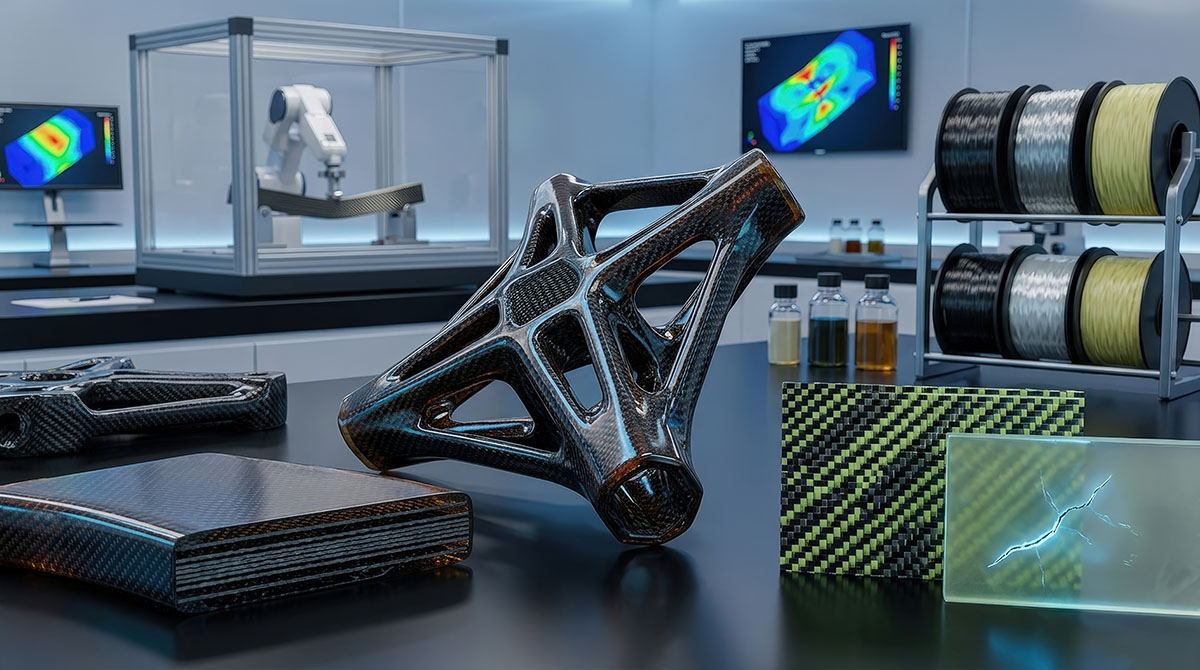
Engineers utilize photothermal conversion to 3D print thermoset composites, cutting oven curing and delivering robust parts for industry.
Traditional composite manufacturing forces engineers into costly, multi-day layups and energy-intensive oven curing cycles. Additive manufacturing solves these bottlenecks using in-situ photothermal conversion. When developers expose carbon fibers to monochromatic blue laser light, the fibers absorb electromagnetic energy and generate intense localized heat instantly. This rapid thermal spike triggers ring-opening metathesis polymerization within thermoresponsive resins, curing the matrix without external heat. To maintain strict geometric tolerances before curing, direct ink writing systems rely on engineered rheology. Formulators utilize shear-thinning and rapid elastic modulus recovery to prevent structural collapse mid-air.
You can also read: Recycled PETG Powers Carbon Fiber Filaments for 3D Printing.
Evaluating Mechanical and Energy Metrics
Performance comparison between In-Situ Printed and Traditional cast
| Manufacturing Method | Material Profile | Tensile Strength | Tensile Modulus | Thermal Energy Demand |
| In-situ Printed | Continuous CF (51.4 vol%) | 1.48 GPa | 106.7 GPa | 0.45 kJ |
| Traditional Cast | Continuous CF (51.4 vol%) | 1.66 GPa | 110.7 GPa | 6912 kJ |
Adapted from Additive manufacturing of carbon fiber-reinforced thermoset composites via in-situ thermal curing.
To evaluate industrial viability, material scientists compare printed structures directly against established baselines. Reviewing these metrics, engineers observe a highly favorable performance trade-off. While printed continuous fiber composites sacrifice a fractional amount of ultimate tensile strength compared to cast samples, they maintain highly competitive elastic moduli. The commercial advantage surfaces in profound energy reduction. Production facilities eliminate massive thermal ovens and extended curing times, slashing operational overhead. Furthermore, developers gain unmatched geometric freedom. Additive toolpaths allow operators to orient fibers in three-dimensional space along unsupported midair trajectories, achieving extreme structural efficiency that planar layups simply cannot replicate.
Engineering Interfacial Adhesion
To maximize load transfer within these structures, material scientists must actively engineer the chemical boundary between the reinforcing filler and the resin. Different formulations demand highly specific bonding strategies. When operators integrate highly hydrophilic natural fibers, the inherent moisture repels the polymer matrix. Chemists solve this by applying covalent surface modifications. They utilize alkaline or silane treatments to reduce hydroxyl groups, forcing the natural fibers to covalently bond with the surrounding matrix. Conversely, developers designing self-healing composites avoid rigid covalent bonds entirely. They engineer Metallo supramolecular polymers relying on reversible coordination complexes and hydrogen bonding. These dynamic networks enable the elastomer to repeatedly heal internal fractures under continuous tensile loading, extending product lifespans in harsh environments.
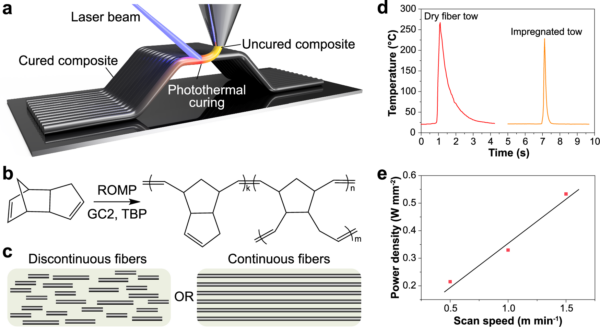
a Schematic representation of the additive manufacturing process. Localized photothermal heating of the composite material immediately upon deposition by a robotic platform allows for high-fidelity printing of composites on solid substrates and in midair. b Scheme of the ROMP of the thermoresponsive DCPD resin system using a second-generation Grubbs’ catalyst (GC2) and tributyl phosphite inhibitor (TBP). c The tunable viscosity and cure kinetics of DCPD resin enables additive manufacturing of composites using discontinuous and continuous carbon fibers. d Photothermal response of dry and resin-impregnated carbon fiber tows (tow size = 3000) as the laser beam passes a point of interest on the fiber tow at a scanning rate of 1.5 m min−1. e Laser power density should be adjusted when decreasing the printing speed or using various tow sizes. Courtesy of Additive manufacturing of carbon fiber-reinforced thermoset composites via in-situ thermal curing.
Scaling Commercial Applications
These material breakthroughs empower product designers to innovate across multiple sectors. Automotive engineering teams actively replace heavy cast iron and steel bumper beams with advanced glass fiber-reinforced polymers. These lightweight composite structures cut component mass by up to sixty percent while preserving vital impact damping capabilities. In consumer electronics, technicians utilize direct ink writing to fabricate self-powered piezoelectric tactile sensors. By processing treated ceramic powders into flexible elastomeric matrices, developers successfully convert mechanical pressure into usable electrical energy. Finally, defense manufacturers print discontinuous aramid fibers to produce incredibly durable, abrasion-resistant components. Operators carefully adjust layer heights and line spacing during extrusion to mimic traditional laminated composites, effectively compacting layers to minimize resin-rich gaps.
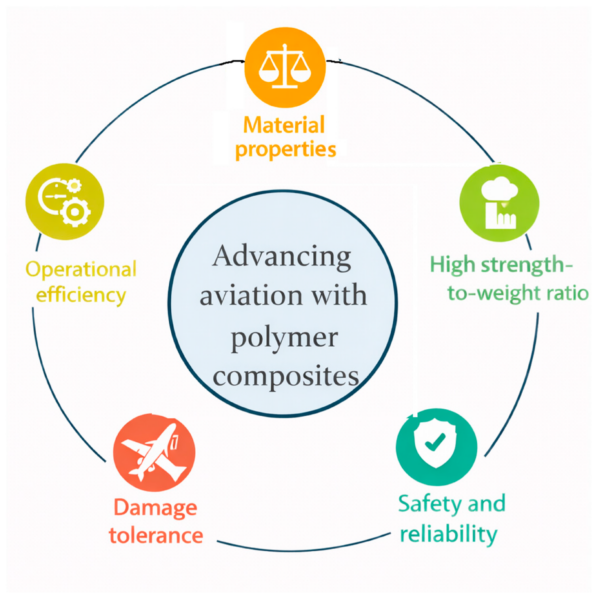
Contribution of polymer composites in materials development and performance enhancement within the aviation sector. Courtesy of Polymer Composites in Additive Manufacturing: Current Technologies, Applications, and Emerging Trends.
Photothermal additive manufacturing rewrites the production rules for structural thermoset plastics. By combining rapid continuous curing with precise three-dimensional fiber orientation, industrial developers can bypass the logistical constraints that have long limited traditional composite manufacturing. Moreover, engineers continue optimizing printing parameters to eliminate interlayer weaknesses, allowing these versatile material systems to scale from laboratory prototyping into demanding commercial production. In conclusion, this technological shift could deliver lighter, stronger, and more cost-effective manufacturing solutions for the next generation of industrial design.

Andres Delgado is a mechanical engineer specializing in design and quality assurance, with experience in precision seal design, turbomachinery maintenance, and orthopedic medical devices. He currently works as a Design Quality Engineer focused on New Product Introductions for knee implants and compliance with advanced manufacturing standards.