
No Assembly Required: Bio-Based Resin for Monolithic Soft Robotics

Monolithic 3D printing with bio-based resins enables origami-inspired soft robotics without assembly, combining sustainability and design complexity.
Soft robotic systems typically rely on multi-material architectures that require sequential processing steps. These approaches combine elastomers, reinforcements, and embedded features, but introduce interfaces that can limit durability and complicate manufacturing. They also constrain geometric complexity and slow down design iteration.
Montazeri et al. propose a different route: fabricate soft robotic structures as fully integrated, monolithic components using vat photopolymerization. By eliminating interfaces and post-processing assembly, the method enables direct translation of complex geometries into functional devices.
You can also read: Designing Polymeric Composites at the Voxel Scale with Multi-Material Jetting.
Bio-Based Photopolymers for Additive Manufacturing
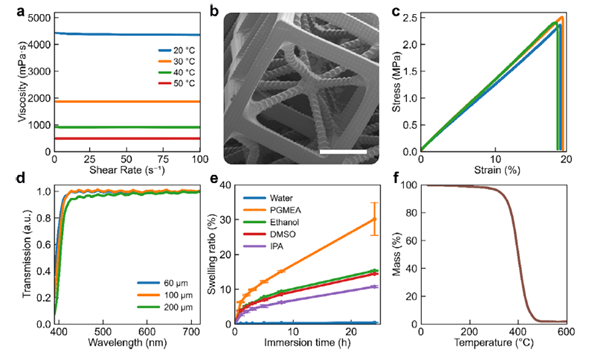
Bio-based resin performance and printability for DLP processing. Courtesy of Monolithic 3D Printing of Origami‐Inspired Soft Robotics from Sustainable Bio‐Based Resin – Montazeri – 2026 – Advanced Science – Wiley Online Library.
The study formulates a bio-based photocurable resin tailored for digital light processing (DLP). The resin incorporates renewable building blocks while maintaining the rheological and photochemical characteristics needed for high-resolution printing.
Mechanical characterization shows elastomeric behavior suitable for large, reversible deformations. The material supports repeated mechanical loading without catastrophic failure, enabling soft robotic actuation. At the same time, the formulation remains compatible with standard DLP processing windows, enabling accurate fabrication of thin features and hinges.
The resin formulation balances viscosity and reactivity to remain compatible with DLP processing while preserving feature fidelity. Rheological characterization shows a temperature-dependent viscosity profile that supports recoating and layer uniformity, while photopolymerization kinetics enable sufficient cure depth without excessive light scattering. The resulting printed features reach lateral resolutions on the order of tens of micrometers, allowing precise definition of hinge regions and crease patterns critical for controlled deformation.
Rather than treating sustainability and performance as competing requirements, the work demonstrates that bio-based photopolymers can meet the functional demands of advanced applications when engineers tailor the formulation appropriately.
Encoding Motion Through Geometry
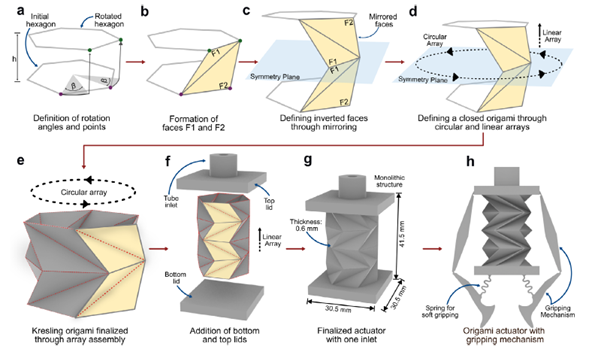
Origami-inspired design and monolithic fabrication of soft robotic structures. Courtesy of Monolithic 3D Printing of Origami‐Inspired Soft Robotics from Sustainable Bio‐Based Resin – Montazeri – 2026 – Advanced Science – Wiley Online Library.
This work integrates origami-inspired principles into monolithic printed structures. Instead of assembling discrete joints or hinges, the authors define folding behavior through geometry. Using DLP, they fabricate structures with programmed crease patterns and compliant regions that guide deformation. These features enable controlled folding and unfolding under external stimuli, eliminating the need for additional components.
The resulting structures exploit geometric nonlinearity and localized compliance to achieve motion. The deformation behavior arises from the coupling between structural geometry and material elasticity rather than discrete mechanical joints. Crease regions act as compliant hinges with reduced thickness, concentrating strain and enabling repeatable folding under applied pressure or mechanical loading. This approach distributes stress more uniformly across the structure compared to bonded assemblies, reducing failure initiation sites while maintaining reversible actuation over multiple cycles. This design strategy shifts complexity from materials and assembly toward digital design and toolpath generation.
High-Resolution Fabrication of Complex Architectures
Vat photopolymerization provides the resolution needed to implement these designs. The process enables precise control over feature size, defining hinge thickness, fold angles, and deformation pathways.
The study demonstrates the fabrication of intricate origami-based geometries in a single printing step. The monolithic approach ensures continuity of material across the structure, avoiding stress concentrations introduced by bonded interfaces typically introduced.
This level of integration allows designers to implement complex kinematics directly within the printed part, expanding the design space for soft robotic systems.
You can also read: Optimizing 3D Printing Parameters to Reduce Gear Wear.
Demonstrating Soft Actuation Through Design
The printed structures exhibit predictable and repeatable deformation behavior consistent with their geometric design. By tailoring crease patterns and structural layouts, the authors achieve controlled shape transformations that are characteristic of origami-based mechanisms.
These demonstrations highlight applications such as compliant mechanisms, deployable systems, and soft actuators. Fabricating these systems without assembly simplifies prototyping and reduces variability between parts.
Cycle actuation tests further demonstrate the structural stability of the monolithic designs under repeated loading. The printed actuators maintain consistent deformation profiles over multiple cycles, indicating stable elastic recovery and limited mechanical degradation. This behavior reflects the combined effect of elastomeric material response and geometry-driven stress distribution, which minimizes localized failure and supports reliable operation in applications requiring repetitive motion.
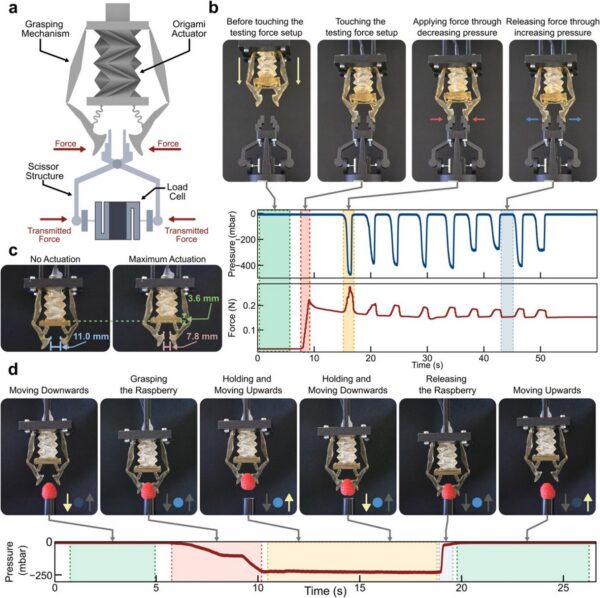
Monolithically printed soft robotic gripper in operation. Courtesy of Monolithic 3D Printing of Origami‐Inspired Soft Robotics from Sustainable Bio‐Based Resin – Montazeri – 2026 – Advanced Science – Wiley Online Library.
Implications for Additive Manufacturing and Sustainable Materials
This work combines three elements that researchers often treat independently: bio-based material development, high-resolution additive manufacturing, and geometry-driven mechanical design. Renewable feedstocks help address growing pressure to reduce reliance on fossil-derived polymers. At the same time, monolithic fabrication reduces material waste associated with trimming, bonding, and multi-step assembly processes. Challenges remain in scaling photopolymer systems and assessing long-term material stability, particularly under cyclic loading and environmental exposure. However, the study establishes a viable pathway for integrating sustainability into high-performance additive manufacturing.
Advancing Integrated Design and Manufacturing
By embedding functions directly into geometry and fabricating structures in a single step, this approach redefines how engineers design and produce soft robotic systems. The combination of origami-inspired mechanics and bio-based photopolymers enables structures that are both complex and manufacturable.
As additive manufacturing continues to mature, co-designing material formulations and geometric architecture will play a vital role in expanding its industrial relevance. This work provides a clear example of how that integration can be achieved in practice.

Paula Sánchez is a recent mechanical engineering graduate focused on sustainable manufacturing and materials innovation, with research experience in bio-assisted manufacturing at Purdue University and bioplastics at Universidad de los Andes, Colombia.