
Large-Scale AM Redefines Composite Tooling
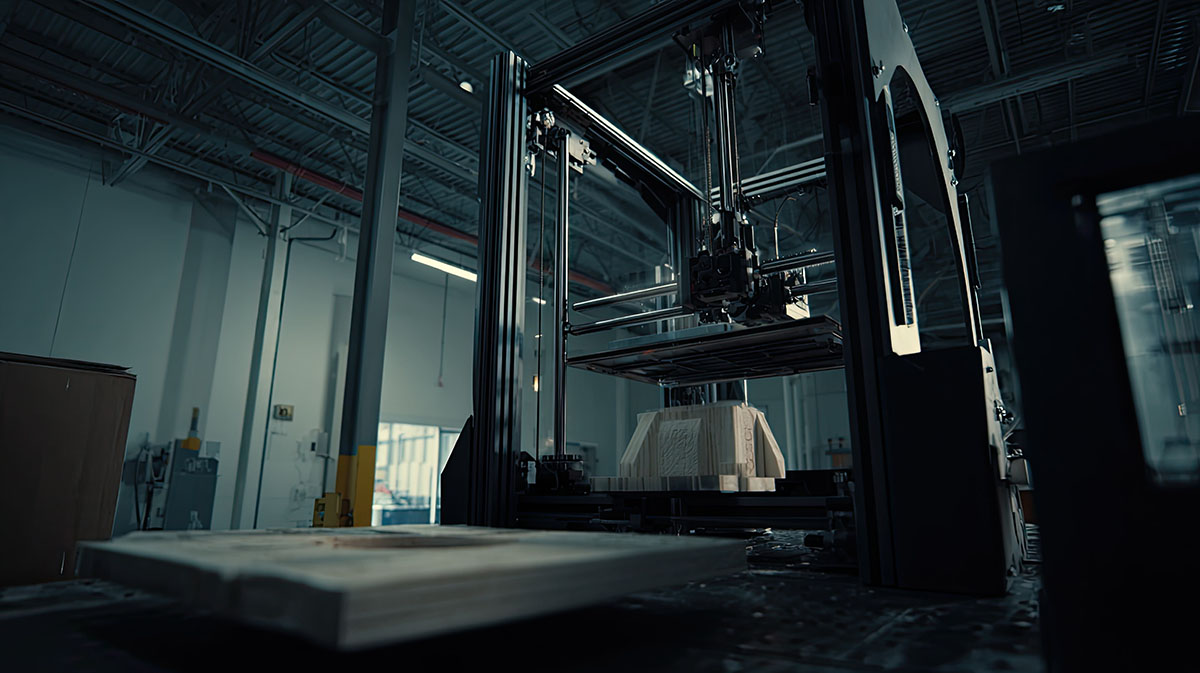
Carbon fiber-reinforced thermoplastics enable large molds, but material behavior and joining strategies still define performance limits.
Aerospace and automotive manufacturers rely on large molds to produce composite parts through layup and compression molding. Traditional tooling uses machined metals, which require long lead times and generate significant material waste.
Large-scale additive manufacturing (LSAM) provides an alternative by depositing material only where needed. Research led by Eduardo Barocio demonstrates that LSAM can produce large composite tooling using high-performance thermoplastics, reducing both manufacturing time and material consumption compared to conventional machining.
Printing Large Molds with CF Enhanced Thermoplastics
LSAM systems use pellet-fed extrusion to manufacture large components at high deposition rates. This approach allows engineers to produce molds at a meter scale for composite processing applications. Recent work shows that industries can use LSAM to fabricate and reuse molding and tooling components using carbon fiber-reinforced thermoplastics. The study demonstrates that these materials support large-format applications while enabling material recovery and reuse, reducing overall environmental impact. Carbon Fiber Reinforcement Improves Stiffness and Dimensional Stability in LSAM molds. Material performance plays a critical role in replacing metal tooling. Carbon fiber-reinforced thermoplastics increase stiffness and reduce thermal expansion compared to unfilled polymers. Research on LFAM materials shows that fiber reinforcement improves dimensional stability and mechanical performance, both of which are essential for maintaining mold geometry during composite processing. However, the same study highlights that processing conditions strongly influence final properties, and printing introduces anisotropy.
Dimensional Accuracy Remains a Key Challenge
The layer-by-layer deposition process creates directional properties in printed materials. Fiber orientation and cooling rates affect bonding between layers and lead to anisotropic mechanical behavior.
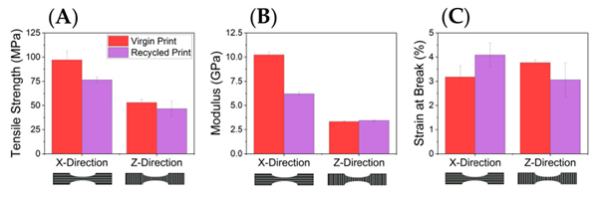
Mechanical properties of carbon fiber–reinforced thermoplastics show direction-dependent behavior, with differences between X and Z orientations highlighting anisotropy in additively manufactured material. Courtesy of Enabling Industrial Re-Use of Large-Format Additive Manufacturing Molding and Tooling. Polymers 2025.
These effects become more pronounced in large molds, where thermal gradients during printing can introduce residual stresses and geometric distortion. As a result, engineers must control processing conditions and often machine printed molds to achieve the required tolerances.
Segmented Mold Design Creates New Tradeoffs
LSAM systems cannot always produce large molds as a single structure. Barocio and collaborators demonstrated that manufacturers often divide molds into sections and assemble them after printing.
This modular approach introduces new challenges. Adhesive bonding between sections must withstand thermal cycling during composite processing. Research shows that these joints can experience fatigue, which can limit the overall durability of the tooling system.
Recyclability and Reuse Support LSAM Growth
Recent research emphasizes not only performance but also sustainability. Studies demonstrate that engineers can recycle and reuse LSAM tooling materials, enabling a more circular approach to manufacturing. This capability contrasts with traditional metal tooling, where rework and recycling require significantly higher energy and cost.
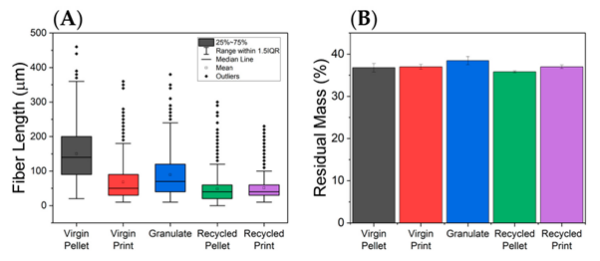
Fiber length distribution and residual mass analysis across recycling stages show that carbon fiber–reinforced thermoplastics retain key material characteristics after reprocessing. Courtesy of Enabling Industrial Re-Use of Large-Format Additive Manufacturing Molding and Tooling. Polymers 2025.
Large-Scale AM is a Strong Alternative for Industry Applications
LSAM does not yet match the thermal conductivity or long-term durability of metal molds in high-volume production. However, it provides a viable solution for large, low-to-medium-volume composite applications where cost, weight, and lead time are critical.
For engineers and manufacturing specialists, LSAM represents a shift toward designing tooling specifically for additive processes. As materials and processing methods continue to improve, carbon fiber-reinforced LSAM tooling will play an increasingly key role in large-scale composite manufacturing.

Paula Sánchez is a recent mechanical engineering graduate focused on sustainable manufacturing and materials innovation, with research experience in bio-assisted manufacturing at Purdue University and bioplastics at Universidad de los Andes, Colombia.