
Eco-Hybrids vs. Foam Cores in Aerospace

Engineers benchmark flax-glass progressive folding against carbon-Kevlar foam cores to optimize kinetic energy absorption for aircraft safety.
Aviation engineers must absorb catastrophic kinetic energy while strictly minimizing aircraft weight to reduce operational fuel costs. Traditional metallic components deliver vital safety but impose massive weight penalties. To solve this commercial challenge, materials scientists currently contrast two distinct aerospace energy-absorption philosophies: progressive folding in natural-synthetic open-web profiles versus core crushing in synthetic closed foam panels.
You can also read: Pros and Cons of Natural Fiber-Reinforced Plastics in Automotive.
Progressive Folding in Open-Web Profiles
Engineers utilize flax and E-glass eco-hybrid composites to manage quasi-static axial crushing. During severe deceleration, these open-web profiles dissipate energy through a progressive folding mechanism. The structures undergo controlled buckling, localized fragmentation, and fiber splaying. High transverse shear stresses drive interlaminar cracks, allowing the composite to yield safely over an extended period.
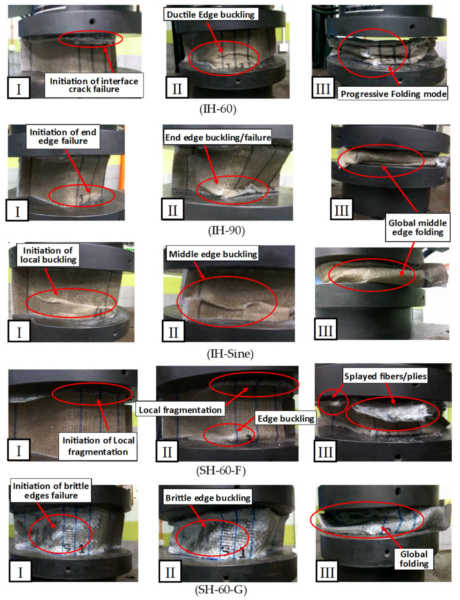
The crushing morphology at each stage of crushing (I: Zone I) (II: Zone II) (III: Zone III). Courtesy of Experimental Investigation of the Axial Crushing Response of Flax/Glass Eco-Hybrid Self-Supporting Web Composites.
To prevent catastrophic brittle failure, designers place natural flax fibers on the exterior layers. These flax fibers possess a tensile strength of 370 to 630 MPa and physically hold the shattered internal E-glass layers together. By alternating natural and synthetic layers in an intercalated stacking sequence, manufacturers minimize the formation of destructive interlaminar cracks. This specific intercalated configuration achieves a highly competitive specific energy absorption of 20.36 kJ/kg and a crash force efficiency exceeding 80%, strongly rivaling traditional synthetic baselines. Commercially, aerospace manufacturers integrate these open-web profiles directly into aircraft fuselage subfloors to protect passenger cabins and reduce overall manufacturing costs.
Core Crushing in Closed Panels
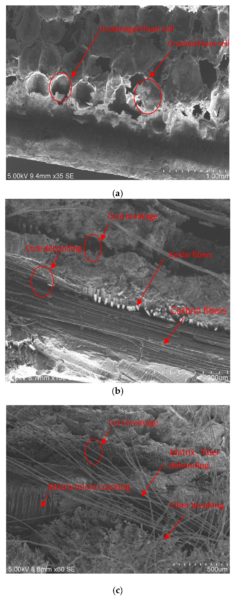
Characteristic Scanning Electron Microscopy (SEM) microstructure in the region of low-velocity impact of sandwich specimens: (a) impacted foam core, (b) interface between the foam and face sheet, (c) impacted face sheet region. Courtesy of Low-Velocity Impact Behavior of Foam Core Sandwich Panels with Inter-Ply and Intra-Ply Carbon/Kevlar/Epoxy Hybrid Face Sheets.
On the contrary, designers deploy foam core sandwich panels utilizing carbon, Kevlar, and epoxy face sheets to manage sudden, low-velocity dynamic impacts. When external projectiles strike the panel, the structure absorbs energy through localized face-sheet deformation and internal foam crushing. The structural damage sequence includes initial fiber breakage, matrix cracking, deep foam core cracking, and subsequent face-sheet debonding.
Engineers manipulate the ply sequence to maximize load tolerance without adding material volume. When technicians position Kevlar on the outer surface and carbon on the inner surface of the face sheet, the inter-ply hybrid architecture maximizes impact resistance. This exact configuration prevents premature face-sheet penetration and transmits shear forces safely into the low-density foam core. Commercially, manufacturers apply these rigid, lightweight foam panels to localized strike zones, such as cargo hold linings or exterior radomes, where sudden point-impact protection remains critical for flight operations.
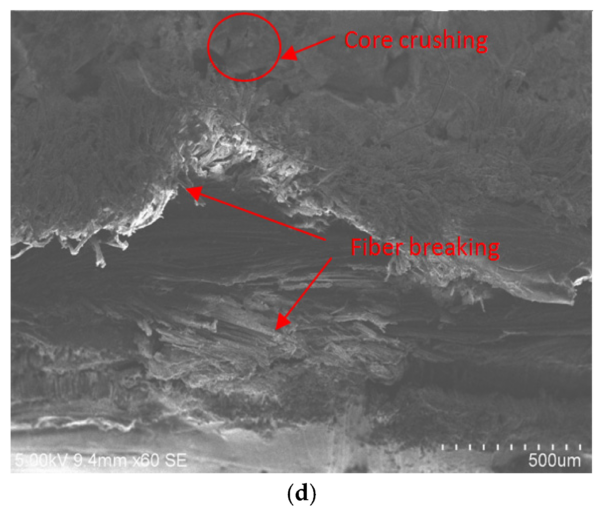
(d) debonding zone. Courtesy of Low-Velocity Impact Behavior of Foam Core Sandwich Panels with Inter-Ply and Intra-Ply Carbon/Kevlar/Epoxy Hybrid Face Sheets.
Engineering the Ideal Airframe
When engineers analyze the mechanics, they find both approaches can mitigate specific aerospace hazards without adding unacceptable weight penalties. In steady crushing conditions, intercalated flax-glass structures perform especially well, delivering substantial kinetic energy dissipation that supports whole-structure survival effectively. By contrast, Kevlar-outer inter-ply foam panels perform best against sudden point impacts, helping preserve structural integrity against foreign-object damage. As a result, aerospace companies use both strategies to design airframes that are lighter, safer, and better matched to service conditions. Manufacturers often choose open-web progressive folding structures to manage whole-cabin deceleration while also reducing material costs versus pure carbon. However, they still rely on hybrid foam-core systems for localized strike protection, where surface integrity remains essential to flight safety.
By comparing these architectures, developers gain a more precise materials toolkit for solving different aerospace energy-absorption problems across applications. Although carbon-Kevlar foam panels offer excellent localized impact resistance, flax-glass open-web profiles provide a more sustainable scalable alternative. As the industry moves forward, manufacturers will likely combine both approaches to improve safety, reduce weight, and support sustainability goals.

Andres Delgado is a mechanical engineer specializing in design and quality assurance, with experience in precision seal design, turbomachinery maintenance, and orthopedic medical devices. He currently works as a Design Quality Engineer focused on New Product Introductions for knee implants and compliance with advanced manufacturing standards.