Digital Twins Transform Injection Molding Training
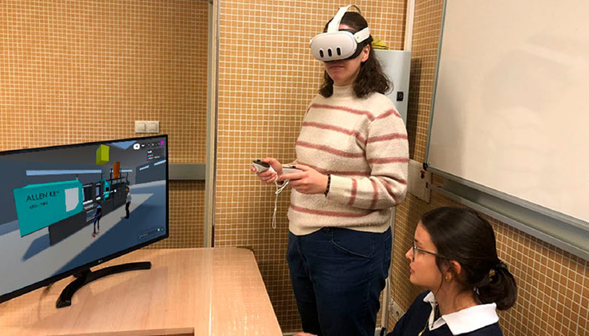
Virtual injection molding training using digital twins improves skills, cuts costs, and reduces material waste.
Injection molding demands precise control of thermal, rheological, and mechanical variables. Operators must understand melt flow behavior, cooling kinetics, and machine parameters to produce defect-free parts. Traditional training relies heavily on physical machines, which limit access, increase cost, and generate material waste.
You can also read: Plastics Training: The Secret of Competitiveness.
Vicente Jover, Peris, Juan Luis Gámez Martínez, Sergio Ferrándiz Bou, and Amparo Jordá Vilaplana propose a different approach. They use digital twins within a metaverse environment to train users in injection molding operations. Their work shifts training from physical trial-and-error to controlled, data-driven simulation.
Building a Digital Twin of the Process
The authors develop a virtual replica of an injection molding system that integrates process, physics, and machine behavior. This digital twin reproduces key stages of the cycle, including filling, packing, and cooling. Users interact with the system in real time, adjusting parameters such as injection speed, mold temperature, and holding pressure.
The model captures cause-and-effect relationships between processing conditions and part quality. For example, users can observe how changes in packing pressure influence shrinkage or how cooling time affects residual stresses. This approach allows trainees to explore process windows without risking defective production. The metaverse environment enhances this experience by creating an immersive interface. Users not only input parameters; they also navigate and manipulate the process as if they were operating a real machine.
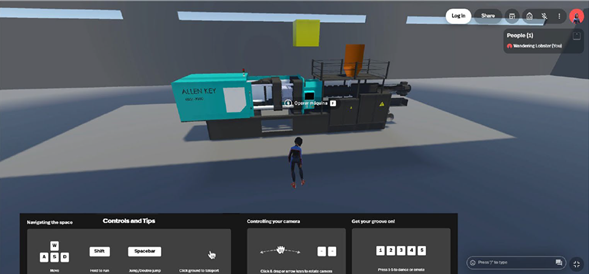
User navigation in the metaverse environment. Courtesy of Application of digital twins in the metaverse for plastic injection training.
Technical Value for Process Understanding
The system provides more than visualization. It reinforces processing concepts that often remain abstract in conventional training. Users can correlate rheological behavior with flow front evolution, analyze the impact of thermal gradients on warpage, or identify optimal processing conditions through iteration.
This interactive feedback loop accelerates learning. Instead of waiting for physical cycles, users receive immediate responses from the model. They can evaluate multiple scenarios in a fraction of the time required in a real plant. Also, this platform supports deeper analysis. It enables validation of theoretical models and exploration of parameter sensitivity. Additionally, it strengthens intuition about process stability and robustness.
Reducing Cost and Material Waste
Physical training consumes polymer, energy, and machine time. It also introduces risk, especially when inexperienced operators run the equipment. The digital twin eliminates these constraints. Trainees can make mistakes without consequences, repeat experiments indefinitely, and optimize parameters before applying them on the shop floor. This approach directly supports sustainability goals. It reduces scrap generation and energy consumption during training phases. It also shortens the learning curve, which improves overall production efficiency.
Innovation Beyond Simulation
Many simulation tools already exist for injection molding. However, this work integrates simulation with real-time interaction and immersive environments. The authors do not treat the model as a passive analysis tool. They position it as an active training system. This distinction matters. Traditional software often requires expert knowledge and post-processing interpretation. In contrast, this platform delivers immediate, intuitive feedback that users can understand during operation. The metaverse component further differentiates this approach. It creates a collaborative and scalable training environment where multiple users can interact with the same system. This capability opens new possibilities for remote training and knowledge transfer across facilities.
You can also read: Industry 4.0 in Injection Molding.
Implications for the Plastic Industry
The plastics industry faces a growing skills gap in advanced manufacturing processes. Companies need operators who understand not only machine settings but also the underlying physics of polymer processing. Digital twins can address this challenge. They provide a safe, flexible, scalable platform for training and process optimization. They also align with broader Industry 4.0 strategies, where data integration and virtualization play central roles.
This work demonstrates that training can evolve alongside manufacturing technology. By combining physics-based modeling with immersive interaction, the authors create a tool that improves both learning outcomes and operational performance. For processors and researchers alike, this approach signal shift. Training no longer needs to depend solely on physical machines. Instead, it can leverage digital environment to build expertise faster, cheaper, and more effectively.

Paula Sánchez is a recent mechanical engineering graduate focused on sustainable manufacturing and materials innovation, with research experience in bio-assisted manufacturing at Purdue University and bioplastics at Universidad de los Andes, Colombia.