
Biodegradability : Understanding What “Breaks Down” and What Doesn’t
Microorganisms metabolize polymer carbon into CO₂ or CH₄, proving actual biodegradation beyond physical or chemical degradation.
Misconceptions still prevail in the conversation surrounding biodegradable plastics. Many people assume that any material labeled “biodegradable” will vanish naturally within weeks or months. However, actual biodegradation depends not only on the polymer’s chemistry but also on the environmental conditions it faces. Recognizing this distinction helps designers create materials that genuinely support circularity.
In their paper Dos and Don’ts When Assessing the Biodegradation of Plastics, researchers urge the industry to apply greater rigor when defining and verifying biodegradability. They emphasize that only microbial assimilation of plastic carbon can prove biodegradation, not indirect signs such as visual disintegration or mass loss.
What True Biodegradation Means
Microorganisms drive biodegradation by metabolizing the carbon in a polymer and converting it into CO₂ in aerobic environments or CH₄ in anaerobic systems, while also producing microbial biomass. Researchers track this process through respirometric measurements that quantify gas evolution or oxygen consumption over time, providing a direct measure of microbial activity.
They also use carbon–isotope–labeled plastics to trace polymer carbon into microbial biomass. This complementary validation provides strong, quantitative evidence that microbes have incorporated carbon atoms from the plastic into living cells, rather than leaving them as fragments or oxidized residues.
In contrast, changes such as weight loss, surface cracking, or reduced tensile strength reflect physical or chemical degradation, rather than biodegradation. A material may disintegrate completely without being biologically assimilated.
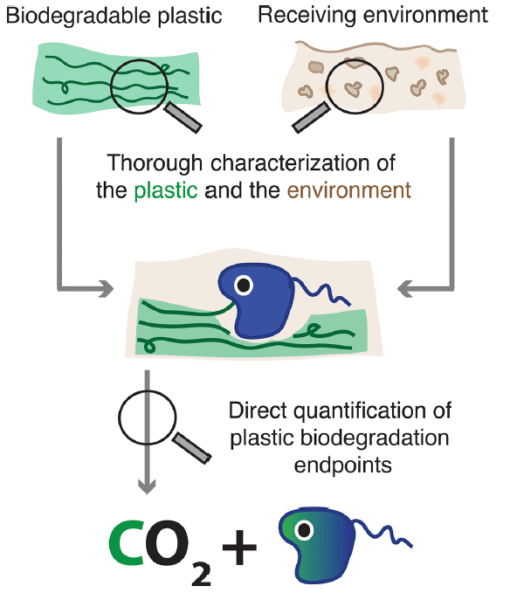
Assessing Plastic Biodegradation Demands a Thorough Characterization of Both the Material Properties of the Plastic and the Characteristics of the Receiving
Environment, Given That Both Strongly Affect Plastic Biodegradation. Courtesy of Dos and Do Nots When Assessing the Biodegradation of Plastics.
Testing Standards Define Biodegradability
To ensure consistency, biodegradability must be assessed under standardized, well-characterized environmental conditions. ASTM, ISO, and OECD standards establish test parameters, including temperature, microbial inoculum, and duration, to realistically evaluate biodegradation. The table below summarizes the most relevant international standards and their corresponding environmental contexts.
“A key requirement to claim environmental biodegradability as a value attribute is to demonstrate that 90%+ of the polymer carbon converts to CO2 in a practical time frame — 180 days or less in industrial compost environment, and less than 2 years in soil environment”. Prof Ramani Narayan
Biodegradability Standards by Simulated Condition
| Simulated Condition | Specification Standards | Test Method Standards | Primary Measured Parameters | Typical Duration |
| Industrial Composting | ASTM D6400, ASTM D6868, ISO 17088 | ASTM D5338, ISO 14855 | Carbon conversion to CO2, disintegration, and ecotoxicity | 180 days |
| Natural Soil (Aerobic) | EN 17033 | ASTM D5988, ISO 17556 | Respirometric CO2 evolution and plant toxicity | 6–24 months |
| Aquatic Environments | ASTM D7081 (withdrawn) | ASTM D8646, ASTM D6691, ISO 14851, ISO 14852 | O2 consumption or CO2 evolution in microbial inoculum | 28–180 days |
| Anaerobic Digestion | ISO 18606 | ASTM D5511, ISO 15985 | Biogas production (CH4 and CO2) under high-solids conditions | 15–60 days |
| Anaerobic Landfill | N/A | ASTM D5526 was officially withdrawn by ASTM without a direct replacement. | Long-term methanogenesis under accelerated static conditions | 6 months+ |
| Laboratory Screening | N/A | OECD 301B, OECD 302B | Theoretical CO2 (ThCO2) or Theoretical Oxygen Demand (ThOD) | 28 days |
Specification Standards define the pass/fail requirements for environmental claims, while Test Method Standards provide the technical laboratory procedures used to measure those results.
Why the Environment Matters
Each testing environment represents a distinct microbial ecosystem. A polymer certified under ASTM D5338, for example, is designed to degrade in hot, oxygen-rich industrial composting facilities, not in soil, the ocean, or home compost systems. Similarly, materials that degrade in anaerobic digesters require methane-producing microorganisms that do not exist in open environments.
Biodegradability, therefore, is not an intrinsic property of the polymer alone but a system-dependent process. When evaluating materials, the intended disposal or end-of-life scenario must align with the test method used.
Avoiding Misinterpretation
Many studies and marketing claims still confuse disintegration with biodegradation. Visual disappearance, microbial growth, or molecular weight loss do not prove that microorganisms have metabolized the polymer carbon. True biodegradation requires respirometric data and, ideally, complementary isotopic tracing that confirms carbon assimilation into biomass.
Without these data, claims of “environmental biodegradability” remain scientifically unsupported, and risk misleading consumers and policymakers alike.
Contextualizing Biodegradable Plastics
Biodegradable plastics have valid and valuable applications, but only when used appropriately. Examples include:
Food packaging designed for industrial composting, which can reduce contamination in organic waste streams.
Agricultural films intended to biodegrade in soil, eliminating costly recovery operations.
Controlled industrial digestion systems, where methane generation can be recovered for energy.
- Plastics used in the marine environment (such as pots, nets, and buoys).
Nevertheless, no commercially available plastic has been shown to achieve complete biodegradation under uncontrolled marine or natural terrestrial conditions within practical timescales. In general, a polymer must demonstrate at least 90% conversion of its carbon content to CO₂ within 180 days in an industrial composting environment, or within two years in soil, to be credibly classified as environmentally biodegradable. However, there is currently no international consensus across national regulations regarding these thresholds or test conditions.
Toward Credibility and Clarity
To build trust and transparency, manufacturers, researchers, and regulators must:
Use recognized international standards to match materials with realistic end-of-life environments.
Report respirometric and isotopic data rather than indirect indicators.
Avoid making generic claims such as “biodegradable in nature” without specifying the environmental conditions and providing supporting technical data.
By anchoring biodegradability in measurable science rather than marketing language, the plastics industry can ensure that new materials genuinely support circular and sustainable design.

Juliana Montoya is Director of Content for Plastics Engineering. A mechanical engineer with an MSc in materials engineering, she has experience as a sustainability and packaging consultant focused on ecodesign and recycling. Her work centers on technical content for the plastics industry, connecting polymer innovation, manufacturing trends, and sustainability strategy for industry audiences.
Helpful article but a few updates.
ASTM D5526 was withdrawn earlier this year and is no longer an active standard.
There are other lab screening test standard out there too.
ASTM D8410 is for thermoset coatings less than 1.0% total of weight on paper; otherwise similar to ASTM D6400, D6868.
ASTM D8646 just passed for water biodegradability at various temperatures and different water types vs D6691 which was at 30C and marine only.
Hello Kelvin! Thank you very much for your engagement. We have updated the ASTM D5526 withdrawal; I didn’t find a direct replacement. I also include the new ASTM D8646 standard, which provides a scientific framework for calculating and reporting the estimated biodegradation time of non-persistent, non-floating plastics intended for aquatic environments.