
AI-Enabled Design of Sustainable Flame-Retardant Composites

AI is helping researchers design sustainable flame-retardant biodegradable composites faster by optimizing fire performance, strength, and material efficiency.
Regulations, environmental concerns, and consumer interests increasingly demand the development of biodegradable polymer composites. Subsequently, sustainable flame-retardant materials ensure fire safety without reliance on halogenated or persistent chemicals.
You can also read: Advancing Fire Performance with Flame-Retardant Fiber Reinforced Thermoplastic Composites.
Integrating sustainable flame retardants with biodegradable polymer composites can help manufacturers meet safety and performance targets. Current flame-retardant design strategies rely on trial and error, with limited tunability and high time and resource requirements. Now, AI-driven design methods are accelerating research and design for flame-retardant materials.
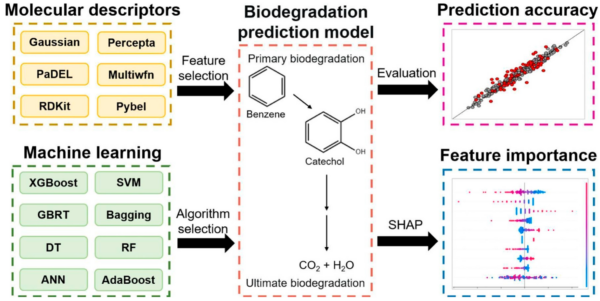
Machine learning can help predict biodegradation behavior. Figure courtesy of Advancing Sustainability: Biodegradable Electronics and New Materials through AI and Machine Learning.
New Developments in Sustainable Flame Retardants
Recently developed sustainable flame retardants include bio-derived phosphorus-containing molecules, mineral-based systems, and metal-organic frameworks. When a polymer encounters heat, bond scission and volatilization generate combustible gases. Flame retardants alter degradation pathways and suppress combustion. Sustainable flame retardants can enhance char formation, suppress flame spread, and reduce heat release from biodegradable polymers. Melt blending, fiber surface treatment, chemical grafting, and hybrid nanostructuring can integrate sustainable flame retardants into biodegradable matrices.
Challenges of Incorporating Sustainable Flame Retardants
Biodegradable polymer composites often require a high additive loading to achieve acceptable flame retardancy. Requirements can exceed 40 wt.%, compromising mechanical performance and making material processing difficult. When using mineral-based flame retardants, this can reduce the composite’s transparency or toughness. Additionally, certain flame retardants require high activation temperatures or long residence times. Biopolymers may experience heightened degradation during these processes.
How AI Fosters Sustainability Research
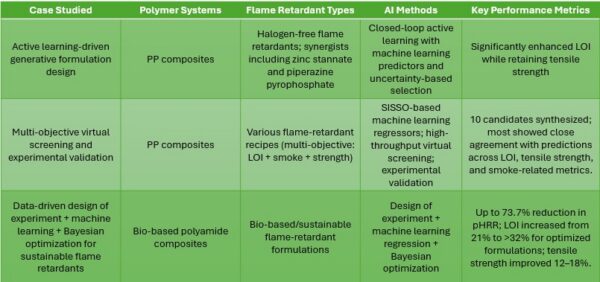
Recent studies have used a variety of AI methods for flame retardant design. Figure adapted from AI-Driven Design of Sustainable Flame-Retardant Biodegradable Polymer Composites, Table 2.
Researchers have taken a variety of approaches to using AI for designing sustainable flame-retardant biodegradable composites. For example, using an active learning-based generative framework, researchers designed halogen-free flame-retardant polypropylene composites. This approach used a closed-loop, AI-guided optimization for the material’s formulation. Starting off with a seed dataset of flame-retardant polypropylene recipes, they virtually designed thousands of potential compositions. Then, machine learning (ML) predictors ranked them, selected formulations for laboratory testing, and retrained with the new data.
Biodegradable composites have multi-objective design challenges. Researchers must balance mechanical stability, environmental compatibility, and fire safety to develop an optimal material. Thus, multi-objective ML frameworks are useful for weighing these tradeoffs. Seeking to address this, a 2023 study used ML regressors to screen over 40,000 virtual formulations. Researchers trained the regressors on a dataset comprising loss on ignition (LOI), tensile strength, specific optical density, and smoke release.
AI offers a way to navigate high-dimensional composition spaces that are difficult to explore through experimentation. A 2025 study integrated experiment design, ML regression, and Bayesian optimization to rapidly identify bio-based flame-retardant polyamide composites. In less than 50 iterations, this workflow achieved a 73.7% reduction in peak heat release rate (pHRR) to neat polymer. Simultaneously, it improved tensile strength by 12-18%.
Advantages in technology offer novel approaches to tackle existing challenges for flame retardant design. As sustainability continues to influence material design, AI and ML can open new doors for biopolymer research.

Having studied Geology, Julienne Smith focuses on environmentalism, sustainability, and the policies that impact plastics professionals today. As a technical writer, she is passionate about the intersection of science, technology, and communication. In her free time, she loves learning new things and writing fiction.