
3D-Printed Polymer Wrap Aims to Reduce Dialysis Site Failure
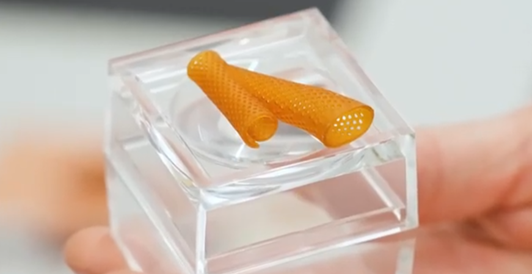
Advanced polymer engineering and 3D printing technology power SelfWrap, VenoStent’s breakthrough vascular implant.
One in eight people worldwide suffers from chronic kidney disease (CKD). As CKD progresses, loss of kidney function continues, potentially reaching end-stage kidney disease (ESKD). Generally, CKD is managed by medication and lifestyle changes to slow damage, but ESKD requires immediate life-sustaining treatments like hemodialysis (dialysis) or kidney transplants. In the U.S., about 480,000 ESKD patients receive hemodialysis according to the National Institute of Health, U.S. Renal Data System. Dialysis requires a surgical procedure to create a vascular access site to conduct ongoing treatment. Of the 480,000 patients, a 50-60% failure rate of dialysis vascular access sites occurs in the first year, according to a meta-analysis published in the American Journal of Kidney Disease. One Houston, Texas area start-up is aiming to improve the lives of patients undergoing ESKD treatment.
You can also read: 3D Printing, Hydrogels, and Polymers in Modern Wound Care
VenoStent is a clinical-stage therapeutic medical device company located in the heart of the Texas Medical Center. The team is a blend of cross-disciplinary experts in biomedical engineering, materials engineering, and medical 3D-printing. Their pioneering team has developed SelfWrap, a novel tissue engineering technology for vascular surgery and dialysis treatment. In 2023, VenoStent secured a 16-million-dollar Series A round, announcing an FDA Investigational Device Exemption for U.S. clinical trials. Most recently, they enrolled their first 200‑subject U.S. clinical trial in the SAVE‑FistulaS Clinical Trial.
SelfWrap: How It Works
SelfWrap uses a flexible, bioabsorbable polymer wrap to help prevent failure at dialysis access sites. Successful hemodialysis depends on reliable vascular access, usually an arteriovenous fistula (AVF), in which clinicians place dialysis needles for treatment. By directly connecting a high-flow artery to a lower-flow vein, surgeons create an access point that typically delivers better long-term outcomes than other options. But veins are not built for arterial pressure and flow. Over time, the vessel wall can thicken and grow inward, restricting blood flow and raising the risk of access failure.
SelfWrap counters that response by supporting the vessel from the outside and encouraging outward remodeling rather than inward narrowing. The device combines a bioabsorbable polymer formulation with a 3D-printed conformal design that, according to the company, improves both performance and manufacturing consistency. The platform could also extend to coronary and peripheral bypass grafting.
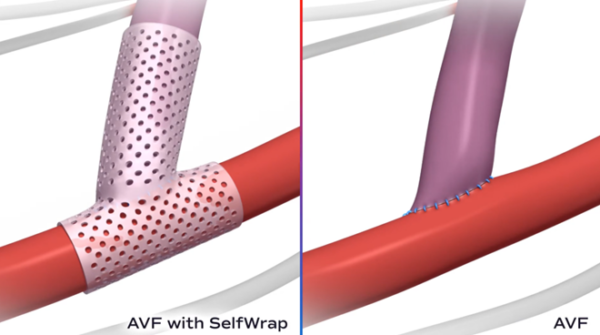
SelfWrap: How Its Made
VenoStent has filed two US patent applications describing their 3D-printed bioabsorbable polymers. Together, the applications summarize device design, vinyl-functionalized chemistry, and additive manufacturing approaches.
- Boire, T.; Miller, J.S.; Grigoryan, B.; Sears, C. Additive manufacturing of vinyl, photocrosslinkable polymers. S. Patent Application No. US17/629,621, 2020.
- Boire, T. Polymeric vascular grafts which induce neovascularization with mild to minimal inflammation and promotion of fibrovascular tissue. S. Patent Application No. US17/709,095, 2020.
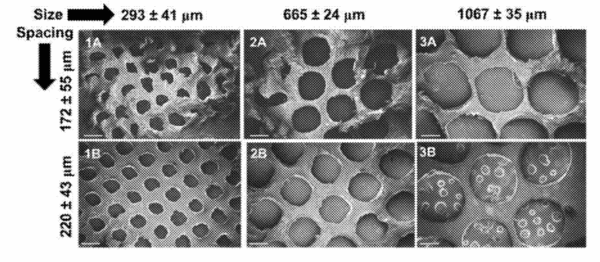
SEM micrographs of various porous scaffold designs. Courtesy of VenoStent Patent Application US17/709,095.
The first application describes additive manufacturing vinyl-functional polycaprolactone based polymers with acrylate or dithiol crosslinkers. These selected crosslinkers tailor mechanical behavior, in-situ degradation rates, and thermal properties. In addition, it also describes additive manufacturing strategies like optimized solvents and heating profiles to maintain polymer printability with stereolithography (SLA) or digital light processing (DLP) systems. Together, these techniques can produce biocompatible, mechanically adjustable, shape-memory polymers, possibly opening the application space for stents, grafts, and other minimally invasive applications.
The second application describes porous, biodegradable shape-memory polymer devices designed to wrap around blood vessels. Further, it describes scaffolding design like pore sizes, pore spacing, and biodegradation. The tailored devices can be molded at body relevant temperatures and regain their original shape, enabling custom fitting during surgery. This is possible due to the additively manufactured crosslinked polycaprolactone variants.

Jennifer Chavez is a chemist-turned materials scientist with expertise in advanced plastics manufacturing and experience spanning orthodontic medical devices, consumer products, and renewable energy. She currently works as a materials engineer in the aerospace sector, focusing on process development and compliance for flight-critical hardware.