
Why Food-Grade PCR Supply Still Lags in Food Packaging
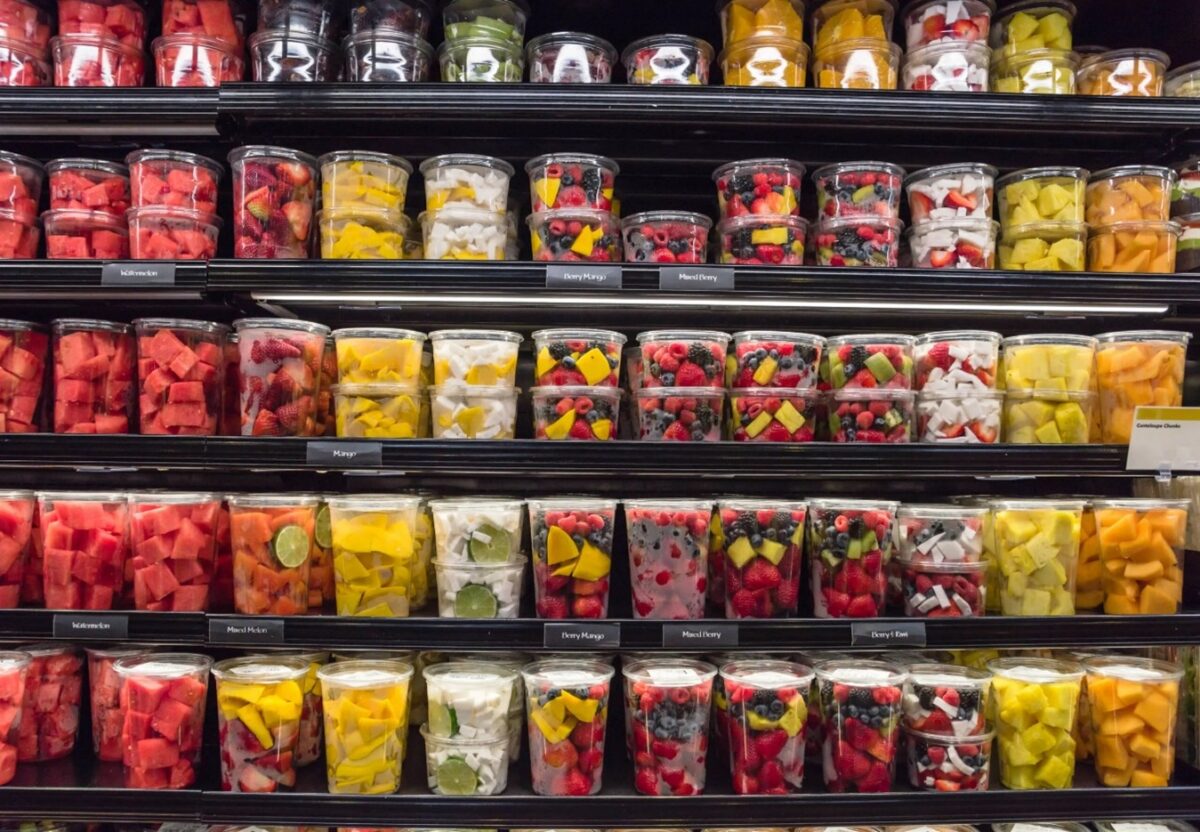
Recycled-content mandates are accelerating, but the supply of compliant recycled polyolefins for food packaging remains constrained.
The plastics industry has entered a more demanding phase of circularity. For packaging converters, recycled content is no longer a voluntary design objective or a brand-led sustainability preference. It is becoming a regulatory requirement. In food-contact applications, however, one constraint continues to limit progress: the availability of food-grade post-consumer resin.
You can also read: FDA Accelerates Approvals for Recycled Plastics in Food Packaging.
That bottleneck is especially visible in polypropylene and polyethylene, where demand for recycled content continues to rise but the supply of resin capable of meeting both regulatory and performance requirements has not kept pace. As a result, the market now faces a structural mismatch between mandated recycled-content targets and the limited volume of food-contact-compliant material available to meet them. Under the EU PPWR, by 2030 contact-sensitive PET packaging must contain at least 30% recycled content, while other contact-sensitive plastic packaging must contain at least 10%.
Why Food Contact Changes the Equation
The constraint goes beyond recycling capacity. Food-contact PCR depends on purification efficiency, feedstock traceability, and regulatory acceptance. For food packaging, recycled polymer must not only re-enter production but also satisfy strict safety thresholds for contaminants associated with prior use, misuse, additives, inks, adhesives, and nonfood applications.
EU Regulation (EU) 2022/1616 governs recycled plastics for food contact, while EFSA currently bases its evaluations on post-consumer mechanical PET recycling technologies. In the U.S., the FDA issues favorable opinions for specific recycling processes and specifies the polymer, process route, and conditions of use. That regulatory framework helps explain PET’s faster progress.
PET benefits from established bottle collection systems, more uniform feedstock, and a longer compliance history in food-contact recycling. PP and PE streams show far greater variability, and that variability continues to constrain the supply of food-grade resin.
Why PP and PE Remain the Weak Link
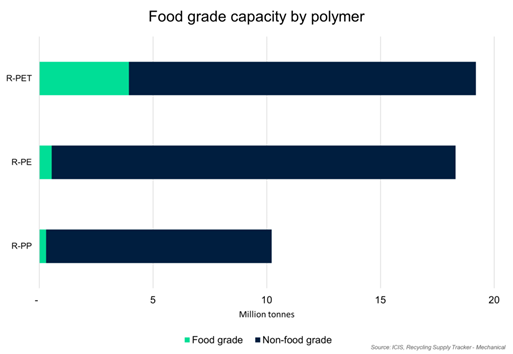
Global mechanical recycling capacity by polymer. While R-PET shows a developed food-grade pathway, R-PE and R-PP capacities are overwhelmingly limited to non-food-grade applications. Courtesy of ISCC, 2023.
Global mechanical recycling capacity by polymer. While R-PET shows a developed food-grade pathway, R-PE and R-PP capacities are overwhelmingly limited to non-food-grade applications. Courtesy of ISCC, 2023.
For polyethylene and polypropylene, feedstock complexity creates the main obstacle. These polymers enter the waste stream through rigid containers, films, multilayer formats, closures, and flexible packaging, often carrying pigments, fillers, barrier layers, printing, and many additives. That mix makes sorting harder, limits decontamination, and lowers stream consistency.
Even when collection volumes look strong, input quality often falls short. A bale can include food-contact and nonfood packaging, incompatible structures, and residues from prior use, all of which raise the burden on recycling operations. Mechanical recycling removes much of the visible contamination, but it often falls short of the purity that direct food-contact applications demand. As a result, food-grade polyolefin supply stays far tighter than general-purpose recycled polyolefin supply. For processors, the issue is practical: they can often source recycled PP or PE for nonfood uses, but securing food-contact-compliant PCR in stable commercial volumes remains far more difficult.
Why Molecular Recycling Is Gaining Strategic Weight
This supply gap is redefining the function of molecular recycling. This technology no longer acts only as a long-term complement to mechanical recycling. In food-contact polyolefins, it offers a route to material purity and compositional control that conventional mechanical systems often cannot deliver with consistent performance.
The underlying constraint lies in contaminant chemistry. Polyolefin waste streams often contain absorbed organic species, complex additive systems, and highly variable feedstock. Mechanical recycling can reduce visible contamination, but it often cannot remove these constituents to the level required for direct food-contact applications. Molecular processes can break the polymer down further, remove a broader contaminant spectrum, and generate outputs that meet tighter purity specifications and decontamination criteria.
Mechanical recycling still plays a central role where feedstock quality is high and cost efficiency remains critical. However, the market is assigning increasingly distinct functions to mechanical and molecular routes. In food-grade PP and PE, molecular recycling is moving from an optional pathway to a technical requirement.
The Supply Challenge Ahead
The main constraint in food-contact polyolefins no longer centers on PCR demand. It centers on resin quality. Recycled-content mandates continue to increase volume requirements, while food-contact applications still require strict control over contamination, traceability, and decontamination efficiency. That combination is exposing the limits of the current supply base.
For converters and brand owners, this means that 2030 planning cannot rely on generic PCR availability. Applications such as yogurt cups, deli containers, and fresh-cut produce tubs need PP or PE resin that is food-contact compliant, consistent in quality, and available in dependable commercial volumes. PET already benefits from stronger collection infrastructure and a more mature regulatory pathway. PP and PE do not, which leaves processors with a much smaller pool of compliant recycled resin as recycled-content targets move closer.
Improved sorting and washing will raise output quality, but those steps alone will not close the gap. The market needs a larger supply of food-grade polyolefin resin. That need is giving molecular recycling a more defined role, not as a general circularity tool, but as a route to deliver the purity and consistency that food-contact applications require.

María José Vargas is a mechanical engineer and MSc candidate in Materials Engineering and Nanotechnology at Politecnico di Milano. Her work focuses on environmental stress cracking in polyethylene, polymer failure behavior, plastics processing, and sustainable polymer applications.