
Self-Lubricating PEEK Bushings for Heavy-Duty Equipment
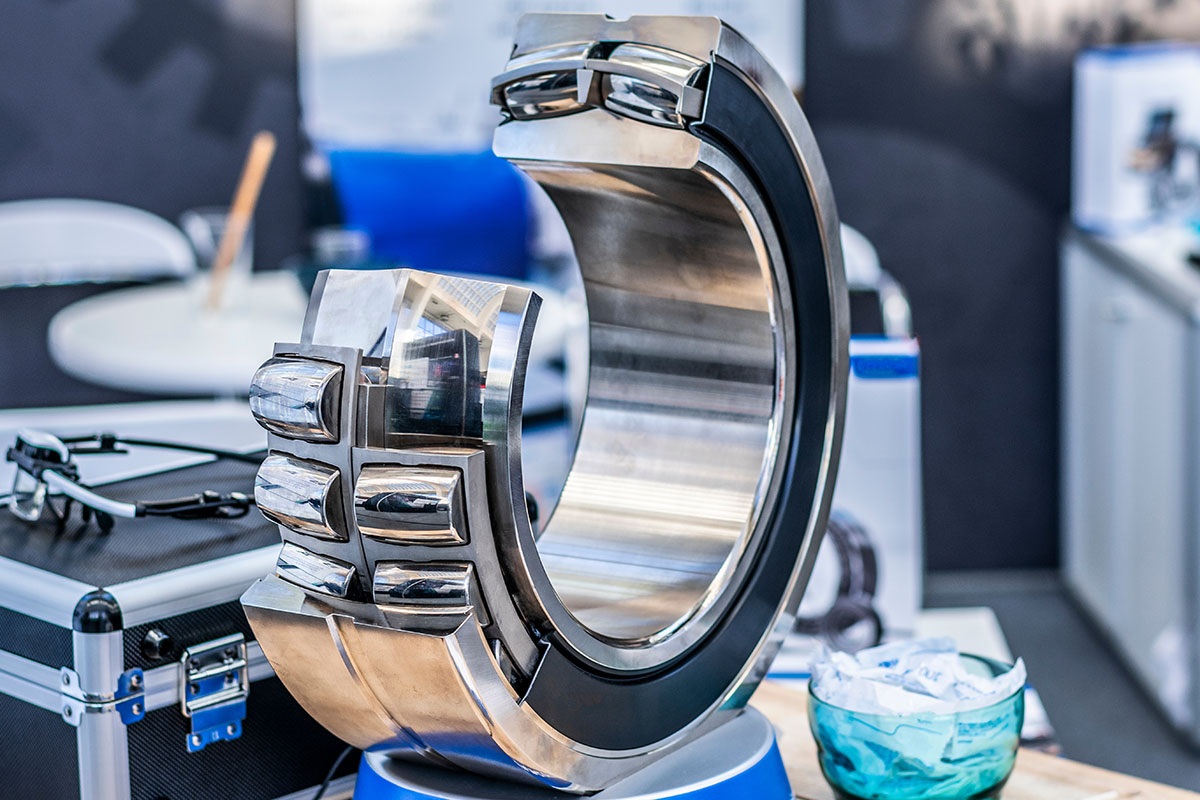
Engineers deploy self-lubricating PEEK composites to eliminate external lubrication and prevent wear on heavy-duty rotating equipment.
Traditional bronze bearings require hydrostatic oil grooves, which fail under heavy-load, low-speed conditions where rotational velocities cannot generate dynamic fluid films. Operators constantly battle particle-induced scratches and catastrophic leakage. Engineers solve this vulnerability by deploying self-lubricating Polyetheretherketone (PEEK) composite bearing bushes. These advanced polymers utilize internal solid lubricants and high-modulus fibers to spontaneously deposit robust transfer films directly onto the metal counterface, eliminating the need for external liquid lubrication.
You can also read: Elevating PEEK Composites with Glass Fiber
Tribological Phase Transitions
Material scientists engineer these PEEK matrices by integrating Polytetrafluoroethylene (PTFE), short carbon fibers, graphite, and poly-p-phenylene-terephthalamide. During active rotation, high-modulus reinforcing fibers bear primary mechanical normal loads. These fibers restrict plastic deformation and prevent sharp metal micro-convexities from gouging the composite. Simultaneously, extreme contact pressure extrudes the soft PTFE component. This solid lubricant fills localized wear grooves and established a protective layer. Under operational pressures reaching 33 MPa, stripped carbon fibers and solid lubricants undergo a self-polymerization reaction. This reaction thoroughly coats the fiber surfaces, generating powerful mechanical anchoring forces that prevent interfacial debonding. By actively depositing a sulfur-rich transfer film onto the metallic counterpart, these composites allow designers to run heavy-duty rotating equipment in completely dry or seawater environments.
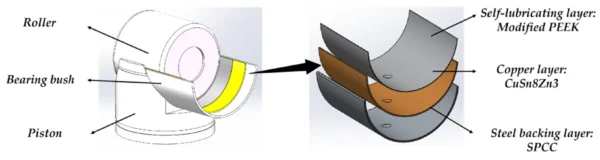
Three-layer sliding bearing bush structure. Courtesy of Friction and Wear Performance of a Hydraulic Motor Roller/Piston Pair Contact Lined with the Self-Lubricating Bearing Bush Modified by PEEK.
Evaluating Hard Performance Metrics
Engineers validate these polymers against conventional baselines, ensuring reliable performance comparisons under controlled tribological conditions and representative loading environments. For example, a bush containing 10 percent PTFE, graphite, and carbon fiber achieves a wear coefficient of 0.13 × 10⁻⁶ mm³/N·m. In contrast, standard 30 percent carbon-reinforced PEEK exhibits a wear rate of 4.33 × 10⁻⁶ mm³/N·m under similar testing conditions. Moreover, the composite also outperforms pure unreinforced PEEK, effectively preventing severe adhesive wear during prolonged mechanical contact. Additionally, adding 6 percent poly-p-phenylene-terephthalamide and 25 percent PTFE reduces friction by 51.6 percent and wear depth by 93.5 percent. As a result, engineers confirm the optimized formulation resists thermal softening, maintaining a stable bulk temperature rise of only 37.4 °C.
Meanwhile, pure PEEK rapidly degrades under similar conditions, exceeding temperatures above 84 °C and compromising mechanical stability. Ultimately, developers conclude that combining carbon fibers with solid lubricants delivers superior load-bearing capacity under demanding tribological conditions. Furthermore, this performance surpasses traditional 30 percent glass-fiber reinforcements, which experience continuous micro-ploughing under loads reaching 93 MPa.
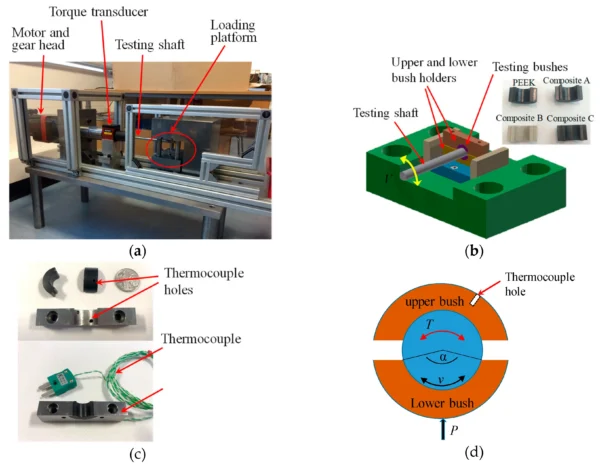
Pin joint test rig and bush specimen arrangement. (a) photo of the pin joint test rig; (b) loading platform with pin/bush assembly, bush halves located in two separate holders above and below the shaft, inset: bush specimens made of PEEK and PEEK composites; (c) thermocouple location; (d) contact geometry between shaft and bush halves subjected to normal load P applied from the lower bush, shaft oscillating speed v and required frictional torque T. Courtesy of PEEK Composites as Self-Lubricating Bush Materials for Articulating Revolute Pin Joints
Prototyping Commercial Applications
Designers translate advanced polymer science into structural components, enabling high-performance solutions for heavy-duty rotating equipment operating under demanding mechanical conditions. For instance, technicians deploy three-layer composite bearing bushes as primary contact surfaces on internal pistons of radial hydraulic motors. In this application, the polymer interfaces directly with steel cam rollers, operating under boundary lubrication and ultra-low sliding speeds. Specifically, these systems function within rotational ranges between 0.5 and 50 revolutions per minute under continuous mechanical loading conditions. Moreover, mechanical engineers install these bushes in articulating revolute pin joints that simulate extreme aerospace and robotic operating environments. Consequently, these configurations replicate forces experienced in landing gear systems and humanoid robot crank shafts at 45 degree-per-second sliding speeds. As a result, manufacturers leverage ultra-low friction coefficients to minimize heat buildup and ensure stable performance during continuous rotation cycles.
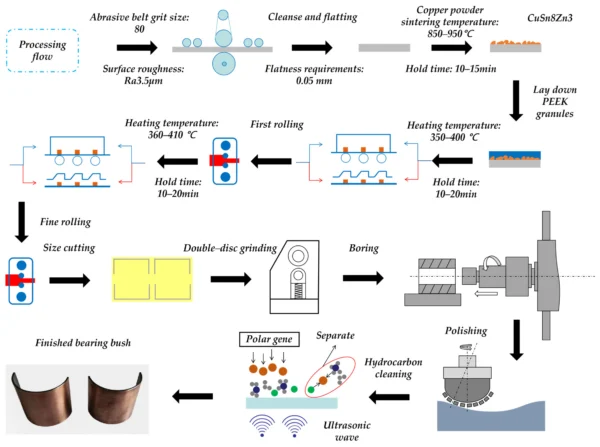
Processing diagram of three-layer self-lubricating bearing bush. Courtesy of Friction and Wear Performance of a Hydraulic Motor Roller/Piston Pair Contact Lined with the Self-Lubricating Bearing Bush Modified by PEEK.
Engineers fundamentally upgrade heavy-duty rotating equipment by transitioning to self-lubricating PEEK composite bearing bushes. By leveraging dynamic transfer films and self-polymerizing fibers, product developers eliminate vulnerable external oil lines and vastly improve mechanical lifespans. As global manufacturers adopt these resilient polymer systems, the industrial sector secures maintenance-free rotational infrastructure capable of conquering extreme pressure environments without catastrophic thermal degradation.

Andres Delgado is a mechanical engineer specializing in design and quality assurance, with experience in precision seal design, turbomachinery maintenance, and orthopedic medical devices. He currently works as a Design Quality Engineer focused on New Product Introductions for knee implants and compliance with advanced manufacturing standards.