Reinforcement Learning for Polymer Design and Manufacturing
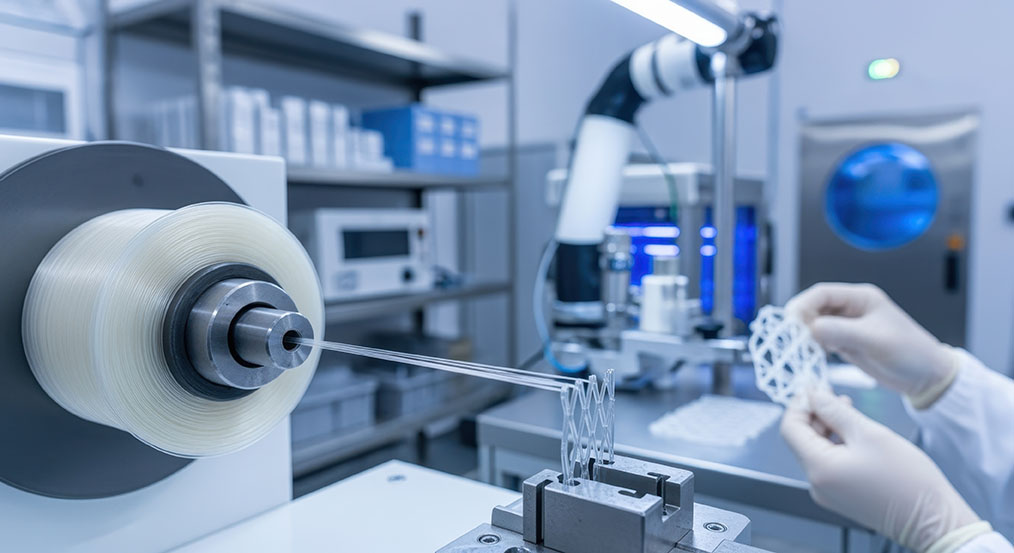
AI-driven reinforcement learning enables polymer design optimized for performance and manufacturability.
Artificial intelligence is reshaping polymer science by turning processability and performance into explicit design targets. Through feature reduction and generalization, AI enables models to navigate complex relationships and accelerate materials discovery.
You can also read: Rheology in Optimizing Thermoplastic Polymer Performance.
From Trial-and-Error to Inverse Design
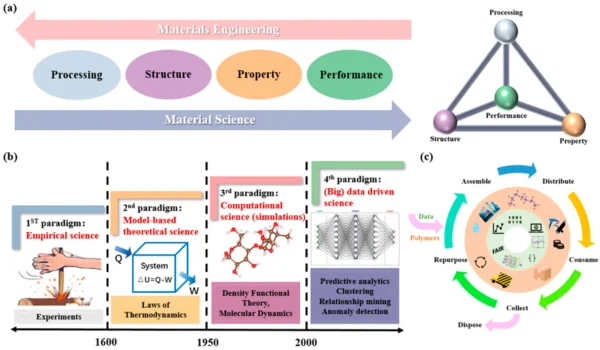
PSPP and Material Science paradigms: Courtesy of Recent Progress of Artificial Intelligence Application in Polymer Materials
Designing polymers for high-value applications has traditionally relied on experience-driven synthesis and iterative experimental screening. Compared to metals or ceramics, polymers exhibit highly complex and heterogeneous microstructures, where chemical structure, processing history, and morphology jointly determine final properties.
The Processing–Structure–Property–Performance (PSPP) relationship is nonlinear and high-dimensional, making direct correlations difficult to isolate. As a result, conventional workflows depend on repeated cycles of synthesis, processing, testing, and refinement. While computational modeling supports this process, it typically optimizes materials within a narrow design space.
Artificial intelligence changes this paradigm. Techniques such as feature extraction and dimensionality reduction enable models to generalize PSPP relationships. Consequently, polymer development shifts from trial-and-error to inverse design, in which target properties guide the generation of new materials. Given performance and processing constraints, models can propose polymer structures likely to satisfy both.
Reinforcement Learning in Polymer Design
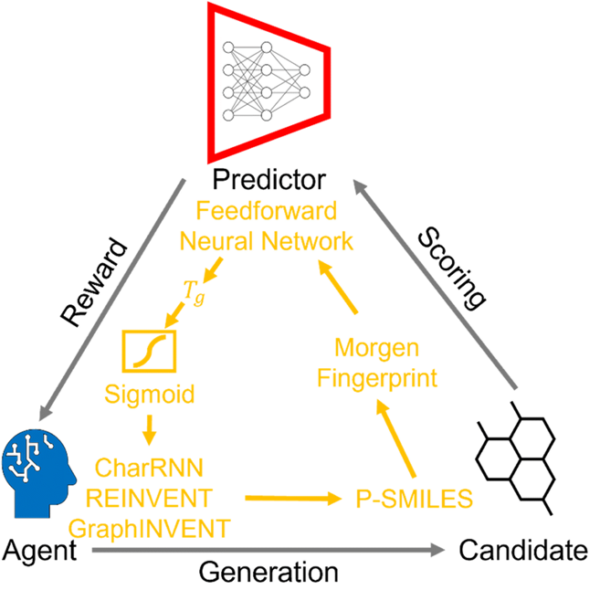
Architecture of reinforcement learning as applied to generative models with the capability to design hypothetical polymer structures possessing specific properties. Courtesy of Benchmarking study of deep generative models for inverse polymer design.
Among AI methods, reinforcement learning (RL) has emerged as a powerful tool for goal-directed molecular design. In this framework, a generative model becomes an optimizer guided by defined objectives.
An RL agent constructs polymer representations step by step, often using p-SMILES strings. Once a structure is generated, predictive models evaluate its properties, such as glass transition temperature (Tg). These predictions are converted into reward signals, allowing the agent to iteratively improve its design strategy.
Unlike random sampling, RL actively explores chemical space by balancing exploration and exploitation. This approach transforms generative models into systems that prioritize high-performing candidates, accelerating the discovery of polymers tailored to specific applications.
Recent benchmarking studies highlight the strengths of different generative models. Recurrent neural networks and graph-based models perform well on known polymer datasets, while autoencoder-based approaches are effective in exploring novel chemical spaces. When combined with reinforcement learning, these models can target high-performance polymers for demanding environments.
Integrating Manufacturability into Design
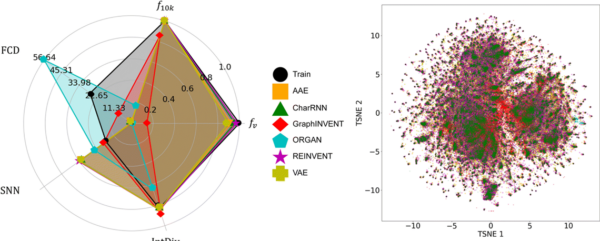
Left: Performance of the six different models on a homopolymer dataset. Right: Chemical space distribution of the generated polymers. Courtesy of Benchmarking study of deep generative models for inverse polymer design.
A key limitation of generative models is that they may propose polymers that perform well in simulations but are difficult to manufacture. To address this, manufacturability must become a design constraint rather than a downstream filter.
Polymer architecture directly affects processing behavior. Variations in branching and connectivity influence chain entanglement, melt rheology, and processing stability—critical factors in extrusion, molding, and other industrial processes.
To bridge this gap, process-aware modeling frameworks are emerging. These approaches link molecular design to processing performance, ensuring that candidate materials are both functional and manufacturable. Multi-objective optimization methods, such as Bayesian optimization, allow researchers to balance competing targets, including mechanical performance and processability.
Physics-Informed AI for Scalable Solutions
Physics-informed neural networks (PINNs) represent a further step in integrating theory with data-driven design. These models incorporate governing equations: such as heat transfer, diffusion, curing kinetics, and viscoelasticity, directly into the learning process.
By embedding physical laws, PINNs reduce reliance on large datasets and improve predictive reliability, particularly when extrapolating beyond known conditions. This approach minimizes the risk of generating impractical materials while accelerating development cycles.
Together, reinforcement learning, generative modeling, and physics-informed AI are redefining polymer design. Instead of optimizing materials in isolation, these tools enable simultaneous consideration of structure, performance, and manufacturability, bringing polymer engineering closer to fully integrated, design-driven innovation.

With a B.Sc. in Mechanical Engineering and a Postgraduate Degree in AI, Sebastian Villalba's work sits at the convergence of technology and its broader implications. He writes about how AI is transforming science and the Workplace. He currently works as a Venture Analyst for tech startups; outside of work, Improv is his hobby of choice.