Polyolefin Hydrogenolysis Boosts Fuel Yield with New Catalysts
A novel catalytic approach overcomes the limitations of polyolefin hydrolysis, a promising technology for a circular fuel-waste economy.
Polyolefin hydrogenolysis enables the upcycling of waste under mild reaction conditions, with a controllable product distribution. During hydrogenolysis, polymers undergo C-H activation, C-C cleavage, and hydrogenation/desorption, thereby upcycling them into liquid alkane fuels. Polymer chains have more degrees of freedom during hydrogenolysis compared to small molecules. Thus, this process results in a reduction of entropy. At the same time, C-H activation is endothermic, making it thermodynamically unfavorable.
You can also read: Redefining Recycling: Depolymerization of PET
Optimizing the Process
Recent research has focused on catalyst design to reduce configurational entropy and address these challenges. These catalysts limit configurational entropy by restricting the domain space that is available to polymer chains. A novel strategy proposes a universal surface-polarity-reconstruction strategy for traditional supported metal catalysts. By matching the polarity between the polymer and support, this method overcomes thermodynamic limitations during polyolefin hydrogenolysis.
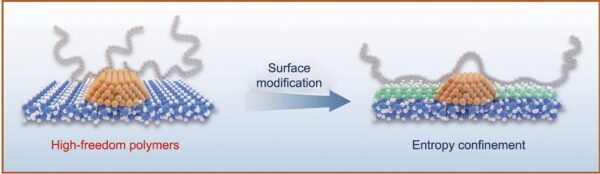
Researchers constructed a catalyst with optimized surface polarity to improve yields of gasoline and diesel components through polyolefin hydrolysis. Figure courtesy of Entropy Engineering for the Efficient Hydrogenolysis of Waste Polyolefins.
Catalyst Creation
In this study, researchers synthesized ruthenium (Ru)-based catalysts, including Ru/CeO2, Ru/ZrO2, Ru/AlO3, and Ru/TiO2. Then, they modified each using a silane coupling reaction. This allows tuning of the catalyst’s surface polarity, thereby inducing an entropy-confinement effect. Once the catalysts were prepared, researchers conducted the polyolefin/alkane hydrogenolysis in a stainless-steel autoclave.
Researchers evaluated Ru-CeO2’s performance with a variety of volumes of coupling agent during linear low-density polyethylene (LLDPE) hydrogenolysis. Catalyst activity improved significantly with up to 0.2 mL coupling agent, maximizing conversion of LLDPE at 91.3%. This marked a 1.63-fold enhancement of solid LLDPE conversion. Additionally, the yields of gasoline and diesel components increased from 10.1% and 22.2% to 24.4% and 48.2%, respectively. Thus, the surface polarization modification successfully facilitated conversion of polyolefins into liquid fuels. In four hours, the Ru/CeO2 catalyst with 0.2 mL coupling agent achieved a solid conversion of 69.8%. This outperformed the same catalyst without the coupling agent.
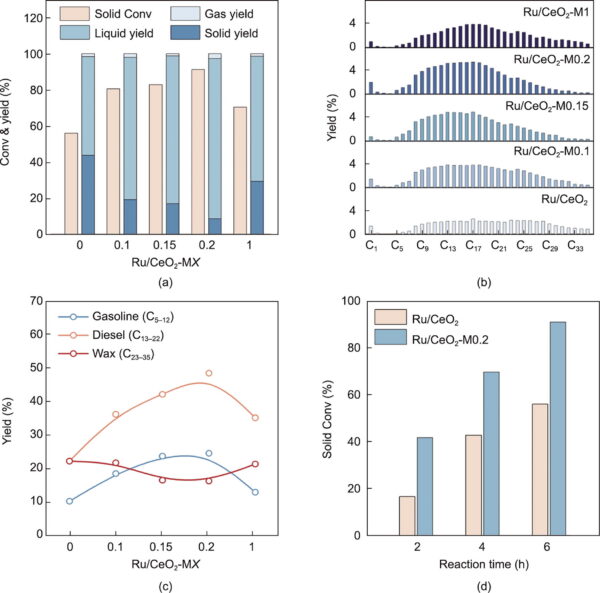
Researchers chose the Ru/CeO2 catalyst to further investigate coupling agent optimization. Figure courtesy of Entropy Engineering for the Efficient Hydrogenolysis of Waste Polyolefins.
Hydrogenolysis of Real-World Waste
Researchers evaluated hydrogenolysis performance of the optimal Ru/CeO2-M0.2 catalyst using various polyolefins. Tested materials included low-density polyethylene (LDPE), high-density polyethylene (HDPE), and polypropylene (PP). This method demonstrated high efficiency, achieving liquid fuel yields of over 70%. Researchers also conducted hydrogenolysis on real-world plastic waste with impurities and additives, such as bags, bottles, lids, and agricultural films. During these experiments, the catalyst maintained efficient hydrogenolysis activity and selectivity toward liquid fuels. This low-cost approach shows potential for performance optimization in industrial polyolefin recycling.

Having studied Geology, Julienne Smith focuses on environmentalism, sustainability, and the policies that impact plastics professionals today. As a technical writer, she is passionate about the intersection of science, technology, and communication. In her free time, she loves learning new things and writing fiction.