Mechanical Recycling of Polyolefins in Food Packaging
Regulations are encouraging the development of food-safe recycling methods for polyolefins.
In the European Union (EU), the Packaging and Packaging Waste Regulation (PPWR) specifies minimum post-consumer waste (PCW) requirements for certain applications. For food packaging, this amount is 10% by 2030. Polyolefins exhibit barrier properties against grease, oil, and aromatic compounds, making them a common choice for food packaging. The amount of recycled polyolefins meeting food-grade quality criteria must increase to meet regulatory requirements. Designing for recycling, improving sorting, and developing more effective washing technologies can help achieve this goal.
You can also read: AI Screens 7.4M Polymers for Recyclable Food Packaging.
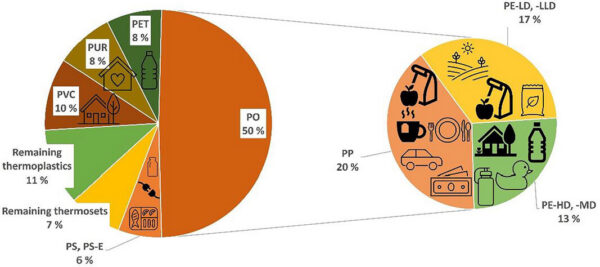
Polyolefins make up a large share of the EU’s market demand for plastic goods. Figure courtesy of An Overview of Enhancing Polyolefin Recycling in Food Packaging: Navigating New EU Regulations and Design for Recycling; data from 2021.
Use of Polyolefins in Food Packaging
Polyolefins have a low water vapor transmission rate (WVTR). This makes them suitable for food packaging, where protection from water ingress prevents early spoilage. Packaged fruits and vegetables continue to respire after harvest; thus, polyolefin packaging for these products requires perforation. Polyolefins’ low WVTR and good mechanical properties also make them a common choice for trays, cups, and dairy product packaging.
For certain applications, commercially-available recyclable polyolefin films can substitute traditionally non-recyclable materials. These films typically have a thin, high barrier layer (often ethyl vinyl alcohol) embedded in the middle. By combining strong barrier properties with good compatibility, these multilayer films provide excellent performance in certain applications.
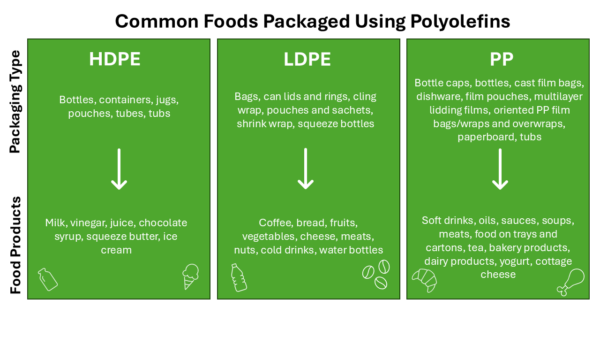
A wide variety of foods use polyolefin packaging. Figure generated by the author.
Recycling Polyolefin Food Packaging
Recent regulation in the EU emphasizes the need for developing and enhancing plastic recycling infrastructure for food contact applications. If decontamination of recycled plastic is insufficient, contaminants could endanger human health or affect the food. Thus, Regulation (EU) 2022/1616 requires recycled polypropylene used in food packaging to come from an EU-authorized recycling process.
Current EU sorting facilities cannot effectively separate food contact materials (FCMs) from non-FCMs. Advanced collection and sorting systems can remedy this, making recycled plastic more feasible in food contact applications. The PPWR sets recycling targets for food packaging and compels design-for-recycling (DfR), encouraging manufacturers to incorporate recycled polypropylene wherever possible. Currently, only one documented post-consumer recycled polyolefin approved for direct food contact is available on the market.
Developing Novel Technology for Recycling Food Packaging
The European Food Safety Authority (EFSA) assesses novel recycling processes to provide recommendations for FCM recycling. Recommendations are achievable if the process uses input materials originating from a closed-loop food contact system. Additionally, chemical migration analysis must satisfy EFSA guidelines to ensure there are no health hazards present.
Material design, sorting technology, and washing improvements can bolster the recycling of food-contact polyolefins. Mono-material design, for example, can replace traditional materials to promote ease of recycling. DfR guidelines provide rules for evaluating the compatibility of packaging elements for recycling. As research continues, these “living documents” continue to expand with added information.
Novel technologies coupling infrared (IR), artificial intelligence (AI), and water marking offer enhancements in waste sorting. New regulatory requirements continue to drive innovations in sorting research, improving recycled polyolefins for applications like food packaging. Additionally, improvements in washing show good mechanical improvement results for recycling polyolefins.

Having studied Geology, Julienne Smith focuses on environmentalism, sustainability, and the policies that impact plastics professionals today. As a technical writer, she is passionate about the intersection of science, technology, and communication. In her free time, she loves learning new things and writing fiction.