High-Viscosity Photopolymers Transform Additive Manufacturing
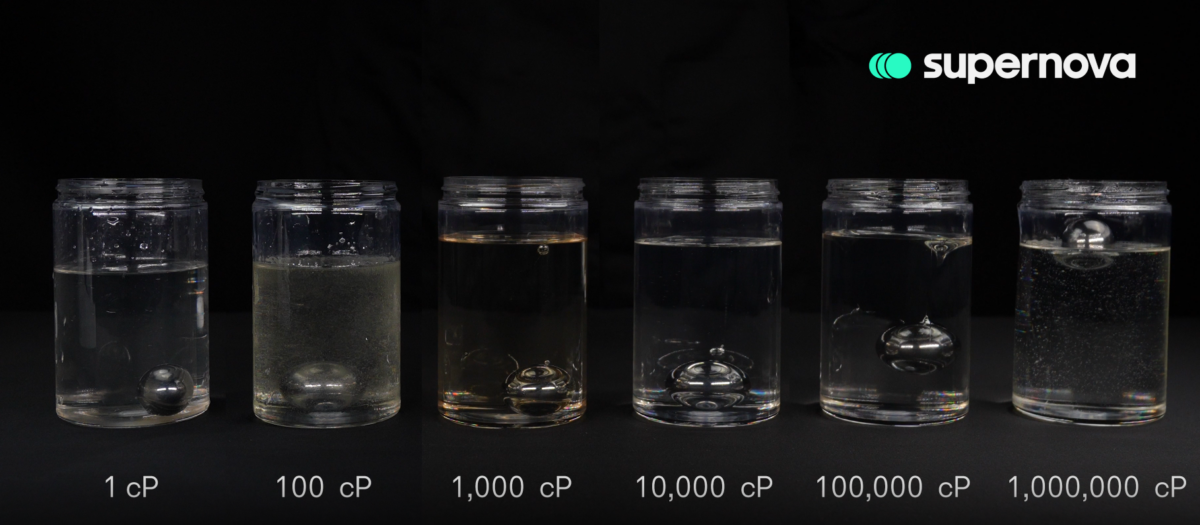
Advanced printing technologies from CubiCure and Supernova are redefining additive manufacturing with high‑viscosity photopolymer resins.
Key Points:
- 🚀 High-viscosity photopolymer technologies are pushing additive manufacturing closer to true production-scale performance, helping bridge the gap with traditional molding and forming.
- ⚠️ Traditional AM photopolymers face key limitations—including weak thermomechanical properties, anisotropy, and high VOC emissions—largely due to the need for low-viscosity formulations that compromise material performance.
- 🔬 New approaches using high molecular weight resins and advanced printing methods (like hot lithography and viscous lithography) enable stronger parts, better layer bonding, reduced emissions, and expanded material capabilities—including elastomers, flame-retardant plastics, and multi-material systems.
AM aims to match the scale and ubiquity of molding and forming processes. Companies like CubiCure and Supernova are enabling this shift through high‑viscosity photopolymer technology.
You can also read: High-Performance 3D Printing with Photosensitive PEEK Ink.
AM photopolymer resins have long leveraged existing adhesive and coating chemistry, accelerating resin development. However, despite resin development and hardware advances, photopolymer performance has often lagged behind that of traditional manufacturing materials. As a result, many AM photopolymers still fall short of thermoplastic standards, limiting end‑use adoption.
AM Photopolymer Limitations
Common AM photopolymer shortcomings include weak thermomechanical performance, severe anisotropy, and higher VOC emissions, raising product and chemical safety concerns. A key driver of these issues is the need to drastically reduce print viscosity, or the measure of resin flow during the print process. This trade secret and hardware-specific process is critical to ensure part geometry, throughput, and ultimate end use. High-viscosity resins tend to cause hardware issues, such as high delamination forces, leading to poor prints. To reduce print viscosity and improve final part geometry, formulators rely on low-molecular-weight oligomers and high levels of reactive diluents. Short-chained oligomers tend to dominate cured polymer performance, while reactive diluents drastically reduce print viscosity. This formulation approach addresses viscosity concerns but produces printed polymers with poor network architecture and effective molecular weight.
High Viscosity Solutions
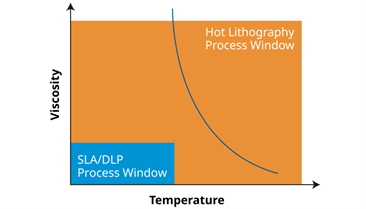
Comparing relationship between print process temperature and print viscosity of hot lithography and traditional SLA/DLP technology. Courtesy of CubiCure.
Incorporating higher molecular weight oligomers is a leading solution, improving mechanical characteristics and ultimately product safety. As molecular weight increases, so does the influence of an oligomer’s characteristics in final properties. This enables more uniform crosslinking, can reduce internal stress, supports stronger interlayer bonding layers, and reduces VOCs. Though high molecular weight may improve material performance, it also drives dramatic increases in print viscosity. This double-edged sword can be solved with tailored oligomer backbones, smartly designed reactive diluents in tandem with hardware innovations.
State-of-The-Art Technology
CubiCure
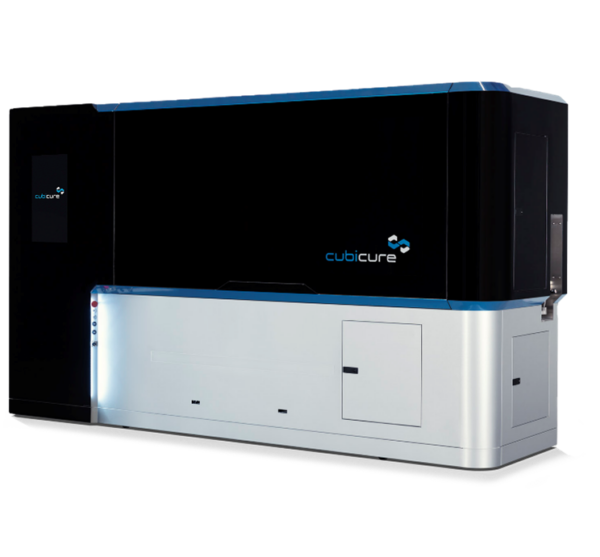
CubiCure’s Cerion production printer enabling hot lithography. Courtesy of CubiCure.
CubiCure, an award-winning Austrian additive manufacturing company, is a trailblazer for innovative high viscosity photopolymers and print technologies using hot lithography. Hot lithography is a heated stereolithographic production process, up to 100 °C, where layers are cured with UV light. This technology enables a broad material portfolio including industrial elastomers to high impact performance resins. Most recently, their expanded portfolio shows a rigid flame-retardant plastic for electrical applications and a high-resolution resin for dimensional accuracy of micro components.
To print high viscosity materials, CubiCure has developed two hot lithography printers for viscous photopolymers. Cerion, their industrial printer system, uses a unique carrier film method to deposit and cure resin per layer. Caligma, the smaller of the two printers, leans towards a more traditional SLA printer. Each hardware allows for printing up to 100 °C. This key hardware implementation enables viscous resin cure and optimal performance after post processing.
Supernova
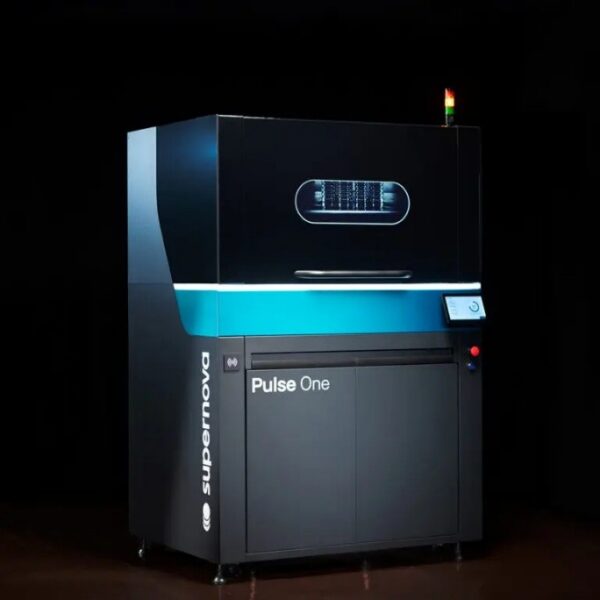
Supernova’s Pulse One production printer enables viscous lithography manufacturing. Courtesy of Supernova.
Supernova, a US headquartered company with Spanish roots, is also a trailblazer for viscous printing. Pioneering viscous lithography manufacturing (VLM), Supernova’s technology deposits precise viscogel laminates followed by a controlled photopolymerization. Viscogels are Supernova’s proprietary high‑viscosity photopolymers. Moreover, the VLM technique claims the ability to process materials of unlimited viscosity. This wide-ranging capability allows an impressive resin portfolio spanning rigid, high impact plastic to elastomeric, high tear strength silicone materials. Research materials are under development including unfilled dielectric ESD battery plastic and investment casting. Pulse One, Supernovas premier printer, showcases VLM technology on a production scale. This lamination-based technology unlocks multi-material printing, providing a potential alternative to traditional 2K over molding.Together, CubiCure and Supernova are expanding the boundaries of industrial AM materials and print technologies.

Jennifer Chavez is a chemist-turned materials scientist with expertise in advanced plastics manufacturing and experience spanning orthodontic medical devices, consumer products, and renewable energy. She currently works as a materials engineer in the aerospace sector, focusing on process development and compliance for flight-critical hardware.