Feedstocks for Light Olefins, Steam Cracking & Decarbonization
Feedstock choice shapes olefin yields, costs, and emissions, driving new strategies in steam cracking and petrochemical decarbonization.
Global ethylene and propylene production continues to grow, driven by the demand for polyethylene, polypropylene, and elastomers. At the same time, petrochemical complexes face increasingly severe cost and decarbonization pressures. In this context, the choice of feedstock and cracking technology has become a key aspect for competitiveness. It defines the olefin yield, the co-product balance, and the plant’s energy and carbon footprints.
You can also read: Dynamics in Polymer Production: U.S. and Middle East Perspectives.
Essential Raw Materials for Polymer Portfolios
The different alkanes influence the efficiency of the cracking process, the degree of petrochemical integration and the downstream polymer production strategy. It also defines the production profile of a petrochemical plant, directly impacting on the availability of olefins for polymers.
Producers derive Ethane from natural gas liquids, establishing it as the most efficient raw material for dedicated ethylene production. In steam cracking, it can achieve ethylene yields of 78–84% by weight. This production scheme makes it the preferred feedstock when the objective is to maximize polyethylene capacity with minimal operational complexity.
However, the predominant raw material worldwide is light Naphtha, which is a liquid fraction of the petroleum refining process. Despite its more modest ethylene yield, around 29 to 34% by weight, Naphtha’s great strength lies in its product flexibility. Thanks to this flexibility, a single cracking unit can produce ethylene, propylene, butadiene, and BTX aromatics. This translates into downstream integration into polyethylene, polypropylene, butadiene elastomer, and a wide range of aromatic-based resins.
Another interesting feedstock is LPG (propane and butane), which occupies an interesting intermediate zone. Since this gaseous stream is available in natural gas chains and during refining, it enables flexible operating schemes. Hence, producers can adjust the ethylene/propylene ratio by modifying process conditions. This is highly beneficial in the current context, where demand for propylene grows faster than for ethylene. In brief, LPG becomes a strategic candidate for closing polypropylene capacity gaps without relying exclusively on propane dehydrogenation.
In contrast, methane from natural gas, despite its abundance and low cost, presents substantial challenges for direct conversion to olefins. Routes such as synthesis gas reforming followed by methanol to olefins (MTO), or oxidative coupling of methane (OCM), remain technically complex. In many cases, these are not yet competitive with steam cracking from a CAPEX, OPEX, and reliability standpoint.
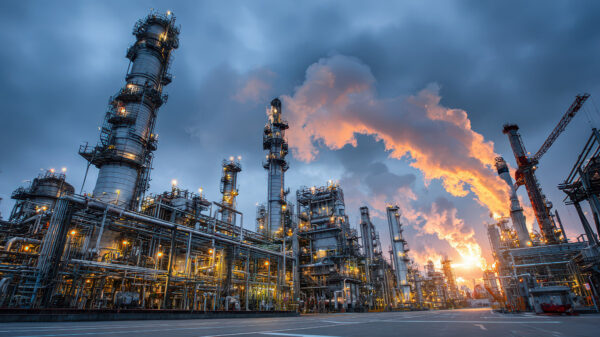
The dominant process for ethylene production remains steam cracking of ethane and naphtha, which accounts for 80% of global production.
Steam Cracking: The Heart of the Polymer Chain
Steam cracking is an energy and carbon intensive process strongly dependent on the fuel and efficiency of the unit. Companies conduct this process in tubular furnaces at elevated temperatures, between 800 and 860 °C, in the presence of steam. From a chemical point of view, it is a radical homolysis. The free radical chain reactions break the C–C bonds of saturated hydrocarbons to generate light olefins.
In the case of ethane cracking, the process favors highly specialized complexes of ethylene. In contrast, naphtha cracking generates propylene, C4 fractions, particularly butadiene, and aromatics. This difference has direct implications for petrochemical integration. While ethylene feeds large polyethylene (HDPE, LLDPE) and PVC chains, propylene forms the basis of polypropylene (PP) and various copolymers. For instance, manufacturers use butadiene from naphtha to produce synthetic rubbers, such as SBR and BR, widely used in tires.
Steam Cracking & Decarbonization Challenges
The industry is exploring alternatives to produce light olefins with less emissions. For instance, feedstock catalytic cracking on zeolite materials, particularly ZSM-5 and MFI structures, allows operation in windows of 500-750°C. This partially reduces the energy load, improves control of the propylene/ethylene ratio, and opens the door to selective operating schemes.
However, these processes involve many challenges. For instance, in steam cracking furnaces and in fixed or fluidized bed catalytic reactors, the main issue is coke formation. These carbon deposits on the walls of the furnace tubes reduce heat transfer efficiency. Therefore, furnaces require periodic shutdowns for decoking, strongly impacting equipment availability and maintenance costs. Similarly, in zeolite catalysts, coke forms inside micropores and outer surface, blocking access to acid sites and accelerating deactivation. Researchers seek to mitigate this phenomenon by designing hierarchical (micro-mesoporous) materials, acidity modification, and the use of promoter metals. However, they still need to make significant advances to achieve operating and regeneration cycles compatible with industrial scale.
At the same time, the discussion on decarbonization is becoming specific. Environmental assessments typically associate steam cracking production emissions around 1–2 tons of CO₂ per ton of ethylene produced. Of course, depending on the fuel mix, thermal efficiency, and degree of furnace electrification. Therefore, clear lines of development are the adoption of fully electric furnaces powered by renewable energy. Also, the integration of high-temperature heat recovery, and process intensification such as membrane reactors or integration of dehydrogenation stages.
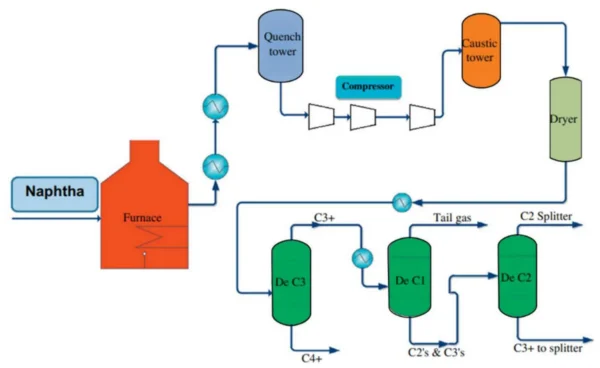
Typical Steam Cracking Block Diagram. Courtesy of A Review on the Production of Light Olefins Using Steam Cracking of Hydrocarbons. Open Access CC BY 4.0.
Towards Greater Flexibility and Smaller Carbon Footprint
A clear trend is the implementation of hybrid schemes. Here engineers add catalytic cracking units, typically fluidized bed, to existing complexes to increase propylene production. This prevents massive investments in new thermal cracking units. This is particularly attractive in regions where PP demand is growing faster than PE demand.
In contrast, routes based on renewable raw materials, such as bioethanol and biomethane, are beginning to move beyond academic curiosity. For instance, Bioethanol dehydrated to ethylene, or biomethane can produce olefins using processes similar to those for natural gas. This particularly opens the possibility of monomers with lower carbon footprints, potentially integrable into value chains for bio-based plastics. However, these alternatives currently face challenges in terms of cost, scale, and availability. For that reason, they are, for now, complementary to conventional steam cracking.
For the next decade, the challenges will be how to combine feedstock flexibility, emissions reduction, and operational reliability. Especially in a growing demand for clean-sustainable plastics, the key question is, how to transition to economically robust cleaner operations?

Carlos Ruidiaz is a mechanical and aeronautical engineer with experience in fluid systems design for Aero-Propulsion, Oil & Gas, and Power Generation.