
Carbon Fiber Production from End-of-Life Automotive Polymers
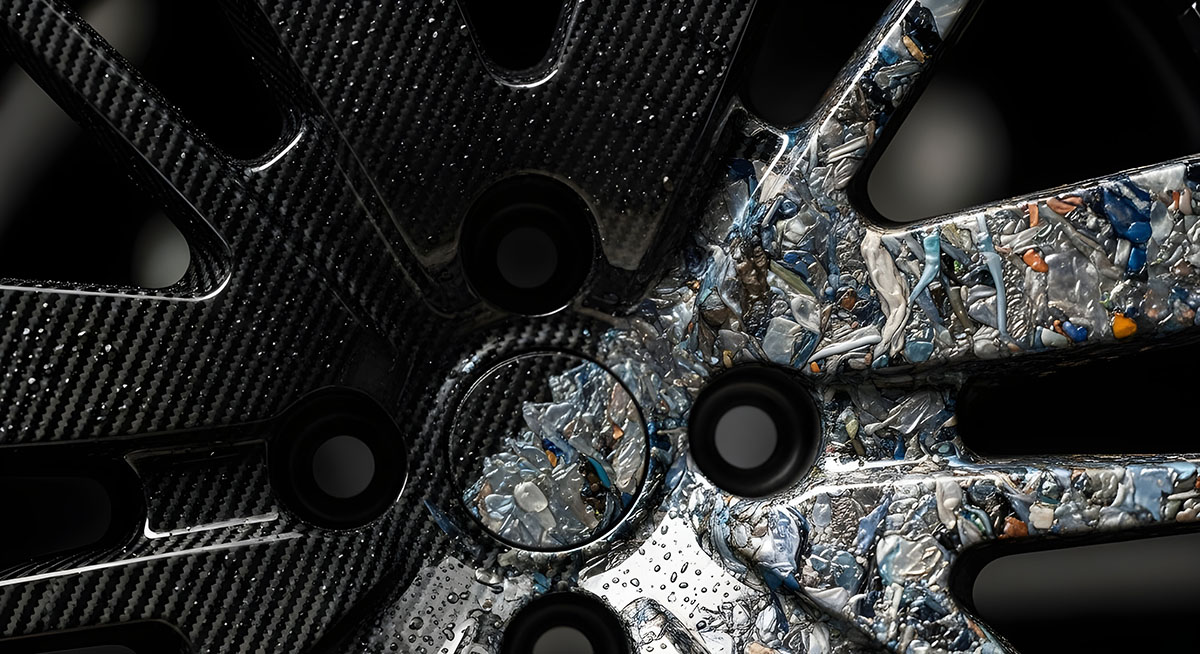
New method converts automotive PP waste and CFRP scrap into recycled carbon fiber composites with improved mechanical performance.
Every year, millions of vehicles reach the end of their useful life, and with them comes a growing environmental challenge. Certain vehicle parts rarely get a second life despite their potential for mechanical recycling and reuse. Bumpers, for instance, commonly made of PP, often end up in landfills due to difficulties in sorting and the lack of efficient recycling systems. Researchers also reveal that industries discard CFRP at an alarming rate. CFRP industries generate significant waste during manufacturing when performing cutting, trimming, and molding. This waste is commonly landfilled or incinerated despite retaining much of its original mechanical performance. Therefore, researchers successfully demonstrated the feasibility of solving both problems using an effective recycling strategy.
You can also read: Recycled PETG Powers Carbon Fiber Filaments for 3D Printing.
From End-of-Life Waste to Composite Feedstock
Engineers developed an injection-molded composite combining recycled polymer matrices from end-of-life vehicle polypropylene car bumpers (rPP) with rCF obtained directly from manufacturing scrap. The researchers thermally processed the rCF in a muffle furnace at 500-700°C and then reduced it with a rotary cutter to 5mm. They recovered the rPP from four different front and rear bumpers, some useful, some damaged, and some unusable. They estimated that the life of the bumpers exceeded 15 years of use in each case. Afterward, they mixed and reduced the rPP with a fiber cutting machine to a standard length of 200mm to clean it and grind it into 2-10mm shredded pieces, ready for compounding. Researchers also defined a baseline using the commercial-grade polypropylene Moplen HP400H.
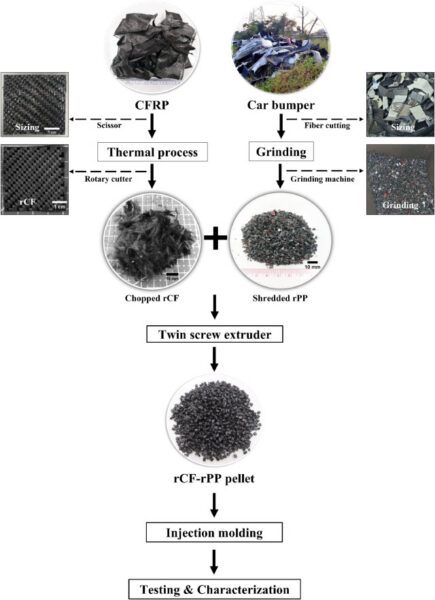
Schematic step of the recycling of CFRP by thermal process and the polypropylene car bumpers to obtain rCF-rPP composite material. Courtesy of Recycled composite materials from plastic parts of end-of-life vehicles mixed with recycled carbon fiber from automotive manufacturing waste.
To produce the composite material, the engineers studied three configurations with rCF content of 0, 5, and 10 wt.%. The 0 wt.% rCF specimens corresponded to 100% recycled car bumper mix. They dry mixed the rCF and the rPP before removing moisture at 80 ◦C for 4h, to later perform the compounding via a twin screw extruder. With this, they obtained pellets of 2-4mm, which they later shaped into specimens using an injection molding machine at an injection pressure of 1530 kgf/cm^2.
Thermal Treatment and Recycling Stability
Researchers evaluated the stability of the material using thermogravimetric analysis (TGA). In this method, they heated the samples from room temperature up to 800 °C under and controlled atmospheres. By measuring weight loss as a function of temperature, they determined when the material began to degrade and the percentage of residue remaining. With this, researchers then performed a full factorial design of experiment based on three levels of temperature and three holding times. They selected temperatures of 500, 550, and 600 ◦C and holding times of 30, 60 and 90min. The results showed that both factors significantly affect matrix degradation, while their interaction was negligible.
Mechanical Performance and Material Trade-Offs
After performing testing, researchers’ study reveals an optimized recycling of the carbon fiber through a thermal process at 500°C with a 60 min hold to achieve a clean fiber surface. With this configuration they were able to achieve an efficient balance between matrix degradation and fiber preservation. Prolonged exposure accelerated oxidation and surface damage, configurations that were determined unfeasible for use.
Research also showed that rCF enhances rPP mechanical properties such as tensile strength, flexural strength, tensile modulus, flexural modulus, and hardness when compared to no rCF content. Nevertheless, when compared to virgin PP the perspective is different. Findings are, nevertheless, interesting from an innovative point of view
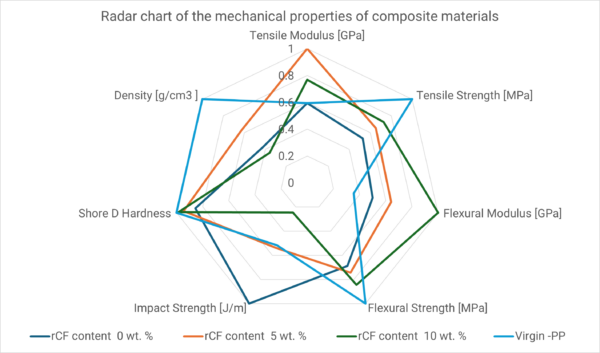
Novel method obtains results comparable to traditional methods highlighting the feasibility of sustainable solutions. Adapted of Recycled composite materials from plastic parts of end-of-life vehicles mixed with recycled carbon fiber from automotive manufacturing waste.
As a result, researchers provide that the addition of 5 wt.% recycled carbon fiber (rCF) yields the highest tensile modulus, indicating superior stiffness. While increasing the content to 10 wt.% leads to notable improvements in tensile strength, flexural strength, flexural modulus, and hardness. These enhancements translate into better load-bearing capacity and overall mechanical performance. Therefore, composites with 5 wt.% rCF are better suited for stiffness-driven, non-critical automotive components such as interior structures and housing. Whereas 10 wt.% rCF is more appropriate for load bearing and wear-resistant parts like brackets and battery enclosures. However, due to reduced impact resistance, higher rCF contents are not suitable for crash-critical applications.
Scaling Recycled Composites for Industrial Use
The novel method provides a valuable basis on complete recycled composite materials with a significant contribution in sustainable manufacturing. As industries yield for environmental impact reduction the method addresses a practical solution for waste management and improvement on energy efficiency. The recycling strategy delivers a contribution to a circular economy where materials have a second life and industries reuse their scraps rather than discarding valuable material.
Now, to implement this technology on an industrial scale, scientists will need to continue studies on the reduction of fiber degradation during recycling, enhancing interfacial bonding, and refining the processing parameters to improve composite performance. As well as studying the feasibility of manufacturing scalability and full life-cycle impacts.

Daniela Castaño is a mechanical engineer specializing in automotive and motorsport engineering, with experience in material testing, vehicle performance, advanced manufacturing, and emerging transportation systems.