
Renewable Functional Coatings for Advanced Applications
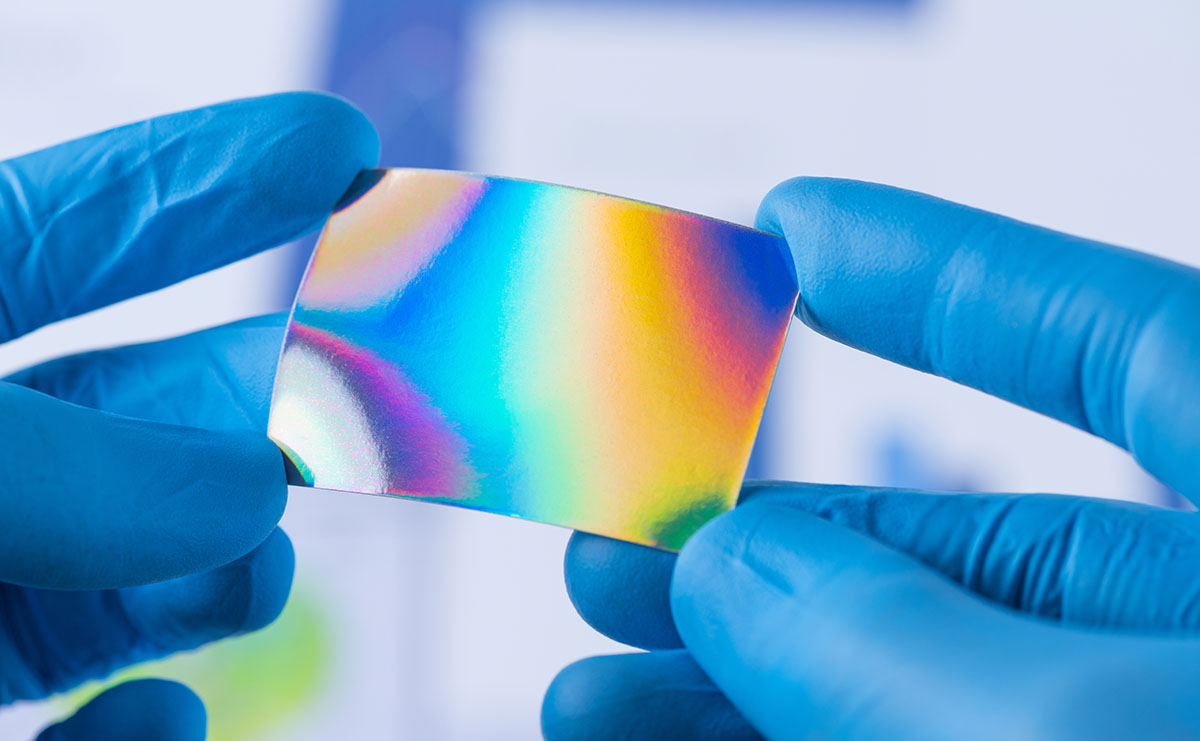
Coatings derived from renewable resources meet performance requirements while addressing environmental concerns.
Functional coatings protect plastic parts while enhancing their performance and applications. These coatings provide benefits such as abrasion or fire resistance, as well as self-healing, anticorrosive, and antibacterial properties. By developing and using functional coatings made from renewable resources, researchers and manufacturers can lessen their carbon footprint. Over recent years, advancements in renewable functional coatings have shown significant innovation in performance and sustainability.
You can also read: Advances in Sustainable Polymer-Based Anticorrosive Coatings.
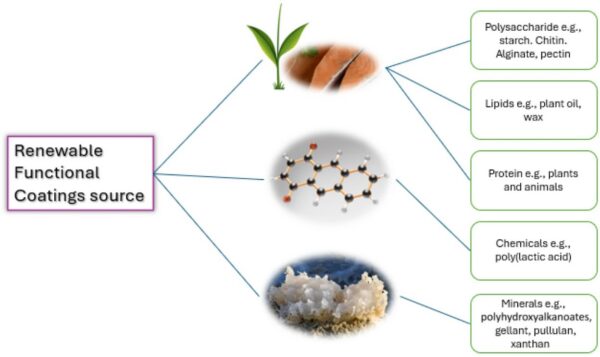
Renewable sources for functional coatings include bio-, mineral-, and chemical-based materials. Figure courtesy of Advancing renewable functional coatings: sustainable solutions for modern material challenges.
Bio-Based Resources for Functional Coatings
A wide range of sources provides functional coatings, each offering unique benefits and use cases. Bio-based polymers, such as polylactic acid (PLA), are both renewable and biodegradable. These are particularly beneficial for coatings for biodegradable packaging, textiles, and biomedical applications. Their synthesis is achievable through polymerization, chemical modification, or blending them with other materials.
Recent innovations have developed bio-based polymer coatings that can extend the shelf life of fruits. Advances in asphalt additives and shape memory polymers also leverage this technology, reducing dependence on fossil-fuel-based coatings.
Rosin: Cost Effective Functional Coatings from Tree Resin
Rosin, a resin produced by trees, is another example of a renewable source of functional coatings. It offers corrosion resistance, thermal stability, increased hardness, as well as visual enhancements from gloss and color. It is a low-cost material and thus also has use as a filler material. Recent research improved a rosin-based polymer film for biomedical implant devices. This film offers excellent biocompatibility and antimicrobial properties.
Water-Resistant Coatings from Natural Oils
Natural oils and fats, derived from plants and seeds, are ideal for water and corrosion resistance. These resources are abundant and are sourceable from waste materials, such as fruit peels. Chemical modifications, cross-linking, and nanoparticle integration can allow their use as coatings.
A 2020 study produced Real Michael-Addition paints comprised of 53% renewable content that demonstrated excellent moisture resistance. Researchers synthesized these paints from malonate-functional polyesters, acryloyl-functional oligomers, diethyl malonate, isosorbide, and vegetable oils.
The Future of Renewable Functional Coatings
Already, certain renewable functional coatings have achieved commercial success. Some polyurethane coatings available on the market, used in automotive and industrial applications, incorporate soybean oil-based polyols. Epoxidized soybean oil also has use in epoxy-based coatings, where it increases sustainability in flooring and protective linings.
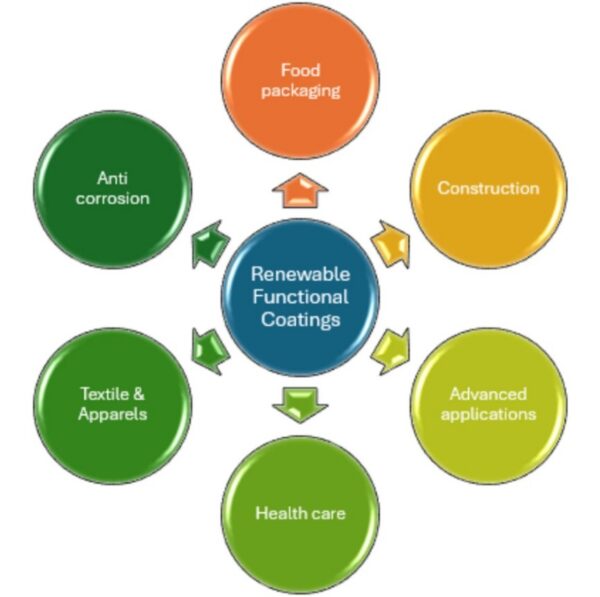
Manufacturers can use renewable functional coatings in a wide range of applications as a substitute for fossil fuel-based coatings. Figure courtesy of Advancing renewable functional coatings: sustainable solutions for modern material challenges.
To further commercial viability, renewable functional coatings must achieve equal or superior performance, scalability, and cost to conventional coatings. Advancements in material science continue to bolster the possibilities for these alternative coatings.

Having studied Geology, Julienne Smith focuses on environmentalism, sustainability, and the policies that impact plastics professionals today. As a technical writer, she is passionate about the intersection of science, technology, and communication. In her free time, she loves learning new things and writing fiction.