
RecyQMeter: Quantifying Recycled Plastic Quality

A newly developed, open-access tool helps plastic recyclers pinpoint appropriate market applications.
Recycling methodology and waste composition can influence the quality of recycled plastics. Many plastic parts require specific grades or amounts of virgin plastic to maintain quality in their specific application. Additionally, regulations may require manufacturers to incorporate certain amounts of recycled plastic into new materials. To help stakeholders in academia and industry more easily assess the quality of recycled plastics, researchers have developed RecyQMeter.
You can also read: Flexible Packaging: Collective Testing Delivers New Insight into Real-World Recycling
RecyQMeter is a tool that analyzes recycled compounds, or recyclates, to evaluate their useability for manufacturing. This tool enables users to easily leverage quality quantification frameworks based in existing scientific literature. It standardizes calculations based on the Quality Model for Recycled Plastic (QMRP) and Recycling Quality (RQ) models. This provides users with consistent data that can help them choose the best sources of recycled plastic.
QMRP and RQ: A Framework for Calculating Quality
The QMRP and RQ are two methods for quantifying recycled plastic quality. The QMRP model compares the properties of recycled plastic to ideal values using a non-linear function. If one of the quality properties evaluates to zero, the overall quality will also be zero. The RQ model defines the values RQproc (quality during manufacture) and RQmech (quality of the final material). This model outputs a value score between zero and one, with a score closer to one indicating higher quality. The use of different functions can influence this model’s sensitivity to deviations. Developers used aspects from both models as the underlying framework of the RecyQMeter tool.
How Does it Work?
RecyQMeter uses three categories of properties to assess material quality. These include processing properties of the material, mechanical properties of the material, and functional properties of the product. These categories are the user’s input to the system.
With this input, it uses application-specific scoring functions and the merged calculation model to calculate material quality. RecyQMeter uses different scoring functions depending on each property type, then calculates a total quality score.
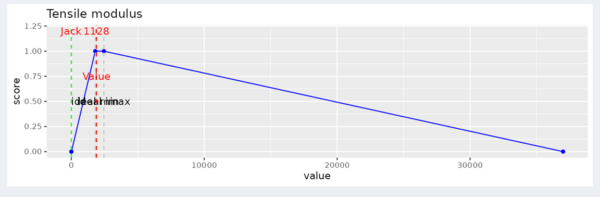
Tensile modulus is an example of a scorable property using RecyQMeter. Figure courtesy of RecyQMeter: Application-specific quality of recycled plastics.
Users of the tool can select whether to use a go/no-go criterion during score calculation. If they choose to do so, one quality score equaling zero will yield a zero for the overall score.
RecyQMeter User Experience
When using RecyQMeter, users can select a product based on polymer type, process, sector, application, and sub-application. They can also add preferred properties, such as ideal values, ranges, and weights. Additionally, researchers can add property values from experiments on recycled plastics, further expanding the amount of available data.
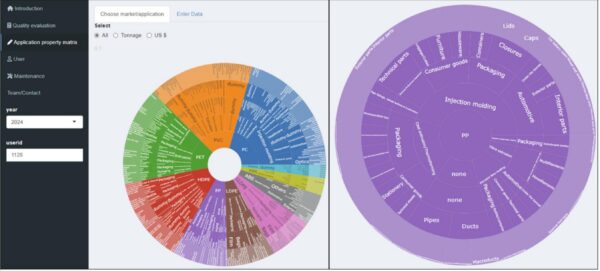
RecyQMeter offers an easy-to-navigate user interface when selecting products. Figure courtesy of RecyQMeter: Application-specific quality of recycled plastics.
Uses for the RecyQMeter Tool
The RecyQMeter tool is open access, making it readily available to academia and industry. It can benefit lifecycle assessment (LCA) studies by providing guidance for applying substitution factors. Additionally, RecyQMeter can help identify suitable recycled plastic feedstocks to help businesses meet recycled content requirements. This tool contributes to the harmonization of concepts in the recycling sector. By standardizing quality scoring, RecyQMeter can reduce inconsistencies in LCA studies and provide valuable, quantitative information to industry stakeholders.