
Recycled Carbon Fiber from Automotive Waste

Automotive recycling combines EOL bumpers with carbon fiber scraps. This rCF-rPP composite increases stiffness and diverts plastic from landfills.
Plastic components from EOL automobiles, such as bumpers, often end up in the landfill. Tangentially, the carbon-fiber reinforced polymer (CFRP) industry generates significant manufacturing waste. Manufacturers primarily dispose of CFRP scraps from automotive, aerospace, and industrial applications in landfills or incineration plants.
Finding recycling pathways for this valuable material is a significant area of study. One such pathway is a composite comprised of EOL car bumper plastics and recycled carbon fiber (rCF). This composite reduces waste while enhancing mechanical performance, with potential applications in non-critical automotive parts and other commercial applications.
You can also read: Lightweight Suspension Design with Polymer–Metal Hybrids
Composite from Carbon Fiber and Car Bumpers
To create the composite, researchers obtained carbon fiber scrap from manufacturing plants. They sourced four brands of discarded car bumpers from a car garage company in Thailand. Additionally, they purchased commercial-grade polypropylene (PP) to compare the mechanical properties of virgin material to those of the recycled bumpers.
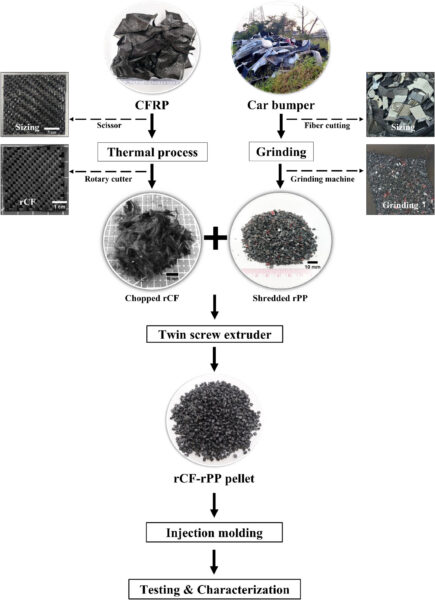
Researchers prepared each material to obtain the rCF-recycled polypropylene (rPP) composite. Figure courtesy of Recycled composite materials from plastic parts of end-of-life vehicles mixed with recycled carbon fiber from automotive manufacturing waste.
The study conducted tensile, flexural, impact, and hardness testing, and measured the density of the composite. They found that carbon fiber recycling was achievable at 500 °C with a 60 min holding time. These parameters were optimal for obtaining a clean fiber surface.
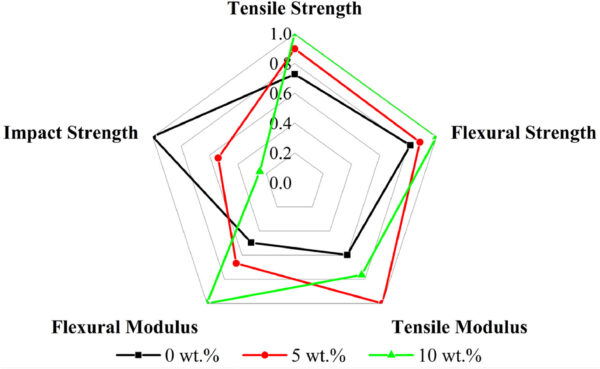
Researchers assessed five properties of the composite at 0, 5, and 10 wt.% rCF. Figure courtesy of Recycled composite materials from plastic parts of end-of-life vehicles mixed with recycled carbon fiber from automotive manufacturing waste.
Fourier transform infrared spectroscopy (FTIR) determined whether the manufacturers of the bumpers coated them before disposal. The bumpers from all four brands exhibited transmittance peaks in the range 1,725-1,730 cm-1. This peak was absent in virgin PP and new, unpainted bumpers. These additional functional groups likely originated from the bumpers’ surface coatings, curing agents, and/or additives from their paint.
Two Components, Working Synergistically
Generally, composites made from virgin materials exhibit greater mechanical performance than those made with recycled plastics. However, testing showed that the rigidity of this recycled composite increased as the rCF content rose. In this system, rCF contributes high stiffness and mechanical reinforcement. Meanwhile, the rPP from the car bumpers provides the necessary ductility and processability. Together, these two components result in a value-adding material that creates a new avenue for two distinct automotive waste streams.
Materials for Sustainable Vehicle Manufacturing
As automakers strive to reduce their environmental impact, composites like this one can help reduce waste. Recycling polypropylene automotive components diverts them from the landfill. Carbon fiber is challenging to recycle, and energy-intensive to manufacture. By enhancing rPP’s performance with waste carbon fiber, auto manufacturers can reduce the need for the extraction