Digitalization and Simulation: Redefining What is Possible
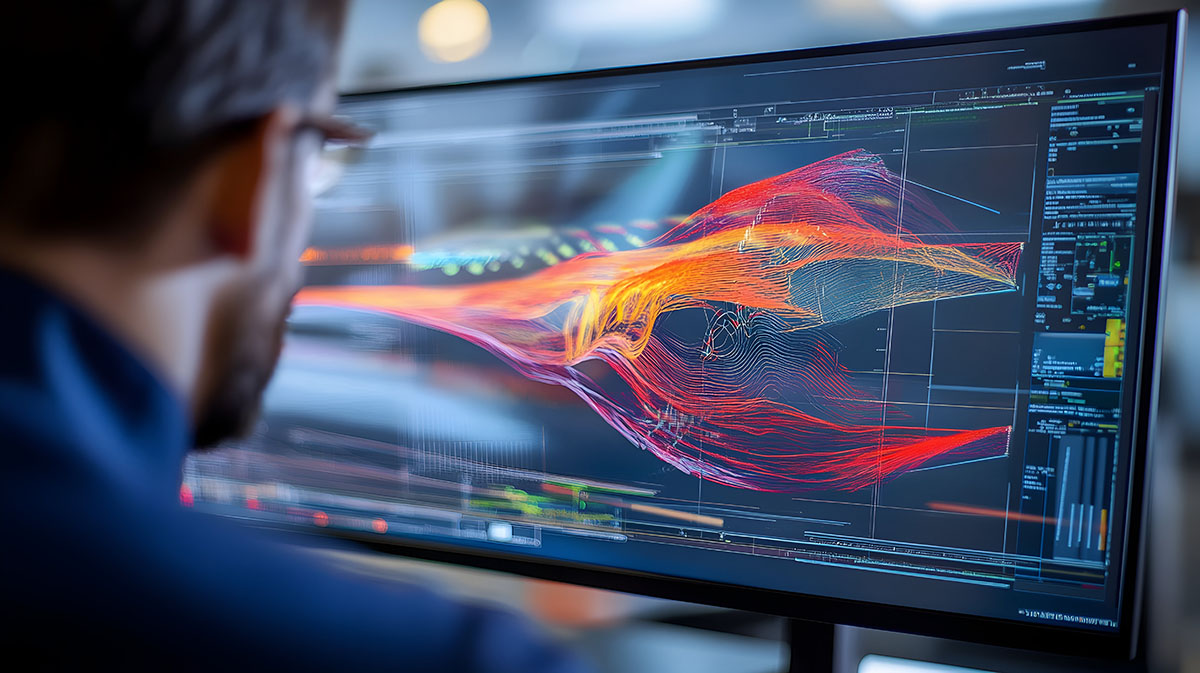
AI-aided polyurethane simulation reduces modeling time from days to seconds. Digital material twins optimize tool design and predict foaming behavior.
In this third article of our series, we review how digitalization partners with simulation to empower material development and troubleshoot production parameters. While simulation has supported plastics processing for over three decades, the introduction of AI marks a new revolution. Specifically, this new era combines high-performance computing with machine learning to reduce simulation times from days to mere seconds.
Why Simulate Polyurethane (PU)?
PU is formed through a reaction between isocyanates and polyols, commonly processed via reaction injection molding (RIM). Because this process is highly complex, manufacturers must avoid air traps and achieve a homogeneous density distribution. Furthermore, engineers often need to tailor foam density to achieve specific rigidity levels within a single mold.
In complex automotive parts, it is necessary to identify where air traps may occur to implement appropriate venting. Additionally, external conditions such as ambient humidity or altitude can require immediate adjustments to the production setup. By using a predictive model, processors can anticipate variations in chemistry and curing, effectively reducing scrap.
Building a Material Digital Twin
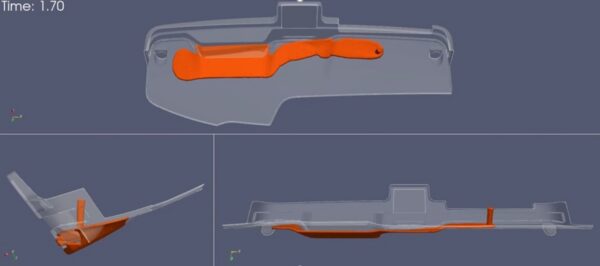
Simulation software predicts the foaming process in an instrument panel. The model can predict the foaming process and material behavior. Image courtesy of Bayfill® technology from Covestro.
Companies like Covestro have developed proprietary material models coupled with powerful computing to create a “Digital Twin” of the foaming process. Notably, predicting reactive PU flow involves multi-physics computational fluid dynamics based on Navier-Stokes equations. Consequently, the model must track CO2 formation, volume changes, and chemo-viscosity over time and space.
Through this digital twin, processors identify the best tool design and define process parameters early. In this way, they calibrate the optimum processing window, including filling points, tool temperature, and venting layout, without conducting expensive physical experiments.
How to Generate a Digital Twin
The generation of a Digital Material Twin follows a four-step process:
Formulation: Understanding the specific PU mixture.
Experimentation: Analyzing how the system behaves under changing production conditions.
Validation: Comparing the model against real-life applications.
Optimization: Adjusting the model through high-performance computing until it mirrors observed behavior.
A New Era: Combining AI with Simulation
While accurate, conventional Digital Material Twins can require up to three days of computation across hundreds of cores. To solve this, the next goal is to implement AI systems that predict outcomes instantly. Specifically, Covestro generated an automated workflow to create simulation training sets for an AI model.
In a 2D pilot study, researchers performed 300 simulations to train the AI. As a result, the AI model can now predict air traps and flow front growth in just 10 seconds—a task that previously took hours. Ultimately, this speed enables real-time troubleshooting on the production floor. If an operator faces a quality issue, they can use an AI tool on a laptop to get results within seconds, drastically changing the pace of decision-making in plastics processing.