Beyond Flaps: How Composite Skins Enable Morphing Wing Design

Morphing technology is key to green aviation, enabling real-time adaptation that significantly improves aerodynamic efficiency.
Traditional aircraft design optimizes performance for a single phase of flight. This phase is cruise, and aircraft use discrete surfaces such as flaps and slats for other phases or conditions. The concept of morphing refers to a structure’s ability to undergo continuous geometric changes. In this way, the mission profile can be optimized at all stages. In short, advanced polymeric and composite materials are the foundation upon which engineers are building the more efficient NGA.
You can also read: Polymers Take Flight: How Plastics Are Powering eVTOL Design.
Polymeric Materials and Composites as Technical Enablers
Engineers can combine structural properties with adaptive flexibility to break away from the limitations of traditional designs and materials. Aero-structural researchers are currently working with the following types of materials for structures and skins.
- Shape Memory Polymers (SMP) and Composites (SMPC): These materials can remember their original shape and return to it after the deforming effect of thermal or electrical stimuli. This makes SMPCs particularly attractive for wing skin applications with variable stiffness.
- Carbon Fiber Reinforced Polymers (CFRP) and Nanocomposites (PNC): CFRPs offer a high strength-to-weight ratio and directional properties that engineers can exploit through aeroelastic tailoring. This directionality allows for the induction of preset couplings between bending and torsion. Additionally, the use of polymer nanocomposites (PNC) promises further increases in structural stiffness and strength.
- Elastomers for Flexible Skins & Internal Structure: The surface must remain smooth and continuous even with high deformation, which requires skins with low elastic modulus. For example, natural rubber or silicone are strong candidates for tightly conform to the internal lattice structure. The final goal is to prevent surface discontinuities that would increase aerodynamic drag.
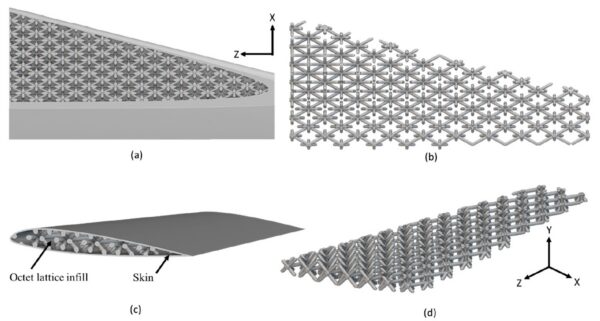
Morphing wing architecture based on octet lattice: (a) structural integration, (b) adaptive topology, (c) configuration with flexible skin, (d) three-dimensional representation of lattice structure. Courtesy of Non-Conventional Wing Structure Design with Lattice Infilled through Design for Additive Manufacturing.
Design Considerations
The technical revolution of these materials and advanced mixtures requires continuous integration between structure, performance, and detection. From this perspective, lattice structures offer advantages such as spatial variation of material properties, better called functional grading. Advanced additive manufacturing techniques such as Digital Light Synthesis (DLS) achieve these structures. The main goal is to design unit cells with locally varying beam dimensions and thickness. Thus, the wing can be rigid at the root (high loads) and highly flexible at the tip (high torsion and displacements). On the other hand, the use of bistable laminated composites allows the structure to support two stable configurations. So, continuous energy input is no longer a necessity, which optimizes the consumption of the actuation system.
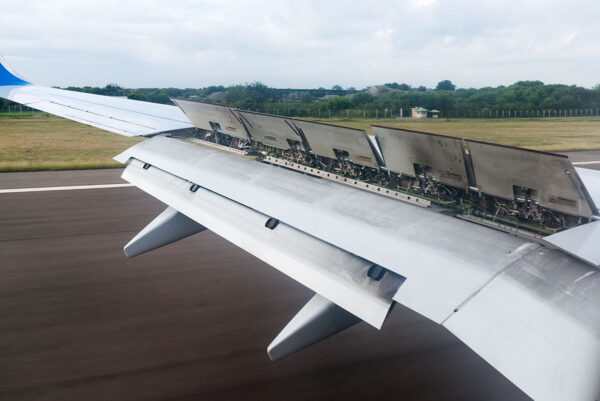
Current actuation systems are based on discrete control surfaces. The aeroelastic design of morphing wings is significantly more complex when moving from discrete surfaces to continuous surfaces.
Impact on Aerodynamic Efficiency
Not using hinges or gaps reduces parasitic drag and flow separation. In addition, continuous camber control feature allows the aircraft to adjust the lift coefficient and minimize drag at various speeds. Recent studies show 23% reductions in drag on variable-span UAV wings and improvements in the lift-drag ratio. Finally, projects such as NASA’s ACTE have achieved a 30% reduction in noise during takeoff and landing. This has been the result of eliminating gaps in conventional flaps using flexible composite skins.

Carlos Ruidiaz is a mechanical and aeronautical engineer with experience in fluid systems design for Aero-Propulsion, Oil & Gas, and Power Generation.