
Artificial Rattan: Furniture from PolyAl
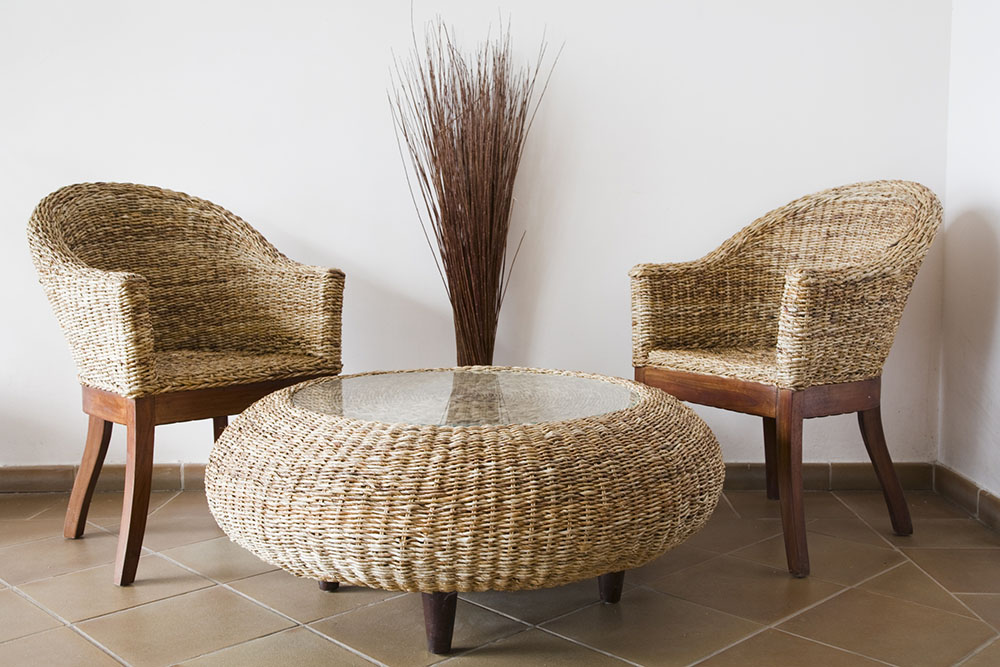
Recycled PolyAl beverage cartons are finding new life as design-forward furniture.
Researchers are finding innovative ways to upcycle plastic waste into valuable products across various sectors. One example is artificial rattan: a durable material used for furniture. Designed to mimic natural rattan, artificial rattan is typically comprised of polyethylene (PE), high-density polyethylene (HDPE), and polyvinyl chloride (PVC). As a sustainable alternative, researchers developed an artificial rattan from “PolyAl”, comprised of PE film and aluminum layers. PolyAl, commonly used for beverage carton packaging, is difficult to recycle. Through thoughtful and creative designs, such as artificial rattan, this material can be converted into useful new products.
You can also read: Turning Coffee Waste into 3D Printed Furniture.
End-of-Life Plastics as a Material Source
To create artificial rattan, researchers sourced PolyAl from used beverage cartons. They processed the plastic film and aluminum layers of the PolyAl into plastic pellets. Researchers also assessed recycled plastics from plastic bag manufacturing scraps, discarded bottle caps, and food packaging scraps for the composite. These comprised linear low-density polyethylene (LLDPE), high-density polyethylene (HDPE), and polypropylene (PP), respectively. Natural fiber from discarded bamboo chopsticks from restaurants served as a natural reinforcement for the material.
Preparing the Artificial Rattan Material
Researchers mixed the PolyAl with recycled LLDPE, HDPE, and PP, then compounded it at 190 °C using a twin-screw extruder. The optimal blend of PolyAl and recycled plastic was 30/70 PolyAl/PP. Adding more than 30 wt% PolyAl showed only minor improvements to stiffness while subsequently decreasing impact strength. Thus, researchers selected this compounding ratio when adding bamboo particles and coupling agent polypropylene-graft-maleic anhydride (PP-g-MA). The coupling agent served as a compatibilizer, improving interfacial bonding between the plastic composite and bamboo particles.
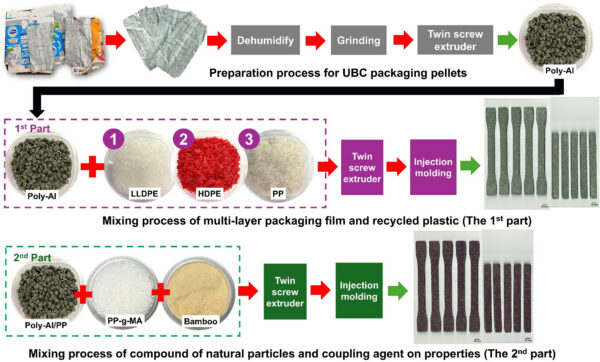
The experiment consisted of two parts, the second of which involved the addition of bamboo particles to the composite. Figure courtesy of Hybrid artificial rattan from upcycled multi-layered packaging waste and natural fibers: Toward sustainable material innovation.
The bamboo particles functioned as short-particle reinforcement with an average length of 168.7 ± 68.4 µm. The PolyAl/PP + bamboo 5 wt% + PP-g-MA 3 wt% composite showed the best mechanical property enhancements. Nevertheless, the material demonstrated limited impact strength. This material shows the greatest potential for applications where structural strength and flexural performance are a priority.
Creating Artificial Rattan Strips
To fabricate the material into artificial rattan strips, researchers employed a screw-type extruder. These strips showed comparable performance to commercial rattan.
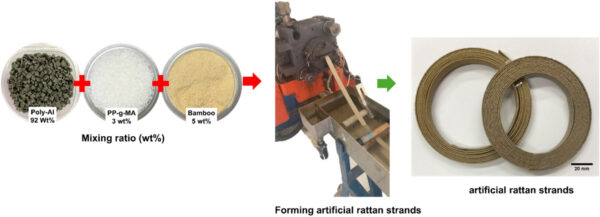
Using a screw-type extruder, researchers produced strands of artificial rattan. Figure courtesy of Hybrid artificial rattan from upcycled multi-layered packaging waste and natural fibers: Toward sustainable material innovation.
Artificial rattan is a popular material for indoor and outdoor furniture. By leveraging recycled plastics, this composite offers an alternative to conventional materials, with potential for commercialization. This material also has potential for other rigid, load-bearing applications that prioritize stiffness and strength.

Having studied Geology, Julienne Smith focuses on environmentalism, sustainability, and the policies that impact plastics professionals today. As a technical writer, she is passionate about the intersection of science, technology, and communication. In her free time, she loves learning new things and writing fiction.