
The Hidden Financial Cost of Non-Recyclable Polymer Design
Non-recyclable polymer design destroys terminal value. Examine how NPV and IRR metrics can address structural financial distortions in plastics.
A material choice is, in practice, a financial one. Designing for non-recyclability sacrifices residual value for short-term savings, effectively stripping embedded capital from the polymer value chain.
As Design from Recycling (2023) emphasizes, material choices made during product development determine whether polymers are returned to high-value applications or permanently downcycled into low-margin uses. The authors argue that upstream design decisions, rather than recycling technology, constrain recyclability by shaping material quality and economic recoverability.
From a financial perspective, these constraints affect long-term cash flows and residual value. The study shows that investments in advanced sorting and recycling lose value when polymer design prevents recycled materials from meeting performance standards.
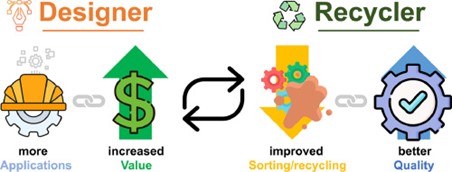
A simplified representation of how polymer design choices allocate value: good design expands applications and preserves capital; poor design collapses recyclability and destroys value downstream Courtesy of Design from Recycling.
A simplified representation of how polymer design choices allocate value: good design expands applications and preserves capital; poor design collapses recyclability and destroys value downstream Courtesy of Design from Recycling
From a capital-allocation perspective, non-recyclable design choices reduce return on invested capital not only for recyclers but across the entire polymer value chain. These decisions push costs downstream and reduce the economic viability of circular material flows. Evidence from recycling economics supports this view.
Studies such as The Economics of Recycling show that recycling delivers cost savings and competitive advantages only when material streams maintain consistent quality. The research finds that contamination and complex materials increase costs, reduce output, and shrink recycling margins.
Why Markets Keep Getting This Wrong
The MDPI Sustainability study identifies a structural distortion in recycling markets. Features like polymer blends, pigments, and multilayer packaging raise recycling costs, but product-level financial analysis rarely reflects them. As a result, market signals fail to reflect the true economic impact of design decisions.
From a financial perspective, this dynamic represents a classic externalization of lifecycle costs. Producers capture short-term savings, while recyclers, municipalities, and society absorb downstream financial burdens. Lawal shows that these distortions weaken recycling markets, lower secondary material prices, and threaten the long-term viability of circular systems.
You can also read: Plastic Waste Solutions: Key Trends in Developing Economies.
Applying NPV and IRR to Material Innovation
If firms applied standard capital budgeting rigor to polymer design, three valuation factors would become unavoidable:
- Terminal Value and Resale Potential: Recyclable polymers retain residual value after their first use. Non-recyclable designs implicitly assume a terminal value of zero, even though they contain recoverable energy and raw resources that better design choices could preserve.
- Risk Premiums and Regulatory Obsolescence: Non-circulating materials face rising market and regulatory risk. As recycled-content mandates expand globally, ignoring these risks understates downside exposure and inflates projected returns on “cheap” but non-recyclable resins.
- Cash-Flow Durability: Design choices that degrade recyclate quality hurt recycling margins and deter infrastructure investment. High-quality upstream design increases input predictability and reduces the volatility of secondary material markets.
You can also read: Plastics Compliance Becomes a Business Imperative.
The Shift to Bio-Based Value
Innovative producers are now transforming agricultural byproducts, such as pineapple leaves and pomegranate peels, into value-adding inputs for biodegradable packaging. Utilizing biopolymers like PLA (Polylactic Acid) allows firms to move away from high-risk, non-recyclable petroleum-based designs.
Current accounting practices allow non-recyclable designs to pass capital thresholds because they ignore end-of-life impacts. What seems rational at the product level destroys value at the system level. To remain competitive, firms must incorporate terminal value and risk exposure into every resin specification.
Recoverability and Resale Potential
Recyclable polymers retain residual value after first use and can re-enter secondary markets. Non-recyclable designs, by contrast, implicitly assume a terminal value of zero, even though they still contain recoverable material and embedded energy that better design choices could preserve.
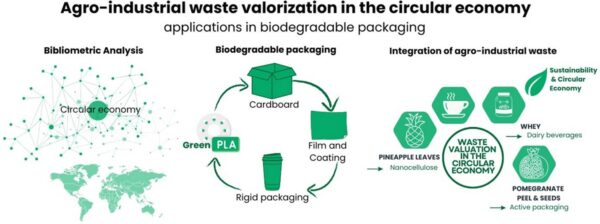
Producers can transform agricultural products such as pineapple leaves, whey, and pomegranate peels into value-adding inputs for biodegradable packaging applications, including films, coatings, and rigid packaging based on biopolymers such as PLA. Courtesy of Cleaner and Circular Bioeconomy.
Risk Premiums Reflect Regulatory and Obsolescence Risk
Non-circulating materials face rising market and regulatory risk as recyclability rules and recycled-content mandates expand. Ignoring these risks understates downside exposure and inflates projected returns.
Design choices that lower recyclate quality hurt recycling margins and deter infrastructure investment, as emphasized in Design from Recycling. These upstream design decisions reduce long-term cash-flow predictability and increase input volatility.
Current accounting practices let non-recyclable designs pass capital thresholds because they ignore end-of-life costs and system impacts. What seems rational at the product level destroys value at the system level. Firms must incorporate terminal value, risk exposure, and cash-flow durability into design decisions.