
Sorting Construction Waste in Real Time

Researchers are fine-tuning computer vision systems to help identify and sort plastic waste on construction sites.
Construction and demolition (C&D) activities are major sources of waste, including plastic waste. Due to time constraints and cost limitations on construction sites, plastic scraps often become contaminated and eventually landfilled or incinerated. Additionally, manual sorting processes often overlook recyclable plastics. To improve the recovery and reuse of construction plastics, researchers developed a tool to automatically sort C&D waste onsite.
You can also read: Hard-to-Recycle Plastics – Facing The Challenge.
Construction-Focused Computer Vision
To create the tool, researchers began by compiling a dataset of images and photographs of active construction and renovation sites. These images captured a range of lighting and environmental conditions, including those taken outdoors and indoors. Having a variety of realistic images in the underlying dataset improves accuracy for computer vision-based machine learning tools. This is especially crucial for real-time, real-life monitoring, such as on a construction site.
The dataset categorized seven major objects frequently found on construction sites. These object classes included Bucket, Cable, Drum, Insulation, Liquid Container, Pipe, and PVC Profile. The PVC Profile object included various structural components made of polyvinyl chloride (PVC). Researchers used the Roboflow platform to annotate the images.
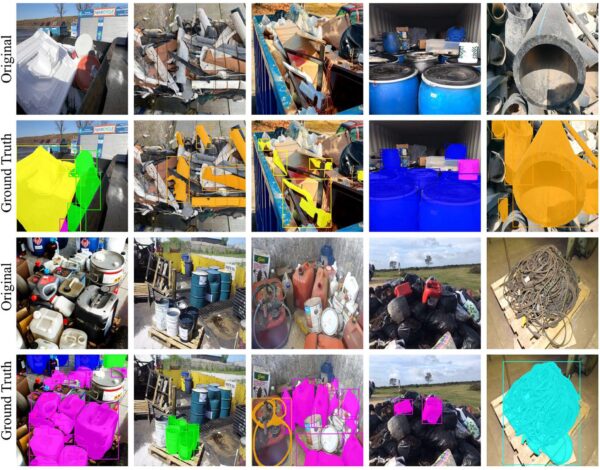
Images in the dataset showed construction waste in real-world environments to improve accuracy. Figure courtesy of Real-time plastic waste segmentation for sustainable resource recovery in construction.
Identifying Recyclable Plastics
Using computer vision and machine learning, the tool successfully provided insights into C&D waste scenes. The Drum object class had the highest rate of success for identification by the model, even when contaminated or deformed. PVC Profile objects were more challenging for the model due to pipe segmentation and disjointedness in images. The PVC Profile category contains objects with a variety of shapes and sizes. Thus, the model had difficulty segmenting these objects within highly cluttered scenes.
An EigenCAM (Class Activation Maps) visualization illustrated which parts of the images contributed most strongly to the model’s predictions. This provides insights into the model’s decision-making process, as well as where detection errors may have occurred. EigenCAM visualizations can help researchers identify potential bias and further refine dataset design and model training.
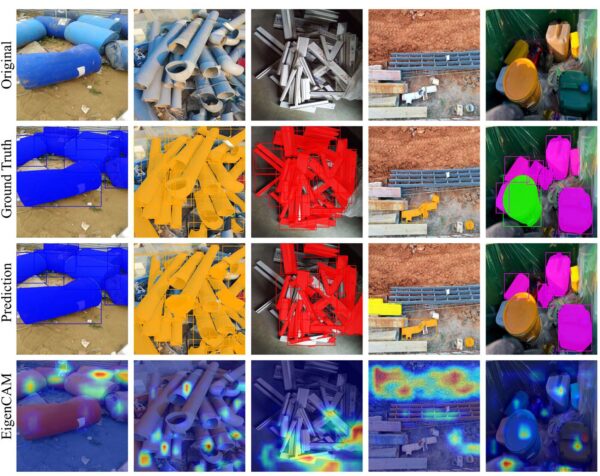
The model successfully distinguished individual plastic objects in images of construction sites. Figure courtesy of Real-time plastic waste segmentation for sustainable resource recovery in construction.
Tradeoff: Speed and Accuracy
Researchers developed this technology with the intention of practical deployment in automated waste sorting systems. Because of this, they choose a real-time architecture optimized for speed and efficiency. Researchers compared the results with a more accurate instance segmentation framework, Mask2Former, in an additional experiment. Though its speed was slower, Mask2Former demonstrated potential for higher accuracy using the same dataset.
Potential for Real-World, Real-Time Applications
Incorporating this model into real-world waste treatment systems will demonstrate its feasibility in identifying C&D waste in real time. The model shows potential for assisting in automated waste sorting, as well as for integration with robotic sorting systems. Nevertheless, future research may seek to improve performance of the model, especially in highly cluttered scenes.