
Self-Healing Coatings for Automotive Applications
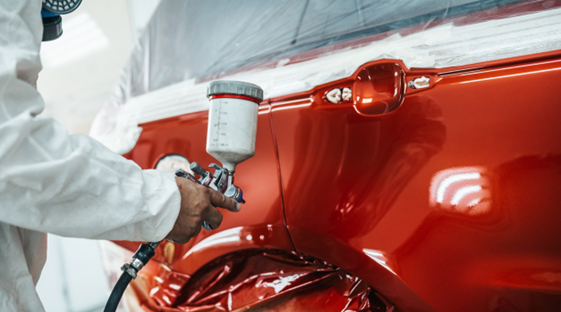
Photothermal-responsive coatings use shape memory polymers to repair surface defects. Structural encoding and light activation enable autonomous recovery.
Historically, automotive paint technology evolved from nitrocellulose lacquers to acrylic–polyurethane hybrid resin systems. Modern coatings combine pigments, binders, solvents, and functional additives to balance flexibility, hardness, and environmental compliance. To reduce weight, manufacturers keep multilayer coatings thin, normally around 65 to 150 microns, making them susceptible to chipping and light scratches. Surface defects are therefore a significant concern for drivers, as they can reduce a vehicle’s value, especially when caused by everyday wear and tear, such as tight parking, car washes, and road debris.
You can also read: Graphene Nanofillers in PP for Automotive Applications
Shape Memory Polymers (SPMs)
SMPs represent a class of stimuli-responsive materials that recover a programmed geometry after mechanical deformation. Automotive coating systems can substitute the conventional clear coat with an SMP-based layer. This introduction enables rapid repair of surface defects through intrinsic self-healing. Researchers have investigated photothermal-responsive SMPs as protective coatings because they promote crack closure and restore barrier integrity under thermally activated recovery. Optical stimulation increasingly triggers this activation, since light enables remote, localized, and contactless healing.
Photothermal fillers embedded in the SMP matrix convert incident light into heat, driving the transition between rigid and elastic states. In addition to self-healing capability, these smart materials offer low density, straightforward processability, high deformability, and enhanced corrosion resistance. In the industry, this constructive interaction seems attractive for advanced protective coating systems.
Working Principle
Photothermal-responsive shape memory polymers (SMPs) convert absorbed light into localized heat, triggering three sequential stages. During the heating and deformation stage, the material rises above its glass transition temperature (). Simultaneously, an external load deforms it into a temporary fixed shape. In this stage the soft segments in the polymer chains become flexible. During the cooling and fixing stage, the system cools the material below while keeping the external load. This allows the polymer chains to fix and support the temporary shape before load removal. During the reheating and shape recovery stage, reheating the SMP above restores molecular mobility and drives the material to recover its original permanent shape.
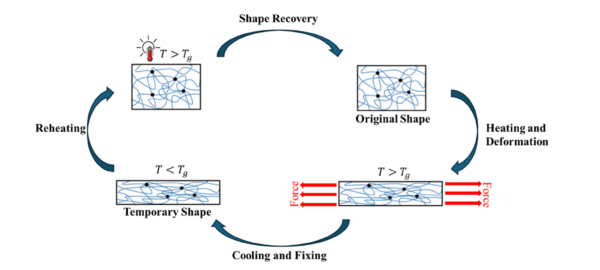
The shape recovery process of Thermo-responsive SMPs consists of three main stages to transition between rigid and elastic states. Adapted from: NIR-induced photothermal-responsive shape memory polyurethane for versatile smart material applications
Photothermal Fillers Enhances the Transition
Investigators incorporate fillers into the SMPs matrix to accelerate recovery and reduce energy consumption with respect to conventional thermal activation. Among these fillers researchers recognize carbon nanotubes, graphene oxide, MXenes, and gold nanoparticles. Graphene stands out due to its high specific surface area, electrical and thermal conductivity, high photothermal conversion ability, and outstanding mechanical strength.
Researchers have enhanced the photothermal performance of graphene oxide (GO) by removing oxidized carbonaceous debris and then functionalizing the purified GO with DGEBA. Subsequently, crosslinking the DGEBA-functionalized GO with an aromatic diamine hardener and epoxide groups to build a continuous photothermal filler network within a polyurethane (PU) matrix.
The resulting crosslinked GO networks improved nanosheet dispersion and interfacial compatibility with the PU matrix. This structure reduced π–π stacking interactions, preventing the nanosheets from clumping together. With this, researchers obtained an increased effective surface area available for interaction with the N–H groups of the PU hard segments. As a result, the composite enhanced near-infrared (NIR) absorption and raised the local temperature to 77.7 °C within 5 s, enabling rapid thermally driven shape recovery.
Barriers to Industrial Adoption of Self-Healing Automotive Paints
Multiple factors limit the large-scale implementation of this technology including materials constraints, manufacturing complexity, economic trade-offs, and performance requirements.
Modern manufacturing facilities rely on spray painting lines and cannot easily adapt their facilities to accommodate materials that still carry technical uncertainty. Especially when the efficiency of the healing depends on the success of the complex processing steps. Designers also need to enable autonomous heal under everyday environmental conditions without user intervention. This is a challenge since these materials do not normally activate under real driving situations. Furthermore, coating must grant long-term durability, satisfy safety and regulatory standards, and deliver an economic benefit over the vehicle’s lifecycle.
This technology sits in a transitional phase; scientifically promising but still undergoing engineering optimization. Nevertheless, its use is not only attractive for coatings but for different elements within the automotive industry.