
Scaling Enzymatic Polymerization for Sustainable Fabric Care Products
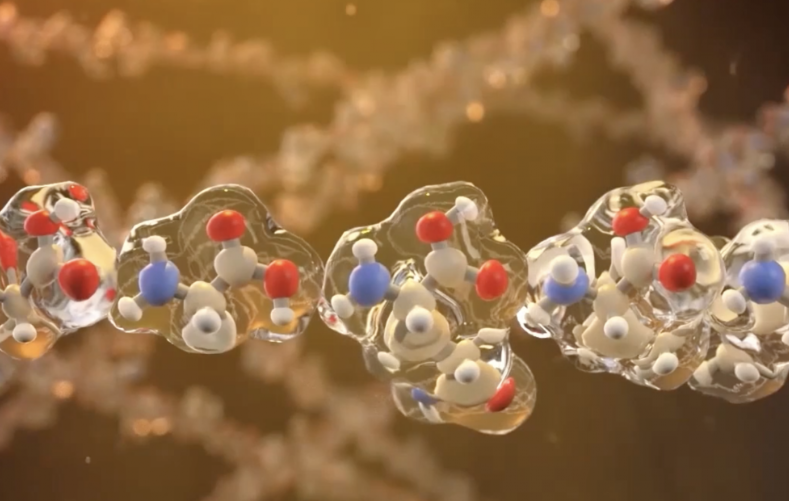
Enzymatic polymerization of plant sugars allows for precise molecular control to replace persistent polyquaterniums in high-volume fabric care.
Bio-based polymers have been incorporated into consumer products unevenly over the past decade. Many struggled to meet formulation stability, processing, or supply requirements at scale. Regulatory scrutiny has increased around polymer persistence and environmental release, particularly in wastewater-linked applications. These pressures place polymer engineers at the centre of material selection decisions.
You can also read: Carbios Broadens Enzyme Recycling Technology.
Enzyme-designed polymers differ in that they address molecular control and manufacturing compatibility within a single approach. Designed Enzymatic Biomaterials, or DEB, represent an enzymatic polymerization technology now used in selected consumer formulations.
Designed Enzymatic Biomaterials as a Technology Platform
This is a biotechnology-based polymer design and manufacturing platform developed by IFF Health and Biosciences. DEB uses enzymatic polymerization of plant-derived sugars to produce tailored polysaccharide polymers. Enzymes control chain length, branching, and molecular uniformity during synthesis.
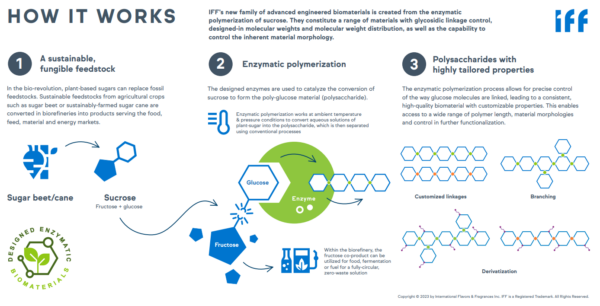
Advanced engineered biomaterials produced through enzymatic polymerization of sucrose. Courtesy of IFF Designed Enzymatic Biomaterials™.
The platform operates under mild aqueous conditions rather than high-temperature petrochemical routes. This process enables the production of consistent polymer structures comparable to industrial synthetic materials. For consumer markets, reproducibility determines whether polymers can be qualified at commercial scale.
Polymer Design and Functional Performance
Polymers produced using DEB technology exhibit controlled molecular weight distributions. These structural characteristics influence viscosity, surface interaction, and formulation stability. Functional groups can be introduced after polymerization to adjust charge density and compatibility.
Technical Comparison: Synthetic vs. Enzymatic vs. Natural Polymers Courtesy of IFF Designed Enzymatic Biomaterials™.
| Feature | Synthetic, petroleum-based polymers | Designed Enzymatic Biomaterials by IFF | Polysaccharides extracted from plants |
| Consistent quality | ✓ | ✓ | X |
| Tailored performance | ✓ | ✓ | X |
| High purity | ✓ | ✓ | X |
| Scalable & reliable supply | ✓ | ✓ | X |
| Renewable | X | ✓ | ✓ |
| Biodegradable* | X | ✓ | ✓ |
| Natural clean label | X | ✓ | ✓ |
This design flexibility allows engineers to target specific functional requirements rather than broad performance ranges. As a result, formulation risk decreases when replacing established synthetic polymers in consumer products.
You can also read: Biopolymers from Bacteria: A Sustainable Alternative to Oil-Based Products
Case Application in Laundry Detergents
The first large-scale commercial use of DEB technology occurred in laundry detergent formulations. A global consumer packaged goods company introduced a detergent containing polymers produced using the DEB platform. In this application, the Lyrature™ portfolio of DEB-based polymers replaced persistent synthetic polyquaterniums.
Performance targets included fabric softness, cleaning efficiency, and soil anti-redeposition. Lyrature™ polymers enhanced surface modification while supporting anti-redeposition behavior. The formulation met baseline performance benchmarks while removing non-biodegradable ingredients. Laundry detergents represent a high-volume polymer application, making this case relevant for scalability assessment.
Replacing Polyquats: The Performance Gap
| Metric | Synthetic Polyquaterniums | Lyrature™ (DEB-based) |
| Source | Petroleum/Acrylamide | Plant-derived Sucrose |
| Biodegradability | Persistent / Poor | Readily Biodegradable |
| Charge Density | High / Adjustable | Tailored via post-polymerization |
| Surface Affinity | High (Potential Build-up) | High (Clean Rinse Profile) |
Manufacturing Compatibility and Process Integration
Polymers produced using DEB technology integrate into existing detergent manufacturing processes. Standard mixing and blending equipment remain sufficient. Operating temperatures and pressures do not require modification.
Batch consistency supports existing quality control protocols. Processing compatibility reduced qualification timelines and limited capital investment requirements. These factors influence adoption more strongly than material novelty.
Quantified Sustainability Performance
Sustainability performance for DEB-based polymers has been assessed through peer-reviewed lifecycle analysis. Studies follow ISO 14040 and ISO 14044 standards. Cradle-to-gate analysis shows carbon-negative manufacturing impact under defined system boundaries.
Renewable plant sugars serve as the primary carbon source. Polysaccharide structures provide intrinsic biodegradability. These characteristics address concerns related to polymer persistence in aquatic environments.
Scaling Supply for Consumer Markets
Long-term adoption depends on supply reliability. IFF and Kemira established the Alpha Bio joint venture to support industrial-scale production. The planned facility in Finland targets conversion of up to 44,000 tonnes of plant sugars annually.
Production is expected to begin in 2027. Dedicated assets support continuity for consumer product manufacturers considering broader deployment of DEB-based polymers.
Implications for Broader Consumer Applications
The detergent case suggests transferability, but not automatic applicability, across consumer product categories. Many formulations share requirements for rheology control and surface interaction. However, differences in pH, electrolyte content, and shear conditions affect performance.
Engineers must evaluate DEB-based polymers against category-specific formulation constraints. Charge density, molecular architecture, and surfactant compatibility remain critical. Sustainability outcomes also vary by use and disposal pathway.
The key implication is methodological. Enzymatic polymerization supports structured material substitution when evaluated through disciplined engineering assessment.