
Next-Generation EV Battery Solution Wins SPE Award
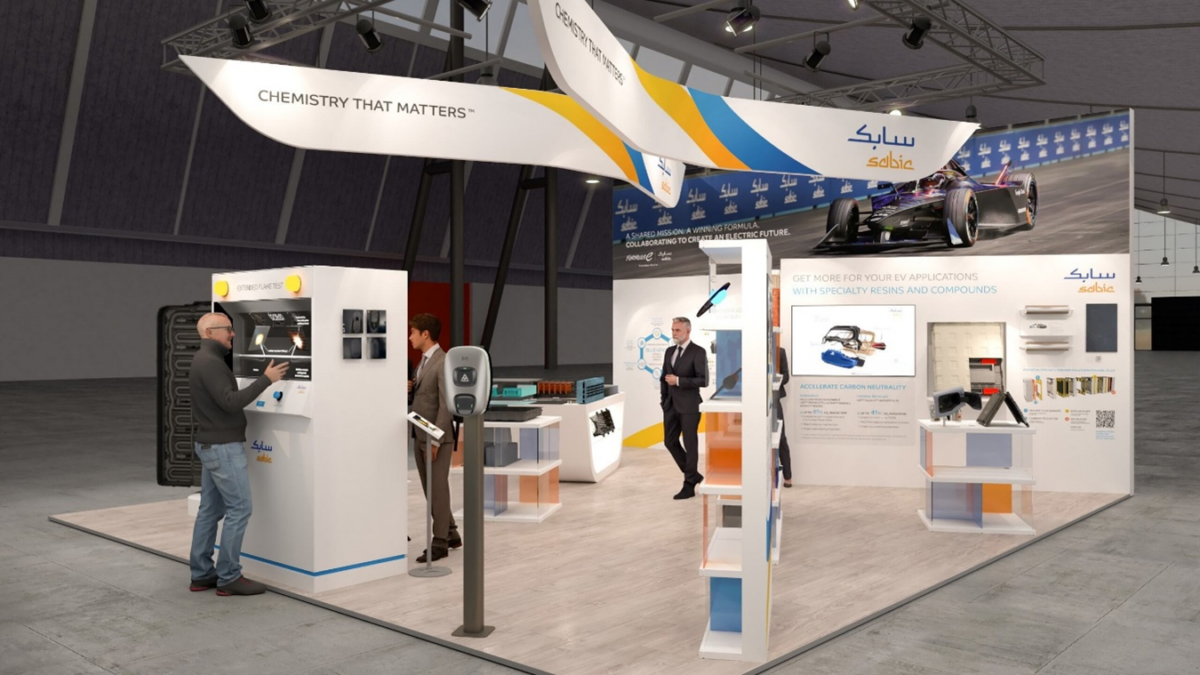
A new hybrid composite EV battery housing reduces weight by 20% and costs by 30%. This SPE award-winning design optimizes safety and scalability.
In the rapidly evolving hybrid and Electric Vehicle (EV) industry, limited driving range remains a persistent challenge. This available distance is parameter that significantly depends on the vehicle’s weight. The EV’s battery accounts for 20-35% of the vehicle’s overall weight. This further reduces efficiency, increases energy consumption, affects handling, and raises manufacturing costs.
You can also read: What the EV Boom Means for Plastics.
As the automobile market continues to grow and consumers demand longer-range EVs, the industry is taking innovative approaches to design, materials, and manufacturing. Innovators have been developing lightweight components that enhance vehicle performance while meeting safety standards and ensuring durability. Last year, engineers at Envalion, in collaboration with SABIC, ENGEL, Siebenwurst, and Forward Engineering, showed leadership in sustainable, high-performance lightweighting solutions for the automotive industry. They have introduced a new perspective on the design and manufacturing of hybrid composite battery housings. The Society of Plastics Engineers (SPE) recognized this development at the Automotive Awards in Bonn, Germany. Winners in the category of “Enabler Technology” for enabling lighter, safer, and more efficient to manufacture electric vehicle (EV) designs.
Advanced Hybrid Composite Design for EV Battery Enclosures
This collaborative development introduces a next-generation hybrid composite architecture for high-voltage electric-vehicle battery housings. The design centers on a lightweight sandwich structure that combines structural efficiency with thermal protection and functional integration. The battery cover features a multilayer sandwich architecture composed of two Tepex® Dynalite polypropylene glass-fiber sheets enclosing a flame-retardant, fiber-reinforced core integrated with a PP STAMAX™ tray. This hybrid configuration exploits the high specific stiffness of continuous fiber laminates while using long glass-fiber reinforced thermoplastics for high impact resistance and flame retardancy. The result is a structurally optimized enclosure that simultaneously outstands in mechanical strength, crash performance, and thermal management.
Engineers have seen that the materials constructive collaboration enable a substantial weight reduction compared with traditional all-metal battery housings. The hybrid composite enclosure achieves a weight reduction of 10–20% while keeping high structural integrity. It also achieves a 46% reduction of while lowering production costs by up to 30%. The thermoplastic composite system improves heat dissipation and enhances fire safety, two critical parameters for high-voltage battery protection. According to SABIC, these key features will allow EV, and hybrid manufactures to extend vehicles range and support overall performance targets.
Beyond the innovative use of materials and their benefits, the design incorporates features that directly address the architecture of the housing. Engineers integrated cooling interfaces, mounting points, and reinforcement zones into the enclosed geometry. This results in a reduction of secondary components, lowering the system complexity and a simplification of system assembly. This functional integration positions hybrid thermoplastic composites as a practical platform for scalable EV battery enclosure solutions.
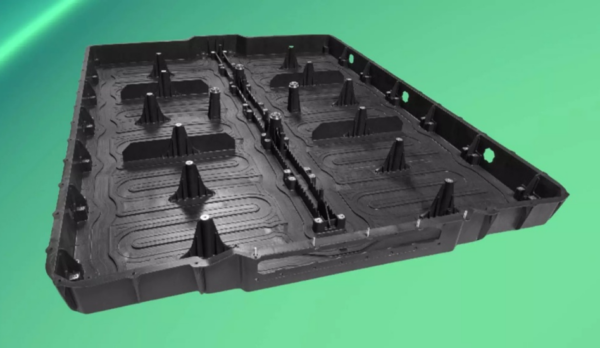
Advanced design for EV Battery Enclosure achieves a weight reduction of 10–20% providing an interesting perspective for EV and hybrid vehicles manufacturers. Courtesy of Envalior.
Automated Manufacturing Process and Industrial Scalability
The project proves a highly automated manufacturing route that aligns with automotive mass-production requirements. The 1.3 × 1.5 m battery cover undergoes production through a fully automated sandwich injection-molding process. Engineers over-mold two organ sheets using a sophisticated 19-gate cascade injection system. This controlled flow strategy ensures uniform material distribution, strong interfacial bonding, and a 44% reduction in required clamping force during processing.
Mechanical testing revealed cohesive laminate failure during validation trials, confirming excellent adhesion between layers. Tests have also verified the structural reliability of the sandwich construction. The process enables direct integration of functional elements such as cooling channels, spacers, fastening interfaces, and ventilation features within a single molding cycle. This consolidation of functions reduces part count, lowers assembly time, and minimizes production costs.
Precision manufacturing plays a critical role in ensuring large-scale feasibility. The process achieves dimensional tolerances below 0.02%, such precision supports consistent integration into vehicle platforms. Consequently, the process shows the capability to produce large composite components with automotive-grade accuracy.
These characteristics highlight the economic and technical advantages of automated thermoplastic composite processing. The collaboration shows how scalable manufacturing technologies can deliver structurally robust and lightweight battery systems. This while accelerating the adoption of advanced polymer solutions in next-generation electric vehicles.
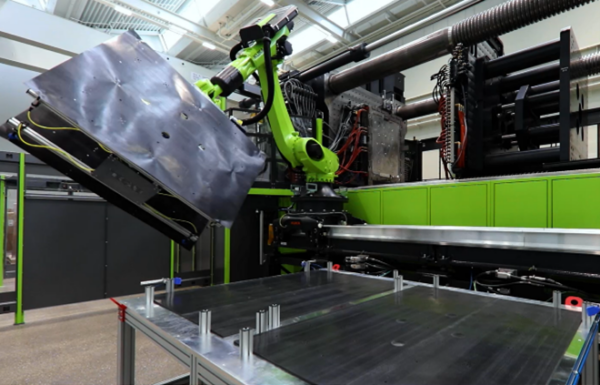
SABICs MEGAMOLDING™ platform enables the manufacturability of large, high-performance thermoplastics parts with greater efficiency simultaneously overcoming traditional cost and processing barriers. Courtesy of Forward engineering.
Key Benefits
Among the most significant advancements engineers highlight:
- The hybrid composite design delivers enhanced flame protection through continuous fiber reinforcement.
- It reduces overall system cost and simplifies assembly by enabling a single-shot molding process that drops post-processing steps.
- The thermoplastic composite architecture achieves an estimated 46% reduction in CO₂ footprint.
- The cascade injection system lowers required clamping force by 44%, improving manufacturing efficiency.
Collectively, this collaborative effort proves that manufacturers can implement composite hybrid solutions in real-world automotive production while supporting practicality and performance.