
MXene Hydrogels: Dual-Conductivity & Self-Healing
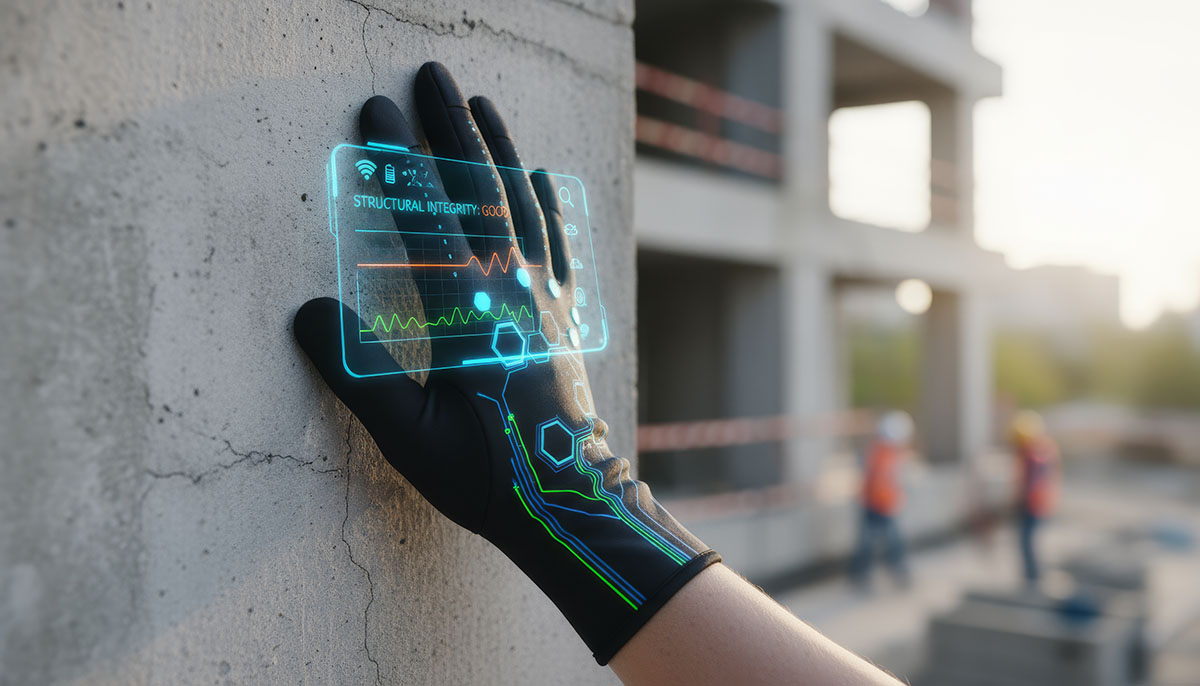
Engineers leverage MXene/MWCNT dual-conductive percolation to solve cyclic fatigue in self-healing Triboelectric Nanogenerators (TENGs).
Materials engineers are coupling MXene nanosheets with solvated ions to develop robust, self-healing hydrogels capable of sustaining high power density under extreme mechanical strain.
You can also read: Soft Robotics in Medicine: A Growing Trend Powered by Hydrogels.
The Electromechanical Challenge in Soft Robotics
Soft robotics developers frequently encounter a specific failure mode: repetitive elongation severs continuous conductive pathways. While rigid metallic conductors delaminate under stress, standard elastomers exhibit pronounced increases in electrical resistance during deformation.
To resolve this degradation, engineers leverage dual-conductive percolation mechanisms. By embedding MXene nanosheets within elastomeric matrices, researchers couple high electronic charge transport with the intrinsic ionic conductivity of base hydrogels. This integration addresses the cyclic fatigue problem, enabling soft robotic interfaces to maintain electrical continuity under extreme operational deformations.
1. Conductivity Physics and Interconnected Network Topology
To optimize electrical output, researchers configure percolation networks by precisely controlling the ratios of nanomaterials. Tests demonstrate that MXene/MWCNT composites reach a critical percolation threshold at 3.5 wt% within self-healing elastomer sensors. This specific mass fraction preserves mechanical elasticity while ensuring a continuous electron flow.
MXene nanosheets establish durable electronic pathways that complement the ionic conductivity generated by solvated lithium (Li+) and sodium (Na+) ions. To densify these interconnected networks, engineers often incorporate:
Conductive Polymers: Such as PEDOT:PSS.
Ionic Salts: To accelerate charge transfer efficiency.
Hybrid Charge Transport: This mechanism stabilizes electrical output during ambient humidity fluctuations—a persistent reliability issue in purely electronic sensors.
2. Triboelectric Nanogenerator (TENG) Power Density Metrics
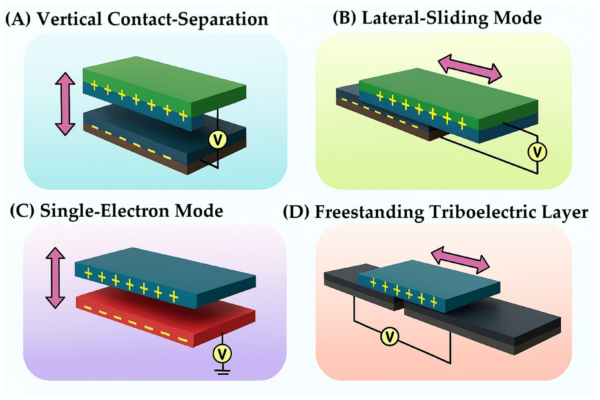
Schematic representation of the working principles and operational modes of TENGs: (A) vertical contact-separation; (B) single-electrode; (C) lateral-sliding; and (D) freestanding triboelectric-layer configurations. Courtesy of Polymer Gel-Based Triboelectric Nanogenerators: Conductivity and Morphology Engineering for Advanced Sensing Applications
Integrating MXene directly amplifies the surface charge generation of Triboelectric Nanogenerators (TENGs). Moreover, empirical data validates that specific SA/MXene/PAAm hydrogel configurations produce a maximum open-circuit voltage (Voc) of 491.98 V and a short-circuit current (Isc) of 75.41 µA.
In comparison, baseline PAA/rGO double-network gels generate a significantly lower Isc of 48.7 µA. Researchers achieve even higher operational limits through specialized composite engineering:
MXene/CuO Composites: These achieve a maximum Voc of 810 V and a peak power density of 10.84 W/m².
Hybrid Cryo-gels: These formations deliver a power density of 7.44 W/m².
TA@CNC/MXene Variants: These specific variants provide 69.97 mW/m².
3. Self-Healing Matrix Chemistry and Robotic Applications
To guarantee long-term durability, formulators program autonomous self-healing capabilities into the polymer matrix using three primary chemical strategies:
Dynamic Hydrogen Bonding: Utilized extensively in lignosulfonate or catechol-modified systems.
Borate Ester Bonds: Deployed within PVA-based hydrogels doped with specific borate salts.
Metal-Coordination Networks: Utilizing catechol-metal interactions to drive rapid structural recovery.
Healing velocities depend on the crosslinking density. While some matrices execute instant mechanical healing, others require between 1 and 10 minutes to achieve full structural recovery at 25°C without external stimuli.
Industrial Use Cases
Developers utilize these resilient hydrogels to fabricate fully functional interactive devices, including:
PTSM-TENG Systems: Specialized glove-based human-machine interfaces for real-time gesture visualization.
Tactile E-Skin: Sensors for smart sports monitoring platforms.
Grip-Assist Gloves: Capturing continuous tactile pressure data during complex robotic manipulation.