
Biochar-Filled Polyolefins: Enhancing Fire Safety and Stiffness
Biochar improves fire performance and stiffness in polypropylene and polyethylene composites by reducing heat release rate and increasing thermal stability.
As sustainability drives material innovation in the plastics industry, researchers are developing bio-based additives as alternatives to synthetic reinforcements for polyolefin products. Among these additives, biochar has gained attention for its ability to improve fire performance and stiffness in polypropylene (PP) and polyethylene (PE) composites. Researchers show that adding biochar to polyolefins reduces peak heat release rate (PHRR), lowers smoke production, enhances stiffness-related mechanical properties, and supports waste valorization.
You can also read: Natural and Mineral Fillers Improve UV Stability in Rotomolded Polyethylene.
The Role of Pyrolysis in Biochar Production
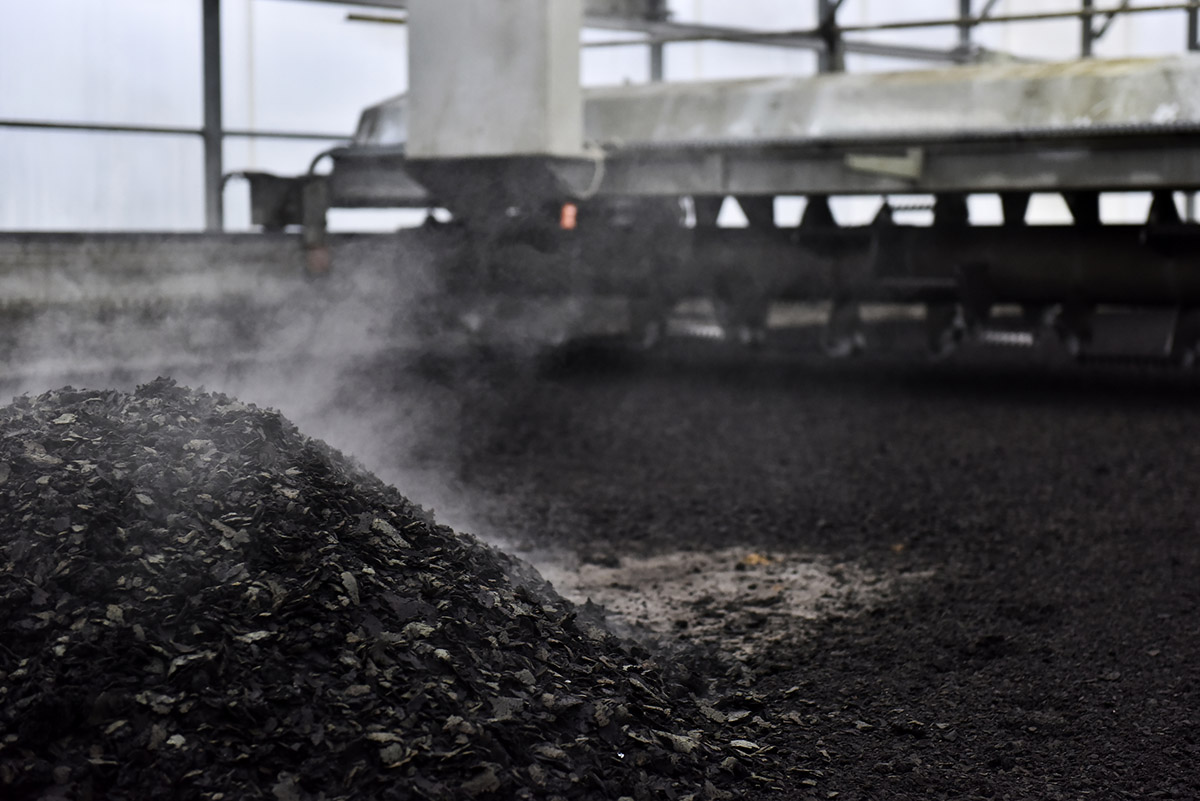
Biochar is a solid, carbon-rich material produced by heating biomass under oxygen-limited conditions in a process known as pyrolysis. This thermochemical process stabilizes carbon that would otherwise escape as CO2, which makes biochar a potential tool for carbon sequestration. Feedstock type and pyrolysis temperature strongly influence biochar’s surface area, pore structure, and chemical composition. Under controlled pyrolysis conditions, biochar develops a uniform and porous microstructure. This structure contributes to thermal stability and promotes interaction with polymer matrices. The high surface area of biochar enables thermoplastic chains to contact and anchor to its surface. During melt processing, molten polyolefins flow around and partially into the biochar structure, thereby promoting mechanical interlocking between the filler and the polymer. As industries seek value-added uses for residues, biochar offers a dual benefit: waste valorization and performance enhancement. Agriculture byproducts, such as rice husks and other biomass streams, can serve as feedstock, transforming low-value waste into functional materials for advanced applications.
Mechanical Performance and Stiffness Optimization
Research by Oisik Das and colleagues examined polypropylene composites with varying biochar loadings produced via compounding and injection molding. The results show that increasing biochar content continuously improves the tensile and flexural moduli of PP. Higher filler loadings increase composite stiffness and improve resistance to deformation under load.
Similarly, Atta ur Rehman and colleagues incorporated rice husk biochar into polyethylene and observed increased stiffness and improved dimensional stability. In both systems, researchers attribute these improvements to the rigid carbon structure of biochar and stronger stress transfer at the filler-matrix interface.
During processing, molten polymer surrounds the biochar particles, creating physical interlocking. This interaction strengthens load transfer efficiency and increases resistance to deformation. Although higher filler loadings increase stiffness, manufacturers must control dispersion quality and optimize loading levels to balance mechanical performance and processability.
Enhancing Fire Performance through Char Formation
Biochar also improves fire behavior in both polypropylene and polyethylene systems. Cone calorimeter testing on PP-biochar composites shows a reduction in peak heat release rate (PHRR) as biochar content increases. Lower PHRR indicates slower heat release during combustion, which reduces flame intensity. Researchers also report reduced CO2 and CO emissions and lower smoke production compared to neat PP.
![Heat release rate of the HDPE and composites. Courtesy of [Mechanical, Thermal, and Fire Retardant Properties of Rice Husk Biochar Reinforced Recycled High-Density Polyethylene Composite Material]](https://www.plasticsengineering.org/wp-content/uploads/2026/02/HRR.webp)
Heat release rate of the HDPE and composites. Courtesy of Mechanical, Thermal, and Fire Retardant Properties of Rice Husk Biochar Reinforced Recycled High-Density Polyethylene Composite Material.
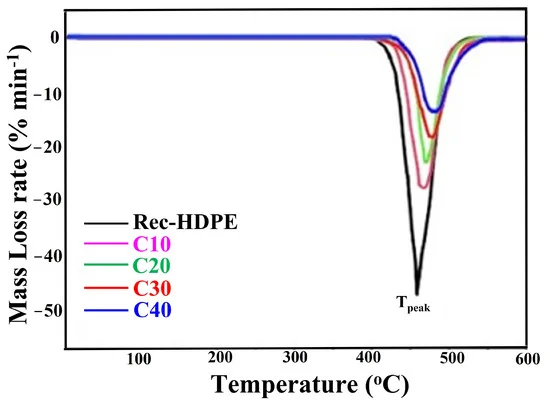
DTG curves of the HDPE and composites. Courtesy of Mechanical, Thermal, and Fire Retardant Properties of Rice Husk Biochar Reinforced Recycled High-Density Polyethylene Composite Material.
During burning, biochar generates a thermally stable carbonaceous layer at the material surface. This layer limits heat transfer to the underlying polymer and restricts oxygen diffusion into the matrix. By reducing heat and mass transfer, biochar decreases combustion intensity and improves overall fire resistance.
Industrial Relevance and Application
The combined findings from polyethylene and polypropylene systems suggest that biochar can function as a multifunctional additive in polyolefin composites. Manufacturers can use biochar to increase stiffness and improve fire performance while incorporating renewable feedstock into conventional thermoplastics.
Unlike traditional halogenated flame retardants, biochar operates primarily through condensed-phase barrier formation rather than gas-phase chemical action. Although it may not fully replace conventional flame-retardant systems in highly regulated applications, it can contribute to improved fire behavior while reducing reliance on synthetic additives.
These properties position biochar-filled polyolefins attractive for applications that require stiffness and controlled fire performance, including automotive components, interior panels, and construction materials. As the industry seeks resource-efficient formulations and lower-emission materials, biochar provides a technically supported approach to combine sustainability with functional performance.