
At ANTEC 2026: High-Performance Polymers for Sealing Applications
Move beyond ASTM D395 compression set to stress relaxation and DMA to predict contact stress retention and leakage risk in high-performance seals.
High-performance polymer seals support applications that push beyond the limits of conventional elastomers and commodity plastics. Many designs combine high temperature, pressure cycling, aggressive media, tight tolerances, and long service life in the same system.
In these conditions, a single property value rarely predicts sealing performance. Performance depends on whether the material maintains contact stress within the actual gland geometry over time. Characterization should therefore reflect the service environment, enabling teams to qualify materials, confirm batch consistency, and evaluate processability, with a clear link to leakage risk and service life.
You can also read: The Cryogenic Challenge: Polymers for Liquid Hydrogen (LH₂)
From Property Screening to Sealing Performance
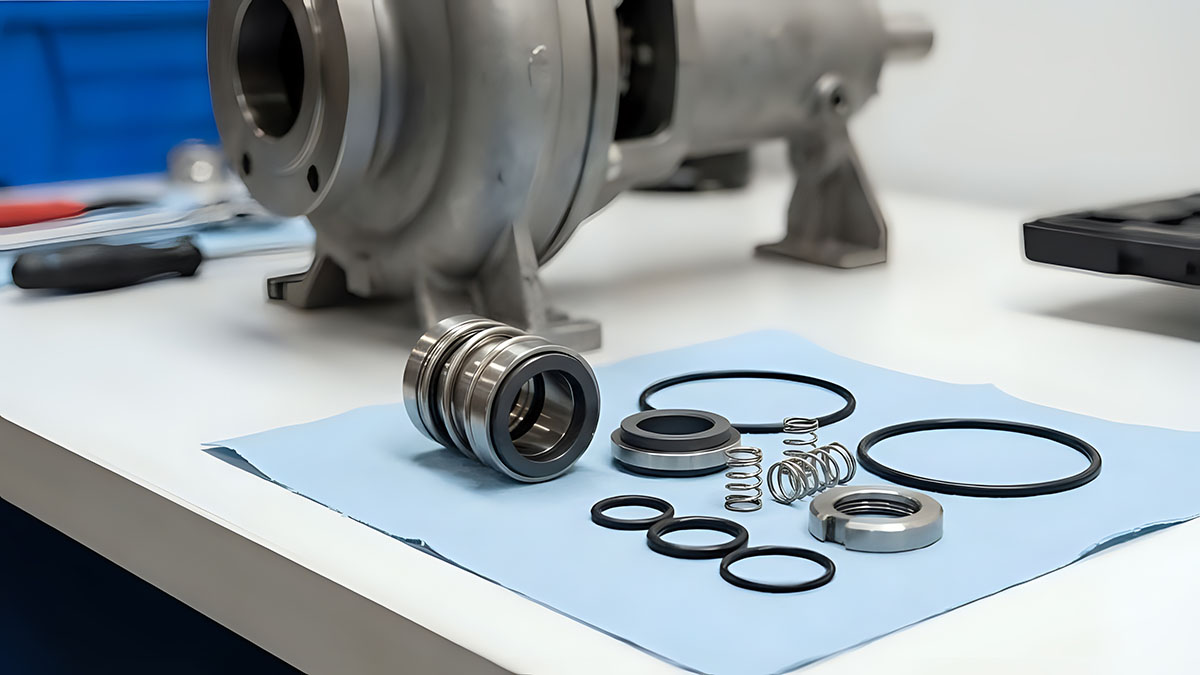
Even the simplest-looking seal depends on the right polymer and testing, because real performance comes down to how well it withstands contact stress over time. Courtesy of Highdom.
Datasheet properties support screening, but sealing performance depends on time-dependent behavior under constraint. Stress relaxation, creep, and thermal softening reduce contact stress during dwell periods, while gland clearances can promote extrusion under pressure. Characterization should therefore probe these mechanisms under representative conditions rather than relying on one baseline test.
The Limitations of Basic Screening (ASTM D395)
ASTM D395 compression set remains a foundational test because it provides a widely recognized baseline for permanent deformation under compressive strain. Teams apply it for early screening and for monitoring production stability across batches. However, compression set alone does not capture the dominant drivers of sealing performance in high-end applications.
Many sealing failures originate from progressive loss of contact stress rather than from residual deformation alone. Viscoelastic relaxation, creep, and thermal softening near upper temperature limits can accelerate stress decay. Gland geometry can also introduce strain gradients that shift load distribution over time. Because sealing performance depends on sustained contact stress, characterization is most effective when it measures stress retention directly or reproduces service-relevant constraints and deformation modes.
Advanced Characterization for Sealing Programs
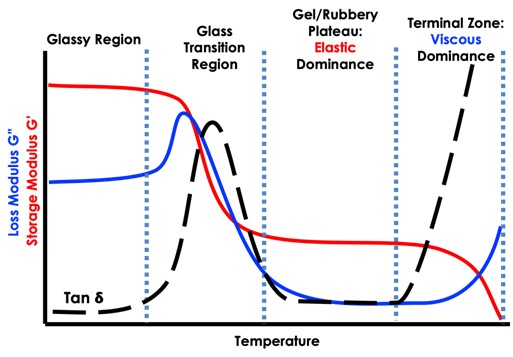
DMA helps determine how stiffness and damping change with temperature by tracking storage modulus (G′) and loss modulus (G″), including the transition region that can affect contact stress retention. Courtesy of Centre for Industrial Rheology.
For high-end applications, engineers are increasingly utilizing a broader suite of mechanical tests to map performance:
Compressive Stress Relaxation (CSR): Quantifies the decay of stress under constant strain. This is the most direct lab-to-field correlation for predicting how long a seal will maintain its “push” against a housing.
Dynamic Mechanical Analysis (DMA): Maps the storage modulus (G′) and loss modulus (G″) across temperature and frequency. This is critical for seals subject to vibration, cyclic loading, or rapid thermal ramps.
Vicat Softening & Thermal Transitions: Essential for thermoplastics where load-bearing capacity may drop sharply near the glass transition temperature (Tg)
Media Compatibility & Swell Testing: High-performance polymers in contact with fuels or solvents may experience dimensional changes and plasticization that standard dry tests cannot replicate.
The Payoff: Reduced Leakage Risk
A characterization strategy that combines compression set with stress retention, thermal response, media compatibility, and gland-representative testing strengthens the link between laboratory data and field performance. It moves qualification beyond pass-fail screening and toward the mechanisms that govern contact stress loss and leakage risk. This approach supports faster qualification, tighter batch control, and more reliable performance prediction under realistic sealing conditions.
To continue the discussion, join the session at ANTEC® 2026, March 9–12, 2026, in Pittsburgh, Pennsylvania.