
When Color Becomes Waste

A decision made at the pigment stage can decide whether a plastic product is recyclable at all.
Black plastic dominates modern life. It appears in food trays, electronic housings, automotive components, and cosmetic packaging. Manufacturers have used black carbon as their preferred pigment for decades. It costs little, blocks light, resists UV damage, and ensures consistent production. Manufacturers and brands value these advantages. Recyclers face a different reality. Black plastic disrupts sorting systems and undermines recycling efforts.
You can also read: Is Color Affecting Plastic Recycling?
How Sorting Really Works
Most material-recovery facilities use near-infrared (NIR) spectroscopy to sort plastic waste by polymer type. PET, HDPE, PP, and PS reflect distinct spectral signatures under near-infrared light. The light typically ranges from 800 to 2,500 nanometers. Optical sorters illuminate fast-moving waste streams; sensors capture the reflected signal, and software identifies the polymer. Air jets separate materials at industrial speed. The system is efficient, automated, and highly accurate, until color interferes with light.
Why Carbon Black Breaks the System
Carbon black strongly absorbs near-infrared radiation across a broad spectrum. Instead of reflecting light back to the sensor, it absorbs it and dissipates the energy as heat. The reflected signal is effectively zero. To an optical sorter, a carbon-black plastic item contains no usable information. In practical terms, it is optically invisible.
This issue is not a marginal problem. Numerous studies have shown that NIR-based systems cannot reliably identify plastics containing conventional carbon black pigments, regardless of polymer quality. The material may be recyclable in theory, but in practice, the sorting system cannot see it.
Why it Matters

Inside the Cirrec plant: multiple STEINERT sensors sorters and magnetic separatorsclean and sort PET trays automatically. Courtesy of STEINERT.
Sorting systems must correctly identify plastics. When they fail, they send materials to landfills or incineration. They may also misclassify plastics into other recycling streams. This contamination reduces yield and lowers material quality. As a result, the industry recognizes a clear outcome: black plastic rarely gets a second life.
Industry standards reflect this reality. The Association of Plastic Recyclers outlines clear guidance in the APR Design® Guide for Plastics Recyclability. The guide identifies clear PET, transparent light blue PET, and transparent green PET as the most valuable formats. Clear PET commands the highest prices because it offers the greatest flexibility in end-use applications. By contrast, opaque white PET, often colored with titanium dioxide, permanently degrades clarity. Recyclers classify dark and black plastics, especially those with low lightness or poor NIR reflectance, as detrimental unless they pass strict NIR sortability tests, which many fail.
Why Recyclers Cannot Simply Adapt
Critics often urge companies to redesign recycling plants. This view misunderstands how the system works. Engineers design facilities for speed, volume, and economic efficiency. Companies invest heavily in NIR equipment and tightly optimize it for throughput. Manual sorting exposes workers to hazards and fails at scale economically. Alternative technologies such as X-ray fluorescence or mid-infrared detection operate more slowly, cost more, and manage high-volume packaging waste poorly. Industrial reality constrains the system more than technical imagination.
What Designers Can Do Instead
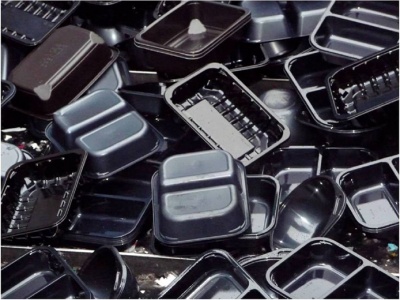
Black plastic packaging on a sorting line showing why carbon black pigments evade NIR detection. Courtesy of The WRAP report Recyclability of Black Plastics: An Overview synthesizes
Packaging teams do not need to abandon dark aesthetics, but they must redesign how they achieve them. First, avoid conventional carbon black where optical sorting dominates the recovery pathway. Instead, use NIR-detectable black colorants or alternative pigment systems designed to reflect enough signal for identification. Second, validate detectability with real sorter conditions, not only lab claims. A pigment that “should work” can still fail at plant speeds, on dirty surfaces, or on thin-walled parts. Finally, document colorant choices in design-for-recycling reviews alongside polymer selection, label design, and barrier layers. When teams treat pigment as a functional material choice, not a styling detail, they reduce the risk of designing a product that becomes waste by default.
Where the real failure lies
The deeper problem is structural rather than technical. Designers, brand managers, and marketing teams make decisions about color far upstream as they optimize shelf impact, cost, and brand consistency. These decisions produce consequences much later and elsewhere inside recycling facilities, municipal waste systems, and public budgets. These actors operate in distinct phases of the product lifecycle and rarely participate in the same decision-making processes.
As a result, materials that perform perfectly in production and marketing can fail completely in recovery. Carbon black exemplifies this disconnect. Its widespread use reflects a design process that excludes end-of-life performance as a design criterion rather than a limitation of recycling technology.