Sedimentology-Inspired Classification for Plastic Waste

Drawing on sedimentology, researchers have proposed a novel classification scheme for plastic waste of all sizes.
Plastics researchers face a barrier when classifying plastic waste: the industry’s lack of acceptance of a consistent categorization method. Though the plastics community has made many calls to action, it has yet to agree on a universal classification system. This makes it difficult to predict and regulate waste behavior on a global scale. The solution? A clear, universally accepted, easily accessible classification scheme. A group of researchers has proposed a classification scheme that takes insights from sedimentology and applies them to plastic waste.
You can also read: EU Launches First Certified Reference Material for Microplastic Analysis
Why Sedimentology?
Sedimentology, a subset of Earth science, focuses on the formation and deposition of sediments such as sand, silt, and clay. By considering plastic as a “sediment,” scientists can apply the well-established classification methodologies of sedimentology to plastic. This is especially relevant when studying the relationship between plastic grain size and particle behavior during transport and accumulation. With sedimentology as a guide, researchers can more readily observe long-term trends in plastic pollution in the environment.
Considering the Properties of Plastic
The differences between plastic and sediment are key to adapting this scheme to plastic waste. Notably, plastics and microplastics comprise a wide range of materials with different properties and behaviors. For larger waste, the object shape can play a role in its behavior in the environment. One such example is a water bottle, which could sink if filled with sand, but float if it remained sealed. This highlights the importance of considering additional factors, such as holes. In this case, the water bottle would exhibit very different behavior than an equivalently sized sediment granule.
Creating a Classification Framework
Researchers have adapted and expanded sedimentology’s classification framework to apply to plastic waste. This included redefining plastic size categorization from previous research, using the categories nano-, micro-, meso-, macro-, mega-, and gigaplastic. Additionally, researchers defined how shape and material influence behavior in the natural environment.
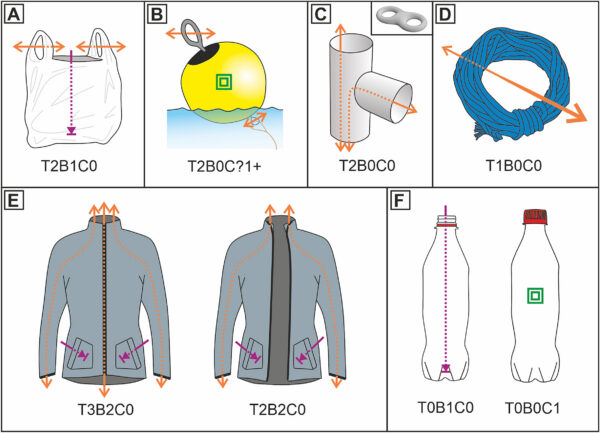
Blind (purple arrow), through (orange arrow), and closed (green square) holes can effect waste’s interaction with water and sediment. Figure courtesy of Plastic as a Sediment — A universal and objective practical solution to growing ambiguity in plastic litter classification schemes.
Key properties for classification using this method include color, opacity, transparency, brittleness, plasticity, softness, hardness, flexibility, elasticity, and static electricity.
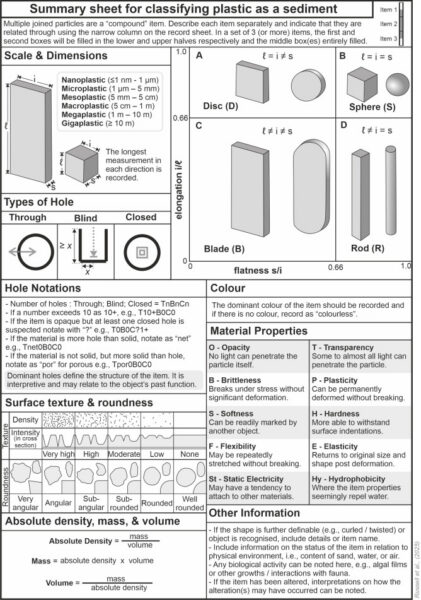
Researchers developed a summary sheet for use in applying this classification scheme. Figure courtesy of Plastic as a Sediment — A universal and objective practical solution to growing ambiguity in plastic litter classification schemes.
Impacting Research
This novel classification scheme presents a readily available, easy-to-use method to unify plastic waste categorization. This approach benefits from sedimentology’s focus on particle movement and environmental interaction. By adopting this, or similar schemes, researchers can achieve greater visibility of the behavior of plastic waste.