
Plastics Geo-Operations: Co-Pyrolysis Pathways for Carbon Capture

Circularity delays emissions, but geo-operations target mitigation by redirecting carbon from plastics into long-term geosphere storage via co-pyrolysis.
Carbon Capture: An Operations and Supply Chain Perspective
With a growing demand for plastic materials, the circular economy is at the forefront of many researchers’ minds. Still, this framework does not have a significant effect on climate change mitigation. To expand the scope of the circular economy for plastics, researchers evaluated carbon transfer flows in the plastics industry. One such pathway involves “geo-operations”, which combines production, logistics, and operations solutions to enhance traditional geo-engineering.
You can also read: Capturing CO₂ with Recycled Household Plastics
Plotting Plastic Impact Pathways
To understand a path towards geo-operations, researchers looked at the plastics industry holistically. Referred to as the “plastics technosphere”, this encompasses both infrastructure, such as petrochemical plants, and business systems.
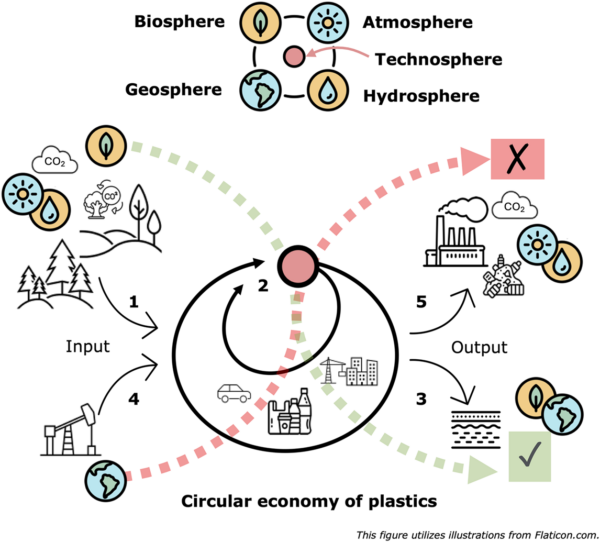
Production theory and operations management principles can function as a framework for carbon flow impact pathways. Figure courtesy of Impact Pathways: geo-operations for turning plastic waste into carbon capture.
The framework tracks carbon transfers between natural spheres and the plastics technosphere. It uses arrows to show how operations move carbon over a plastic lifecycle.
Climate-inhibiting pathways (1 → 2 → 3) capture atmospheric carbon and store it in the geosphere.
Current dominant pathways (4 → 2 → 5) move fossil carbon from the ground to the atmosphere, accelerating emissions.
Circular flows (2 → 2) keep carbon in the technosphere longer, which delays emissions and reduces virgin inputs.
The authors emphasize that combinations of interventions can form operational pathways with larger systemic effects.
Copyrolysis as a Geo-Operation
At a plastic product’s end-of-life, carbon can be refossilized into form that is safe to bury in soil. This can mitigate microplastics from waste while allowing the plastic technosphere while preventing carbon from entering the atmosphere.
Plastic copyrolysis with biomass is a refossilization method. This process produces a char, structurally enhanced by the added plastic waste. Copyrolysis has potential for waste from agriculture, construction, and grocery store supply chains. Scaling up this process could have significant effects for removing accumulated carbon emissions. If all manufactured plastics were eventually refossilized, this process could recapture global annual fossil carbon emissions in just 23 years.
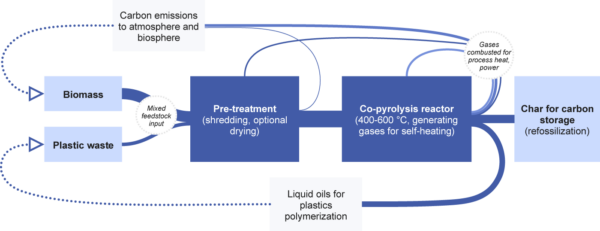
Following copyrolysis of biomass and plastic waste, the resultant char is safe for storage. Figure courtesy of Impact pathways: geo-operations for turning plastic waste into carbon capture.
The “23-Year” Scenario: What the Authors Actually Assume
The paper presents a scenario estimate to illustrate potential scale. It assumes global plastics manufacture equals 0.3 GtC/year, co-pyrolyzed with biomass at a 1:3 ratio and 50% maximum yield. Under those assumptions, the authors estimate geo-operations could net 0.42 GtC/year after process emissions. They then compare that value to 9.7 GtC/year of global annual fossil carbon emissions, producing the “23 years” figure. This is a conceptual scaling argument, not a deployment forecast.
Enablers: Policy, Finance, and Better System-Level Assessment
The authors argue that geo-operations require enabling conditions beyond technology. They highlight needs in:
incentives, regulation, and financing mechanisms that support carbon capture pathways,
operational design choices that control carbon flows at scale, and
LCA approaches that capture scalability and long-term dynamics in open systems.
They also propose that conventional product-level LCA can miss system dynamics that determine real mitigation.