
Electrifying Aviation: Polymer Electrolytes for Al-Air Batteries

Polymer electrolytes boost aluminum-air batteries with safer, leakproof, high-energy performance, unlocking aviation and aerospace electrification.
Electrification of vehicles, energy defense, and aerospace applications are experiencing a surge in new research. Aluminum-air (Al-air) batteries are fueling this resurgence. Although not a new category of batteries, Al-air batteries have been hampered by limitations that have prevented widespread adoption. Solid polymer matrix electrolyte (PME) technologies hope to fill this gap by enabling safety, reliability, and high energy density.
You can also read: Demand materializes for electric urban air mobility vehicles and materials.
Aluminum-Air Battery Technology
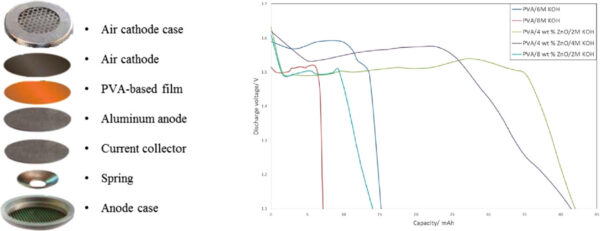
Simplified configuration of aluminum air battery (left) and discharge performance with PVA-based electrolyte at varying KOH levels (right). Courtesy of Energy & Fuels: Polymer Electrolytes for Al-air Batteries: Current State and Future Perspectives.
Typical Al-air battery design includes an Al anode, an aqueous electrolyte, and an air cathode. Together, the Al and oxygen in air undergo a redox reaction, using flight as the reaction initiator. The product is solid metal oxides and energy output. Although promising, aqueous electrolytes limit the efficiency, controllability, and reliability of these batteries, severely limiting their use in aerospace applications.
Solid PME for Al-air batteries expands practical applications, enabling aerospace research and ultimately adoption. The most widely used and successful synthetic polymer backbone is polyvinyl alcohol (PVA), though many polyacrylic acids, polyethylene oxides (PEOs), and polyacrylamides have been synthesized and investigated. The success of PVA is driven by its ability to incorporate only small amounts of electrolyte, owing to its high electrochemical and thermal stability and leakproof properties.
Polymer Matrix Electrolyte Applications
Enabling safety by reducing corrosion is a key metric in aviation for aerospace applications. The high molecular weight of polymers enables controlled placement of conductive electrolytes, reducing corrosion by preventing leakage. Overall, driving reliability under demanding conditions. Another example of providing excellent safety characteristics by preventing electrolyte leakage and dry-out is PEO. By reducing corrosion and leakage, flammability is also reduced. This enhances safety and shelf life relative to free-liquid electrolyte systems.
In addition to safety, battery efficiency is the second driver for aerospace adoption. PVA and PAA-based polymers show promise for producing high-energy-density, or energy-to-weight-ratio batteries. In addition to the polymer backbone, battery cell fabrication contributes to energy density and discharge time. Ionic conductivity in PVA-based polymers may minimize energy loss, enabling longer, more reliable battery operation and system performance.
Combining low corrosion, leakproof operation, and extending energy output, PMEs can enable next-generation Al- and metal-air batteries. Aircraft applications in particular benefit from these safety measures and research advancements. For example, NASA aims to take advantage of polymer matrices to power future subsonic aircraft engines like SUSAN. Like NASA, the University of Illinois Urbana-Champaign Center for Sustainable Aviation and Illinois Institute of Technology are spearheading research for crafting future PMEs and similar solid-state battery technology. Though aviation focused, industries like the defense sector and sustainable energy disciple may benefit from advancements in PME battery systems.