
Developing a Bio-Based Polymer Made for Cosmetics Packaging
Researchers developed a novel, bio-based composite, enhanced with essential oil and chitosan, designed specifically for cosmetics packaging.
Cosmetic packaging, which is commonly single-use plastic, is often composed of polyethylene (PE). Polylactic acid (PLA), derived from natural resources, offers a more sustainable alternative. Through fillers and blending with other materials, manufacturers can enhance PLA properties to meet product design requirements. One such example is a novel, bio-based composite, designed specifically for cosmetics packaging.
You can also read: Beauty Packaging Design for Social Commerce and Gen Z.
A Multi-Part Solution
The composite designed in this study comprised PLA blended with poly(3-hydroxybutyrate-co-3-hydroxyvalerate) (PHBV). PLA/PHBV is an established composite for packaging, offering hydrophobicity, moisture resistance, and water insolubility. Its physical properties (tensile strength, melting temperature, crystallinity, and glass transition temperature) are comparable to those of polypropylene and polyethylene.
You can also read: Beauty Packaging Design for Social Commerce and Gen Z.
Seeking to further optimize this composite for the cosmetics industry, researchers investigated the addition of a variety of other components:
- Chitosan (CS), a cost-effective and plentiful industry by-product that can reinforce biobased composites.
- Plant essential oils (EOs), such as limonene or eucalyptol, which can decrease water vapor permeability of bio-based composites. EOs can also contribute a pleasant aroma to packaging, increasing its value in cosmetics applications.
- Phycocyanin (Pgm), a natural colorant with an intense blue color.
- Acetyl tributyl citrate (ATBC), an effective plasticizer for PLA that increases ductility, processability, and flexibility and reduces brittleness.
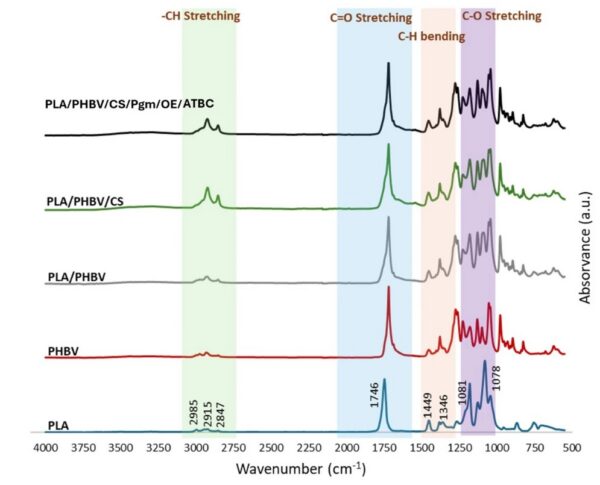
Researchers developed multiple formulations for the potential cosmetics packaging material. Figure courtesy of A novel fully biobased material composite for cosmetic packaging applications.
Characterizing Composites
Researchers prepared a variety of material formulations to investigate their performance. These included PLA/BHVC, PLA/PHBV/CS, and PLA/PHBV/CS/Pgm/OE/ATBC composites. The composites experienced thermal degradation at approximately the same temperature as PLA alone. The three-component formulation showed two degradation peaks, corresponding to the polymers and CS. The PLA/PHBV/CS/Pgm/OE/ATBC system did not exhibit two separate peaks. Adding CS to the composites increased the materials’ resistance to degradation. Of all the formulations, PLA/PHBV/CS/Pgm/OE/ATBC was the least hydrophilic.
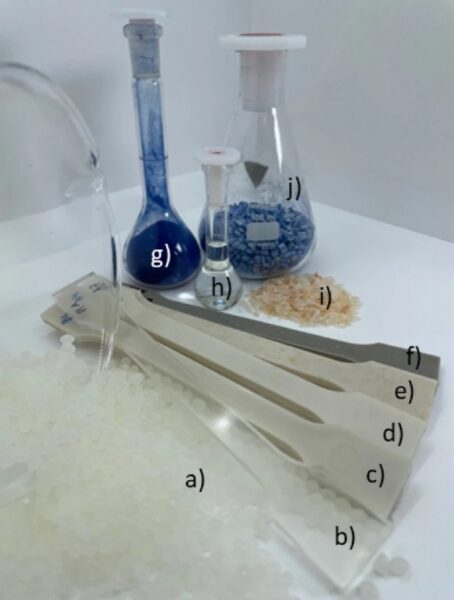
Using a variety of biomaterials, researchers produced a variety of test specimens (b-f) for cosmetics packaging applications. Figure courtesy of A novel fully biobased material composite for cosmetic packaging applications.
Replacing Fossil-Based Plastics in the Cosmetics Industry
The resultant composites had an attractive natural color and smell, with mechanical properties appropriate for packaging applications. In addition, the researchers assessed the materials’ usability for additive manufacturing. Though this showed promising results, further developing additive manufacturing processes with these materials is a potential area for further study.
This research demonstrated a packaging solution for cosmetics using bio-based materials. By incorporating chitosan, manufacturers can have a positive environmental effect through waste material use and valorization.