
At ANTEC 2026: Process-Specific Rheology for Advanced Material Selection

Moving beyond Melt Flow Index: select rheological measurements that match the deformation modes of injection molding and film blowing.
Rheological data can support material selection, but only when measurements match the deformation modes and time scales of the target process. Many teams still screen materials with melt flow index (MFI) or a single viscosity value because these metrics are familiar and easy to compare. However, polymer processing rarely occurs at a single shear rate, temperature, or flow history. As recycled content rises and formulations grow more complex, single-point descriptors often miss the behavior that controls process stability and product performance.
You can also read: Plastic Processing “Must have Equipment.
At ANTEC® 2026, Christopher Macosko will present a structured strategy for selecting rheometry for a specific process. Processing demands shape the most useful measurements. Injection molding and film blowing rely on different indicators, especially for recycled blends. The same principle applies when microstructure drives performance in nanoparticle-filled melts and polymer–polymer blends.
Why Single-point Metrics Do Not Generalize Across Processes
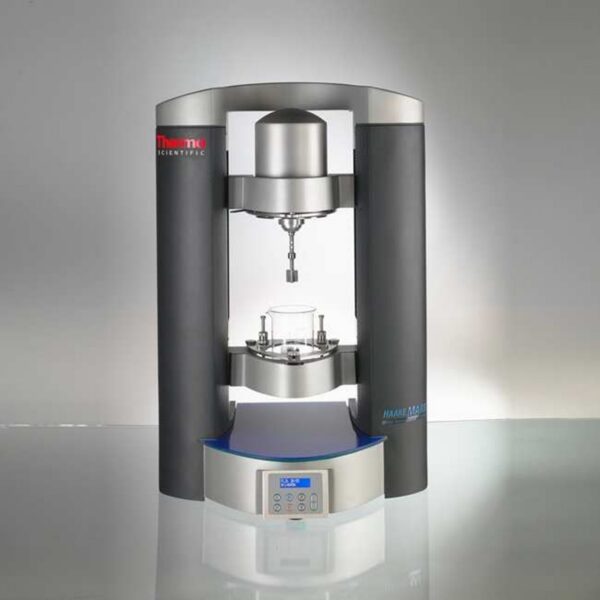
A rotational rheometer supports melt characterization beyond single-point metrics, helping teams compare materials and select measurements that align with the demands of a specific polymer process. Courtesy of Tracomme.
MFI remains useful as a screening tool, but it is an empirical flow indicator measured under a narrow set of conditions. Two resins with similar MFI can differ in shear-thinning behavior, elasticity, temperature sensitivity, and relaxation dynamics. These differences can translate into changes in filling pressure, die swell, flow instabilities, surface finish, and dimensional stability. Recycled streams introduce risk because compositional shifts can alter rheology without a corresponding change in MFI.
A more defensible approach starts with an often-overlooked question: which rheological features control the dominant failure modes in the process?
Injection Molding: Shear-dominated Flow With Strong Transients
Injection molding is shear-driven, especially through runners and gates. During filling and packing, the melt also sees rapid shifts in flow and temperature. Steady shear viscosity curves therefore provide useful guidance, particularly when you relate them to the shear-rate range set by the mold design. However, viscosity alone does not capture the full response. Viscoelastic effects can influence pressure demand, flow-front stability, and residual stress.
Oscillatory shear measurements provide complementary information by capturing elastic and viscous contributions over a range of time scales. The frequency dependence of moduli can indicate how quickly a melt relaxes after deformation, which can affect stress retention, orientation, and warpage tendencies. When comparing recycled blends, these signatures can be especially helpful because changes in molecular architecture and microstructure may appear in the viscoelastic spectrum before they become obvious in single-point flow tests.
Film Blowing: Extensional Response
Film blowing places distinct demands on the melt because the bubble undergoes strong extensional deformation and free-surface instabilities. Extensional rheology and melt strength often govern bubble stability, drawability, and gauge uniformity. Two materials can look similar in shear yet behave differently in extension. Long-chain branching, molecular weight distribution, and weakly connected structures often drive the difference.
For recyclate qualification in film applications, this distinction is critical. Recycled blends may include fractions with lower molecular weight or degraded chains that reduce melt strength, even if shear viscosity remains acceptable. Extensional screening, when feasible, can therefore reduce the risk of costly line trials by identifying candidates likely to fall outside the stable operating window.
Rheology as a Structural Indicator
Rheology can indicate microstructure when morphology or dispersion drives performance. Nanoparticle-filled systems can form networks that raise low-frequency elasticity and introduce yield-like behavior. Polymer–polymer blends often respond to phase continuity, droplet deformation, and interfacial effects. These factors can shift viscoelastic response without large changes in viscosity. Dispersion and morphology also change with processing history. Choose measurements based on the goal: assess dispersion, compare blend compatibility, or check process robustness.
Complementing Rheology
Rheology works best within a broader characterization plan. Thermal transitions, crystallization behavior, degradation signals, and composition shifts often drive performance, especially in recycled materials. Pair rheology with targeted measurements outside rheometry to confirm trends and reduce uncertainty before scale-up. Build a measurement set that predicts processing behavior and supports confident material decisions.
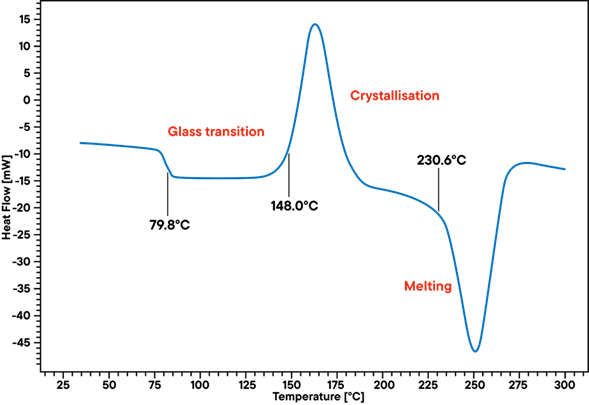
A typical DSC thermogram highlights key thermal events, including glass transition, crystallization, and melting. These features complement rheological data and help confirm how formulation changes or recycled content may affect processing behavior. Courtesy of Linseis.
To reduce uncertainty during scale-up, rheological data should be paired with:
Thermal Transitions (DSC): To confirm crystallization behavior.
Degradation Signals: To monitor how recycled content responds to heat history.