At ANTEC 2026: Compatibilizing Amorphous PHA and PLA for Blown Film
PLA PHA compatibilization for blown film can widen processing windows and improve toughness. See why morphology and moisture control matter.
PLA can meet compostability goals, yet blown film lines still expose its weakest link: process stability. Processors often observe brittle tear, bubble flutter, and narrow windows when increasing output or switching material lots. Moreover, small fluctuations in moisture and thermal history can alter viscosity and crystallization during cooling.
You can also read: Custom Blow Molding Machines Redefine Packaging Efficiency.
Because these effects compound, teams rarely fix them with a single setting change. Instead, they must manage material variability, extensional flow behavior, and morphology development at the same time.
Why Engineers Keep Looking for Toughening Modifiers
PLA delivers stiffness, but it often sacrifices ductility in thin films. Therefore, formulators look for modifiers that absorb energy during impact and tear without undermining end-of-life claims. Amorphous PHA offers one pathway because it can behave like a rubbery phase at ambient conditions.
CJ Biomaterials developed PHACT A1000P as an amorphous PHA grade designed primarily as a polymer and biopolymer modifier. In practice, it aims to tune blend performance rather than replace a base resin. This distinction matters in film design because the modifier must enhance toughness while still allowing the PLA matrix to carry load and draw consistently.
What Amorphous PHA Adds to PLA Blends
Amorphous PHA can provide flexibility through a low glass transition temperature. A1000P exhibits a sub-ambient glass transition temperature, indicating mobility near typical service temperatures. In addition, the grade exhibits very high elongation at break in tensile testing, consistent with a ductility-driven role.
Suppliers also describe this amorphous PHA as a route to improve PLA impact strength and elongation. They also link the blend approach to faster biodegradation compared with neat PLA in certified environments. However, film performance depends less on marketing claims and more on the structure that the blend forms under flow.
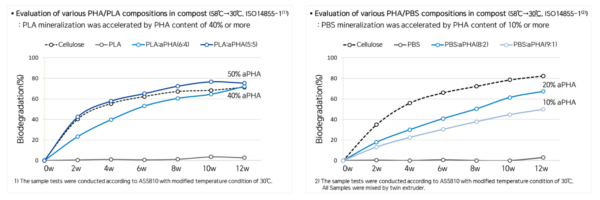
Evaluation of various PHA/PLA compositions in compost 58°C-30°C (ISO 14855-1*) PLA was mineralized in the present of PHA contents between 10% and 50%. Courtesy of CJ Biomaterials.
Compatibilization Decides Whether the Film Behaves Like a Product
PLA and PHA can phase-separate, which can reduce optical clarity and destabilize drawdown. Consequently, engineers must treat compatibilization as the central design variable, not an afterthought. Compatibilization controls interfacial adhesion, domain size, and how the phases respond under deformation.
Blown film amplifies interfacial weaknesses because the bubble creates strong extensional stresses and fast cooling locks morphology quickly. Therefore, poor adhesion or unstable phase structures can translate into tear variability, haze shifts, and bubble instability. Engineers who want consistent film performance must link compatibilizer strategy to measurable morphology and processability outcomes.
Processing Discipline Still Controls the Outcome
Moisture control becomes non-negotiable in biodegradable blends. These materials readily absorb water, and moisture can destabilize melt behavior and accelerate hydrolysis in PLA. Drying discipline and controlled handling protect both viscosity and mechanical performance.
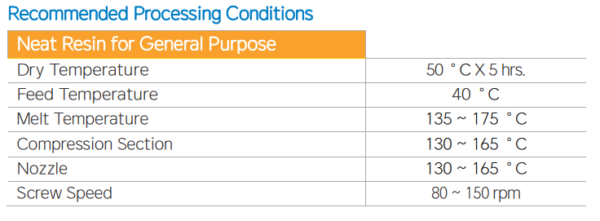
Processing conditions of PHACT A1000P. Courtesy of CJ Biomaterials.
Thermal history also matters because PHAs can be heat-sensitive during compounding. Processors typically need mild extrusion temperatures and short residence time to reduce degradation while still achieving dispersion. Storage conditions matter as well, because pellets can aggregate when exposed to elevated temperature under humid conditions, which can destabilize feeding and output.
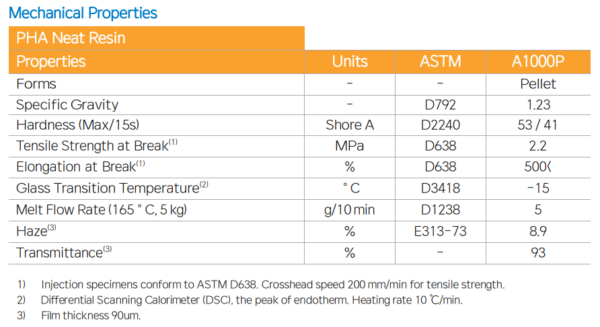
Mechanical properties PHACT A1000P. Courtesy of CJ Biomaterials.
Why This ANTEC Talk Fits the Moment
The ANTEC lecture “Compatibilization of Amorphous PHA and PLA for Blown Film Applications” addresses the real engineering bottleneck in compostable flexible packaging: turning promising blends into stable, repeatable blown film production. Raj Krishnaswamy, Vice-President of R&D at CJ Biomaterials will discuss how compatibilization strategies can improve performance and processing in amorphous PHA/PLA film systems.
For processors, the key question is practical. Can compatibilized amorphous PHA and PLA blends deliver stable bubble behavior, acceptable optics, and improved toughness at production rates? If your team is building compostable film programs, this session should help you connect polymer design to a processing window you can defend.