
Zeolites: A Mineral’s Role in Upcycling Plastic Waste

Incorporating zeolites into plastic recycling could signal a significant advancement for sustainability.
Zeolites are a group of minerals that primarily comprise silicon, aluminum, and oxygen. Approximately 40% of heterogeneous catalysts used in the chemical and petrochemical industries are zeolites. Their unique properties, including their crystalline structure and high surface area, make them well-suited for this role. Zeolites also exhibit tunable acidity, molecule-sized pore dimensions, unique shape selectivity, and excellent thermal and hydrothermal stability.
You can also read: Energy Storage with Plastic-to-Carbon Conversion.
Studies have investigated how these minerals can be harnessed for more sustainable applications. Zeolites demonstrate significant potential for enhancing the yield and quality of hydrocarbon feedstock in plastic recycling.
How Are Zeolites Used in Plastic Waste Recycling?
These versatile aluminosilicate minerals comprise TO4 units, where “T” represents Si or Al. They can accommodate various guest species, in particular, metal species. Zeolites are naturally abundant, but they can also be produced synthetically on a large scale by manufacturers. This makes them an accessible, economically feasible resource for this application. Additionally, using coke combustion, manufacturers can regenerate spent zeolite catalysts. After removing metal impurities, residual solids from spent fluid catalytic cracking catalysts can be repurposed into ZSM-5. Thus, the use of zeolites agrees with circular economy principles.
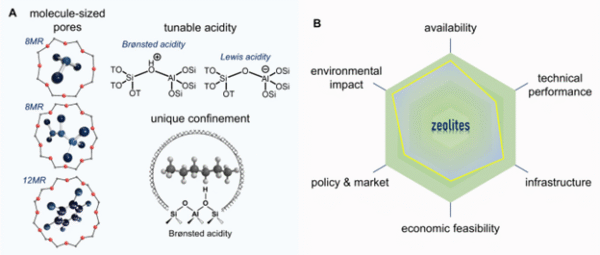
The unique chemical structure of these minerals, combined with their availability and minimal environmental impact, makes them suitable for commercial plastic recycling. Courtesy of Zeolites in the epoch of catalytic recycling plastic waste: Toward circular economy and sustainability.
Zeolites’ unique porous structure allows for the selective removal of harmful contaminants during plastic recycling. Additionally, it enhances the efficiency of processes such as pyrolysis and catalytic cracking. This improves the quality of recycled plastics and maximizes the yield of high-value products.
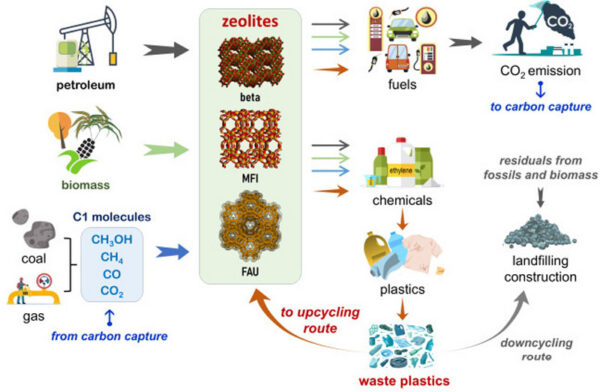
Zeolite catalysts play a crucial role in processing petroleum and biomass, and they also show potential for upcycling plastic waste. Courtesy of Zeolites in the epoch of catalytic recycling plastic waste: Toward circular economy and sustainability.
Challenges and Research Pathways
The significant potential of zeolites for plastic waste recycling presents some unresolved challenges for researchers. Reducing hydrogen consumption, enhancing catalytic activity, and improving selectivity are areas of focus for continued process improvement. Additionally, recycling metal-containing zeolites through pyrometallurgical and hydrometallurgical methods impose significant environmental burdens. Carbon buildup can also lead to catalyst deactivation when employing zeolites. Further optimizing reactor designs and process parameters is key to overcoming these factors.
The Road to a Circular Economy
Some companies are already integrating zeolites into the plastic recycling process. By overcoming barriers such as a lack of specialized infrastructure, this approach can improve recycling output. In tandem, zeolites can help reduce the environmental harm of plastic waste while promoting a circular economy. Research, combined with policy support, may pave the way for a more widespread adoption of zeolites in plastic recycling.