Plastics 2028: AI, Circularity, and Smart Materials from K-2025
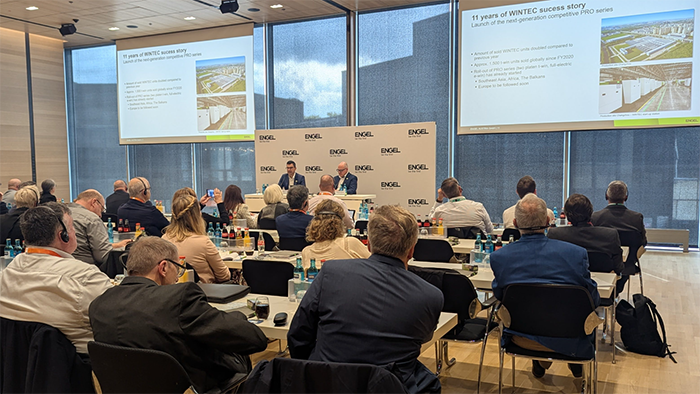
The future of plastics engineering is evolving rapidly, and K-Show 2025 in Düsseldorf showcased groundbreaking innovations that will shape the next three years.
From AI-driven injection molding to circular economy strategies, and from smart materials to digitalization, industry leaders revealed what’s coming and how the future of plastics will be.
You can also read: Next Gen Injection Molding: Best Practices
This article is a sample of interviews conducted by Plastics Engineering with selected exhibitors, offering a clear forecast from top players in materials to machinery. If you want to stay ahead in the plastics industry, keep reading because these insights will define the future.
Interviewed Experts
- Gerhard Dunkler, CTO – Engel Austria
- Felix Schmidt, Application Engineering Manager – Engel Mexico
- Dominik Wiesner, Marketing Manager Europe – Haitian International
- Markus Huber-Lindinger, Managing Director – EREMA Group
- Roel Gunnink, Director of Marketing Insulating Solutions – Performance Materials EMEA – BASF
- Christian Arger, Marketing Manager – Wacker Chemie AG
- Covestro Circularity & Recycling Division Team
Injection Molding Technology – From Inject 4.0 to Inject AI
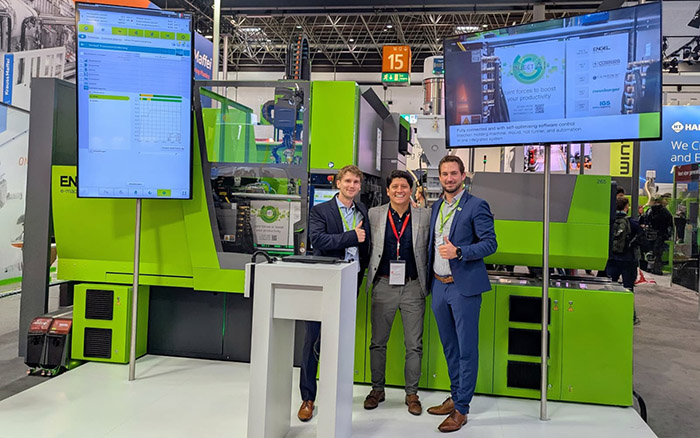
Engel is pushing boundaries with Inject AI, which represents a significant leap forward from the connectivity-driven Inject 4.0 introduced in 2016. In the photo are from left to right: Felix Schmidt (Application Engineering Manager – Engel Mexico), Andres Urbina (Content Editor Europe – Plastics Engineering powered by SPE) and Christian Öllinger (Global Key Account Manager Automotive – Engel Austria). Photo by Andrés Urbina at the K-Show 2025.
First of all, Engel is pushing boundaries with Inject AI, which represents a significant leap forward from the connectivity-driven Inject 4.0 introduced in 2016. As a result, Engel now focuses on true machine intelligence rather than simple data transparency. Furthermore, this shift enables manufacturers to achieve unprecedented levels of automation and efficiency.
Key Highlights
- Autonomous Injection Molding: Machines detect out-of-spec parts and recalibrate automatically after the first two shots. Consequently, scrap and downtime are minimized, ensuring consistent quality.
- Validation Assistant: This intelligent system reduces validation time by up to 30% through automated data capture from machines, molds, and processes.
- Victory Series Upgrade: By combining tie-bar-less design with electric drives, Engel delivers precision and energy efficiency in one package.
- Physical Foaming Competence: After acquiring Trexel, Engel now offers advanced foaming solutions for lightweight components.
- EVA (Engel Virtual Assistance): A digital assistant that supports operators during development and production phases.
Forecast: By 2028, 40% of new injection molding machines will feature AI-driven autonomy, while all-electric machines will grow at 8–10% CAGR.
Smart Materials and PU Integration
Engel and Cannon’s Cleaner Competence Center (CCC) introduces hybrid PU + thermoplastic solutions for large parts (up to 5500 tons), cutting emissions and improving recyclability.
Haitian – Scale and Turnkey Solutions
Similarly, Haitian positions itself as a global powerhouse with a strategy centered on turnkey solutions. Therefore, customers receive not only machines but also complete ecosystems that include automation and software integration.
Key Technologies
- Integrated Automation: Haitian delivers complete systems, including robots, peripherals, and process monitoring software.
- Energy Efficiency: Their all-electric and hybrid machines reduce energy consumption significantly.
- Green Technology: Haitian ensures compatibility with recycled materials, supporting sustainability goals.
- HD Vision and AI: Advanced vision systems and AI algorithms optimize cycle times and part quality.
Why It Matters:
Haitian’s ability to produce tens of thousands of machines annually ensures scalability for global markets.
Recycling – Erema’s Circular Vision
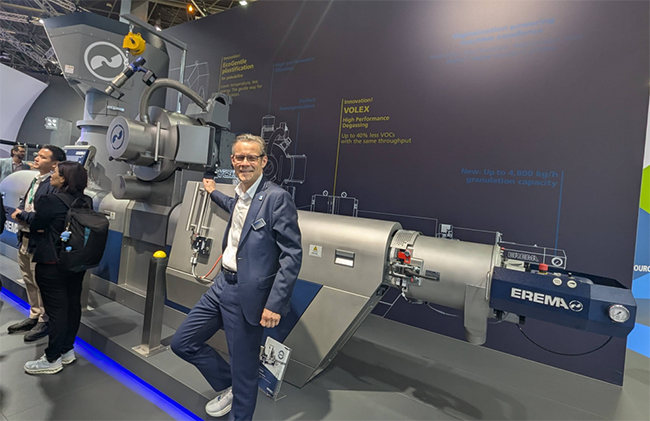
Markus Huber-Lindinger (Managing Director – EREMA Group) highlights EREMA’s dual approach: mechanical and chemical recycling, supported by digitalization. Photo by Andrés Urbina at the K-Show 2025
In addition, Markus Huber-Lindinger highlights EREMA’s dual approach: mechanical and chemical recycling, supported by digitalization.
Breakthrough Technologies
- Eco Gentle System: Processes up to 6 tons/hour of PP and PE without machine adjustments, improving efficiency.
- Advanced Filtration: Laser filters with double screen surface guarantee high melt purity.
- Blueport Digital Platform: Offers predictive maintenance, polymer behavior analysis, and operator training tools.
- Sweet Spot Autotune: Automatically finds optimal operating parameters, reducing operator dependency.
Impact:
Recycling capacity will grow 50% by 2028, with chemical recycling reaching 15–20% share. Predictive maintenance cuts downtime by up to 40%.
Covestro – Designing for Circularity
Moreover, Covestro champions design for recyclability and chemical recycling innovations. As a result, they are leading the way toward a truly circular economy.
Technologies Driving Change
- Mono-Material Solutions: Replaces multi-material composites with PU and TPU, simplifying recycling.
- Advanced Simulation Software: Simulates polyol foaming for dashboards and battery packs, reducing waste.
- Chemical Recycling Methods:
- Enzymatic Recycling: Breaks down PU foams into polyols and amines.
- Smart Pyrolysis: Recovers raw materials from rigid foams.
- Chemolysis: Separates mattress components for reuse.
“We need to find solutions to come back to the building blocks.”
Wacker – Digitalization Meets Sustainability
Furthermore, Christian Arger emphasizes precision and sustainability, which are critical for future competitiveness.
Key Innovations
- Digital Twins: Enable predictive modeling and process optimization.
- SPC and AI Control: Ensure consistent quality in high-volume production.
- Sustainability Goals: 50% emission reduction by 2030 and net zero by 2040.
- Silicon Strip Technology: Achieves 16-micron movement accuracy, critical for electronics and automotive applications.
BASF – Integrated Recycling Network
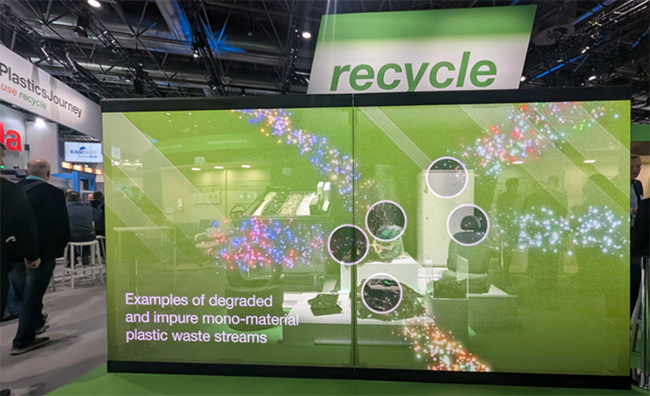
BASF stresses collaboration across the value chain and supportive legislation to scale advanced recycling. Photo by Andrés Urbina at the K-Show 2025
Finally, Roel Gunnink introduces BASF’s tiered recycling system, matching waste complexity with the right technology. Consequently, BASF is creating a holistic approach to circularity.
- Mechanical Recycling (“Back to Polymer”): For clean and homogeneous streams.
- Chemical Recycling (“Back to Monomer”): Depolymerization for mixed or aged materials.
- Feedstock Recycling (Pyrolysis & Gasification): Converts non-sortable waste into oil or syngas for chemical production.
Core Philosophy:
“We use this waste as a valuable resource.”
BASF stresses collaboration across the value chain and supportive legislation to scale advanced recycling.
What’s coming…
In conclusion, the next three years will redefine plastics and injection molding through AI-driven autonomy, mono-material design, circular economy solutions, and integrated digital platforms. Companies that embrace digitalization and sustainability will lead the transformation.
To read more: ENGEL at K 2025 – ENGEL, Edvanced Recycling Innovations at K 2025, Covestro brings “The Material Effect” to K 2025, WACKER at K 2025 – Empowering megatrends with silicones – Wacker Chemie AG