
Lichens Show How Greenspaces Cut Atmospheric Microplastics

As biomonitors, lichens show how green spaces buffer urban areas from atmospheric microplastic pollution.
Microplastics are a growing concern in the environment, particularly in densely populated urban areas. Traffic, industrial emissions, textiles, waste disposal, and construction are some of the primary sources of these urban microplastics. Atmospheric conditions, such as wind and precipitation, often influence their dispersion throughout the environment.
You can also read: Engineering Innovations for Microplastic Prevention and Control
Measuring atmospheric microplastic content can require specialized infrastructure for sampling networks. This can be prohibitive for data collection, which is generally labor-intensive. An alternative approach is biomonitoring—the measurement of air pollutants using plants. Lichens, specifically, are effective biomonitors of airborne pollutants and can thrive in diverse environments. A recent study characterized microplastic content along a gradient from urban to rural environments using lichens. Furthermore, this study compared the amount of microplastics between parking lots and urban parks. This research suggests that green spaces can function as a buffer for atmospheric microplastics while helping detect and assess environmental pollution.
Planting and Analyzing Lichen
Researchers in Tuscany selected 54 lichens and their substrates for this study. They transplanted them in remote, rural areas, as well as urban parks and parking lots. After seven weeks, they collected the lichen samples for analysis.
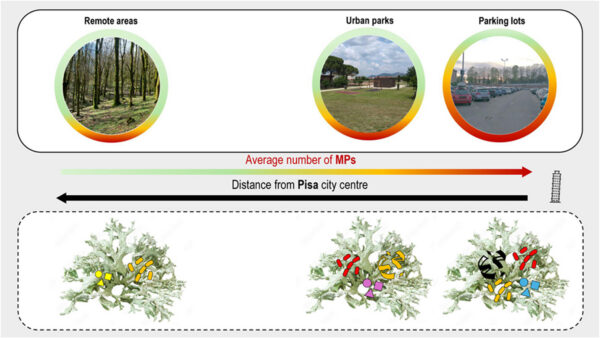
By placing lichens in various environments, researchers could plot a gradient of microplastic content against population density. Figure courtesy of Greenspaces can reduce the level of airborne microplastic contamination in urban environments: Evidence from a lichen biomonitoring study.
To prepare the samples, researchers cleaned and digested the samples, then vacuum filtered the solution onto paper disks. They placed the disks onto petri dishes for microscopic analysis to then categorize the microplastic content of the samples. Researchers grouped the microplastics into fibers, fragments, and tire wear particles (TWPs). The researchers used the following equation to estimate daily microplastic (MP) deposition in the lichen:
MP deposition (MPs/m2/d) = MP concentration (MPs/g dw lichen) × 160 (g/m2) / 49 (days)
Lichen-Derived Data
Microplastics appeared in all the samples, including the origin site of the lichen (2 MP/g dw). Researchers found 7 MP/g dw in urban parks compared to 16 MP/g dw in urban parking lots.
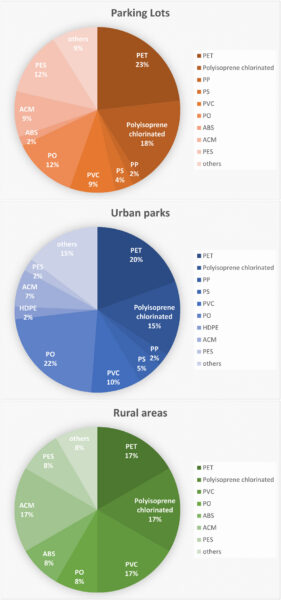
Researchers found a variety of microplastics in the lichens, with polyethylene terephthalate (PET) most frequently detected. Figure courtesy of Greenspaces can reduce the level of airborne microplastic contamination in urban environments: Evidence from a lichen biomonitoring study.
A key takeaway from this study is the role greenspaces may play in buffering atmospheric microplastics. The count of microplastics in urban parks was less than half of that of parking urban parking lots. The lichen used in this study, E. prunastri, showed good suitability for airborne microplastic detection. This detection method is non-invasive and is applicable in a variety of ecosystems. Currently, scientists have not fully established standardized protocols for sampling atmospheric microplastics. Lichen, as a sampling method, could allow for more cohesion during data collection for future studies.
The paper referred to appears to focus on the presence of chlorinated polyisoprene particles? What about tyre derived microplastics? (the major source).
It would be very interesting to see how concentrations would vary between greenspaces and car parks.
Re lichen studies. Are lichens selective in what they absorb? Hard to tell from what is reported.